

On This Day in Science: February 20, 1962
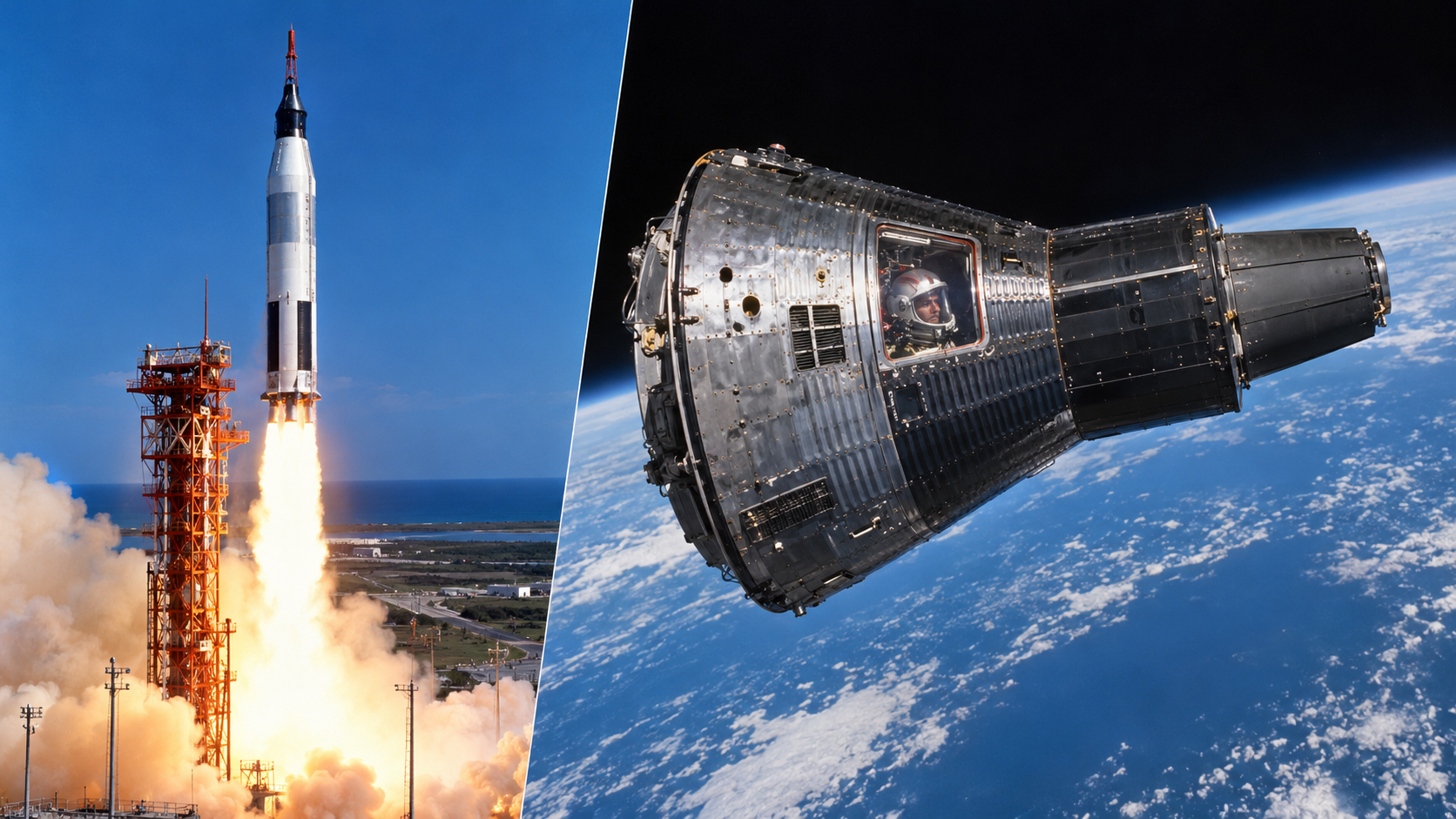
On February 20, 1962, John Glenn launched from Cape Canaveral inside the Mercury capsule Friendship 7 and became the first American to orbit Earth. An Atlas rocket accelerated the small spacecraft into orbit, where Glenn traveled around the planet three times in just under five hours. Soviet cosmonauts Yuri Gagarin and Gherman Titov had already completed orbital missions, so the flight carried Cold War urgency. It also had a direct engineering purpose: determine whether a pilot and Mercury’s systems could function through launch, weightlessness, reentry, and ocean recovery.
Glenn reported views of cloud patterns, sunsets, and countless luminous particles he called fireflies near the capsule. More critically, an automatic control problem forced him to manage parts of the flight manually. Then telemetry appeared to indicate that the heat shield might have come loose. Controllers decided to leave the retrorocket package attached during reentry, hoping its straps would help hold the shield in place. The warning was later traced to a faulty switch, but neither Glenn nor the ground team could know that with certainty while the capsule was in orbit.
Friendship 7 encountered the atmosphere at high speed and was surrounded by ionized gas that temporarily blocked radio communication. Glenn watched pieces of the retained retrorocket assembly burn away outside his window, uncertain whether they were part of the heat shield. The capsule survived, deployed its parachutes, and splashed down in the Atlantic near the destroyer USS Noa. Medical checks and flight data showed that Glenn had tolerated the mission well, while engineers gained evidence about control systems, communications, environmental support, and human performance.
The mission strengthened confidence for longer Mercury flights and the more complex Gemini and Apollo programs that followed. Glenn became a national figure, later served in the U.S. Senate, and returned to orbit aboard the space shuttle in 1998 at age seventy-seven. Friendship 7 remains important because its success included uncertainty rather than eliminating it. The flight demonstrated that a person could make decisions inside an imperfect automated system while teams on Earth interpreted incomplete signals. Three circuits of Earth advanced human spaceflight from short ballistic tests toward sustained operations in orbit. Its place on the calendar is therefore useful as an entry point, not an endpoint. The people involved worked with the instruments, assumptions, and social conditions of their time, and later research has both extended and corrected their conclusions. Reconstructing the event carefully means separating what was known that day from what became clear afterward. That distinction protects the history from myth while showing how cumulative evidence turns a memorable episode into lasting scientific knowledge.
An Atlas rocket placed John Glenn into orbit for a flight lasting just under five hours.
The mission tested the astronaut, capsule, tracking network, recovery force, and ground-control procedures together.
Telemetry suggested the heat shield might be loose, although the indication was ultimately caused by a faulty switch.
Controllers kept the retrorocket pack attached during reentry as a precaution.
The mission showed that Mercury systems and a human pilot could operate through repeated orbits and reentry.
Its data and procedures supported later Mercury missions and the developing Gemini and Apollo programs.
Explore more of "On This Day ..."
Discover more events from the same date across news, politics, technology, sports, and other fields. Each link highlights significant moments that shaped history on different fronts.