

On This Day in Science: March 17, 1958
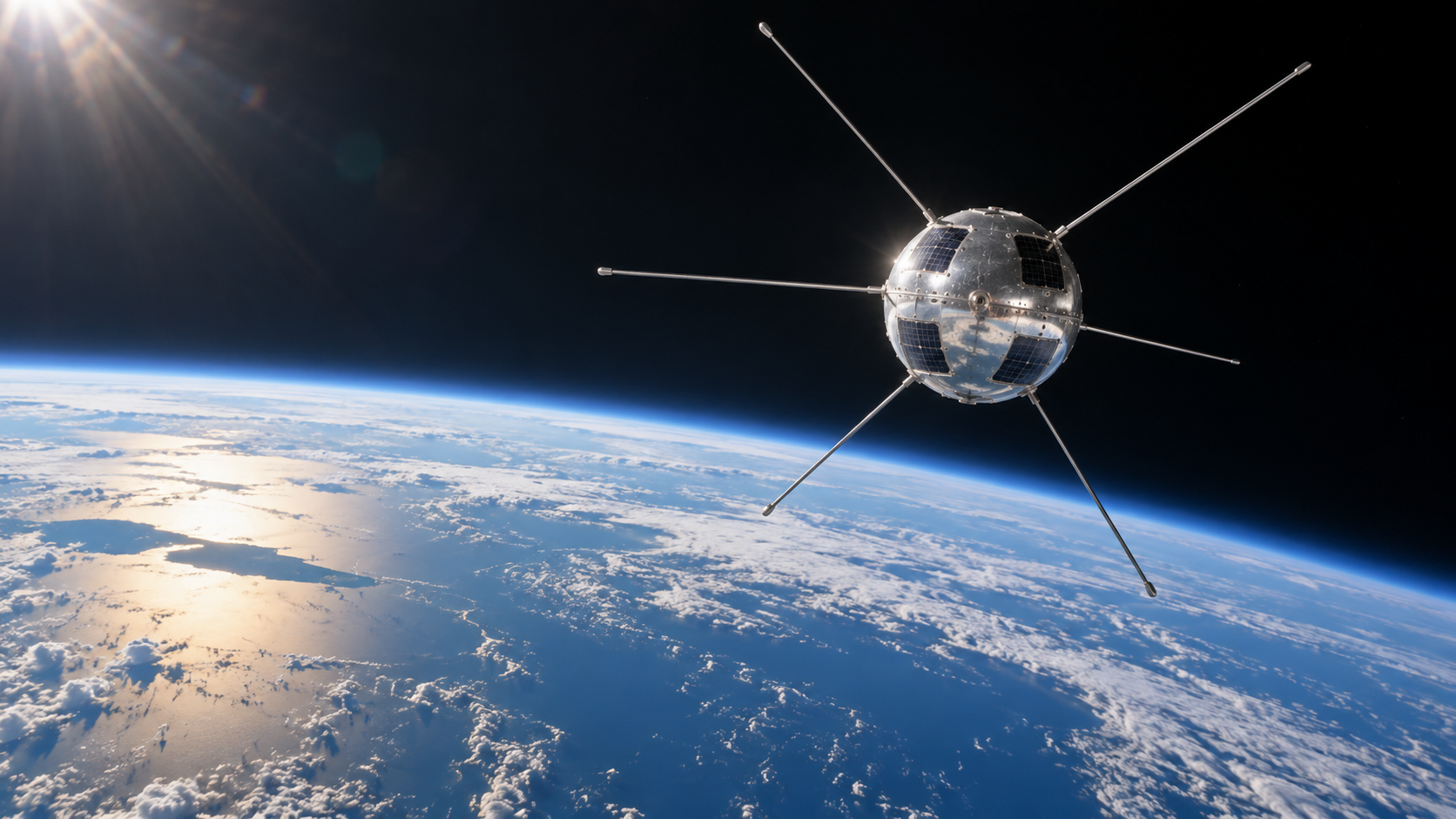
On March 17, 1958, the United States launched Vanguard 1 from Cape Canaveral. The polished aluminum sphere was only about sixteen centimeters across and weighed roughly 1.5 kilograms, yet it became the first satellite powered by solar cells. After earlier Vanguard launch failures, the successful flight placed the small scientific payload into a high elliptical orbit and demonstrated the three-stage launch vehicle’s ability to deliver a satellite.
Vanguard transmitted through two radio beacons. A mercury-battery transmitter operated for weeks, while six small solar-cell panels powered another signal for years. Tracking stations and amateur observers used the signals to refine the orbit. Because the satellite’s shape and mass were well characterized, changes in its path helped researchers study atmospheric drag at great altitude and improve knowledge of Earth’s slightly nonspherical figure.
The mission followed Sputnik 1 and Explorer 1 during the rapid opening months of the Space Age. Vanguard’s scale made the engineering especially visible: the solar cells were small patches on a grapefruit-sized sphere, but they demonstrated a power source that would become essential for long-lived spacecraft near the Sun. The satellite had no camera or complex computer; precision tracking turned its motion into the experiment.
Vanguard 1 stopped transmitting in 1964 but remains in orbit, making it the oldest human-made object still circling Earth. Its path is expected to persist for many more years because the upper part of the orbit experiences little drag. The launch joins two legacies—early scientific geodesy and orbital debris—showing how a tiny pioneering instrument can outlast its electronics, operators, and original historical moment. For science history, the episode is also a case study in how evidence moves from an observation or engineered test into a durable body of knowledge. Instruments supplied measurements, specialists debated interpretation, and later work refined what the first result could mean. Archives preserve the early record while new methods let researchers ask different questions of it. That continuing revision is not a weakness in the original achievement; it is the process through which a dated milestone remains scientifically useful. Seen across a longer timeline, the event also shows that scientific milestones are junctions rather than isolated beginnings. Earlier experiments, tools, and institutions made the work possible, while later teams tested its limits and carried the result into new settings. What survives is more than an anniversary fact: it is a traceable chain of evidence, correction, and application that allows one moment to remain relevant as knowledge and technology continue to change. The anniversary also highlights the difference between a first result and a finished understanding. A successful observation can settle one question while opening several harder ones, and even a failed objective can return measurements that reshape later designs. Preserved data, specimens, photographs, and hardware allow new generations to revisit the work with better tools. Science advances through that continuity, where a specific date marks progress without pretending that inquiry stopped there.
Vanguard 1 was a small polished sphere launched into a high elliptical orbit.
Its success followed several highly visible setbacks in the Vanguard program.
Six solar panels kept one radio beacon operating long after the battery-powered transmitter faded.
The design helped establish sunlight as a practical source of spacecraft electricity.
Orbital tracking contributed to studies of atmospheric density and Earth's shape.
The silent satellite remains the oldest human-made object still in orbit.
Explore more of "On This Day ..."
Discover more events from the same date across news, politics, technology, sports, and other fields. Each link highlights significant moments that shaped history on different fronts.