

On This Day in Science: March 26, 1953
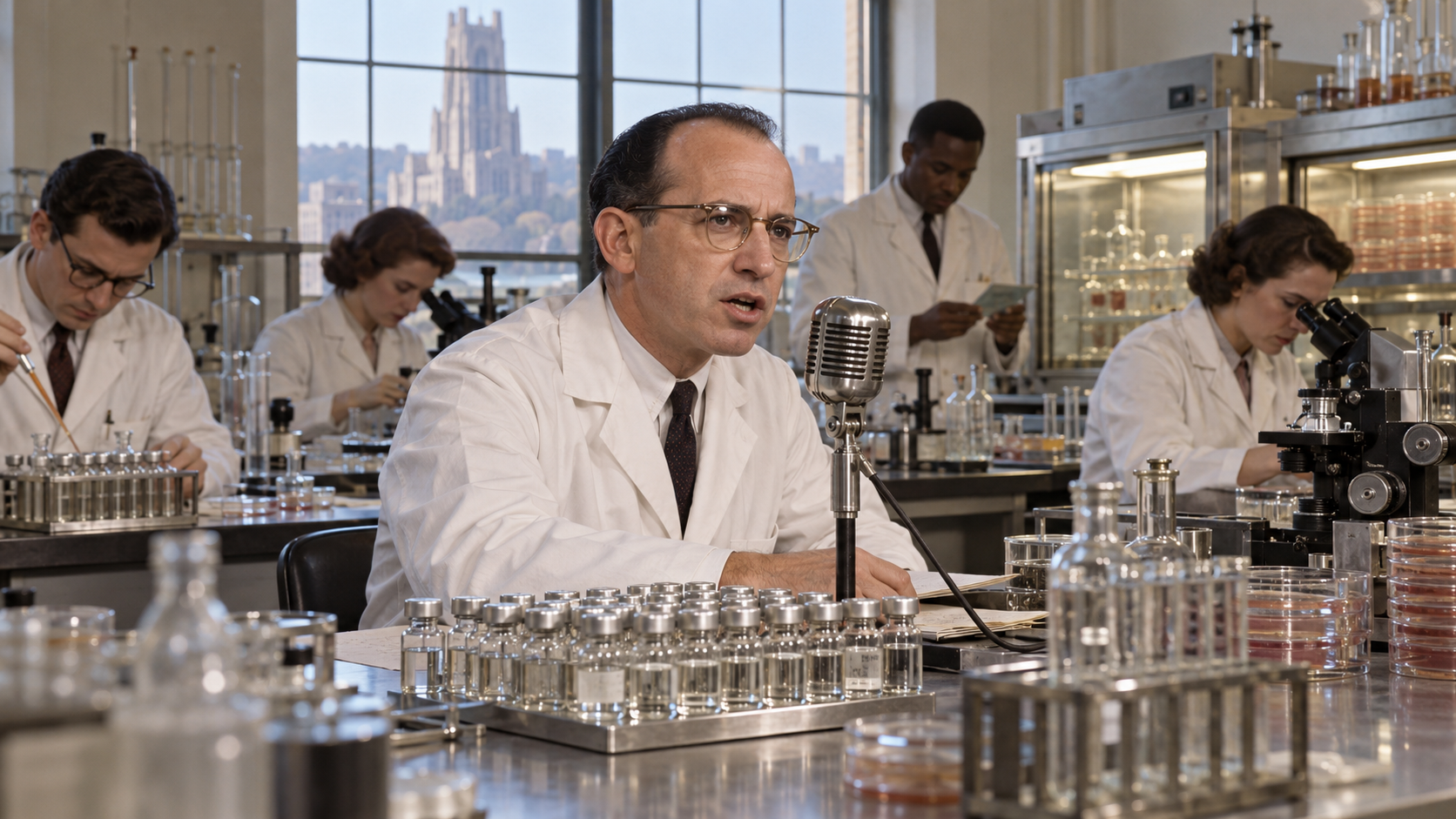
On March 26, 1953, virologist Jonas Salk announced on a national radio program that his laboratory had successfully tested an experimental vaccine against poliomyelitis in a small group of adults and children. The preparation used poliovirus that had been chemically inactivated so it could not reproduce. The news was preliminary, not the final proof of safety and effectiveness that arrived after a vast field trial two years later.
Polio could cause fever, paralysis, respiratory failure, and death, with major epidemics creating fear each summer. Researchers had learned to grow poliovirus in tissue culture, work recognized with the 1954 Nobel Prize for John Enders, Thomas Weller, and Frederick Robbins. That advance helped make vaccine production feasible. Salk’s team combined strains representing major virus types and used formaldehyde to inactivate them while preserving an immune response.
The early report led toward the 1954 field trial involving more than a million children and coordinated by Thomas Francis Jr. On April 12, 1955, evaluators announced that the vaccine was safe, effective, and potent, and licensing followed. Manufacturing problems in one company’s vaccine caused cases of polio and prompted stronger regulation, demonstrating that a sound biological principle still depends on reliable production and oversight.
Inactivated and later oral vaccines drove enormous global declines in polio, though eradication remains incomplete and surveillance must continue. The March announcement is best understood as one step in a collective chain of laboratory science, clinical testing, public participation, manufacturing, and public health delivery. It offered justified hope while reminding medicine that promising initial results must be confirmed at scale before they become population protection. Seen across a longer timeline, the event also shows that scientific milestones are junctions rather than isolated beginnings. Earlier experiments, tools, and institutions made the work possible, while later teams tested its limits and carried the result into new settings. What survives is more than an anniversary fact: it is a traceable chain of evidence, correction, and application that allows one moment to remain relevant as knowledge and technology continue to change. The anniversary also highlights the difference between a first result and a finished understanding. A successful observation can settle one question while opening several harder ones, and even a failed objective can return measurements that reshape later designs. Preserved data, specimens, photographs, and hardware allow new generations to revisit the work with better tools. Science advances through that continuity, where a specific date marks progress without pretending that inquiry stopped there. Its place on the calendar is therefore useful as an entry point, not an endpoint. The people involved worked with the instruments, assumptions, and social conditions of their time, and later research has both extended and corrected their conclusions. Reconstructing the event carefully means separating what was known that day from what became clear afterward. That distinction protects the history from myth while showing how cumulative evidence turns a memorable episode into lasting scientific knowledge.
Salk's preparation used chemically inactivated poliovirus to stimulate immunity without viral replication.
The 1953 announcement described encouraging early tests rather than final population-level proof.
A massive 1954 field study evaluated the vaccine among schoolchildren across many communities.
Results announced in 1955 supported licensing and widespread use.
Effective vaccination required tissue culture, careful manufacturing, regulation, surveillance, and public trust.
Polio cases fell dramatically, but continued immunization remains necessary until eradication is complete.
Explore more of "On This Day ..."
Discover more events from the same date across news, politics, technology, sports, and other fields. Each link highlights significant moments that shaped history on different fronts.