

On This Day in Science: April 6, 1965
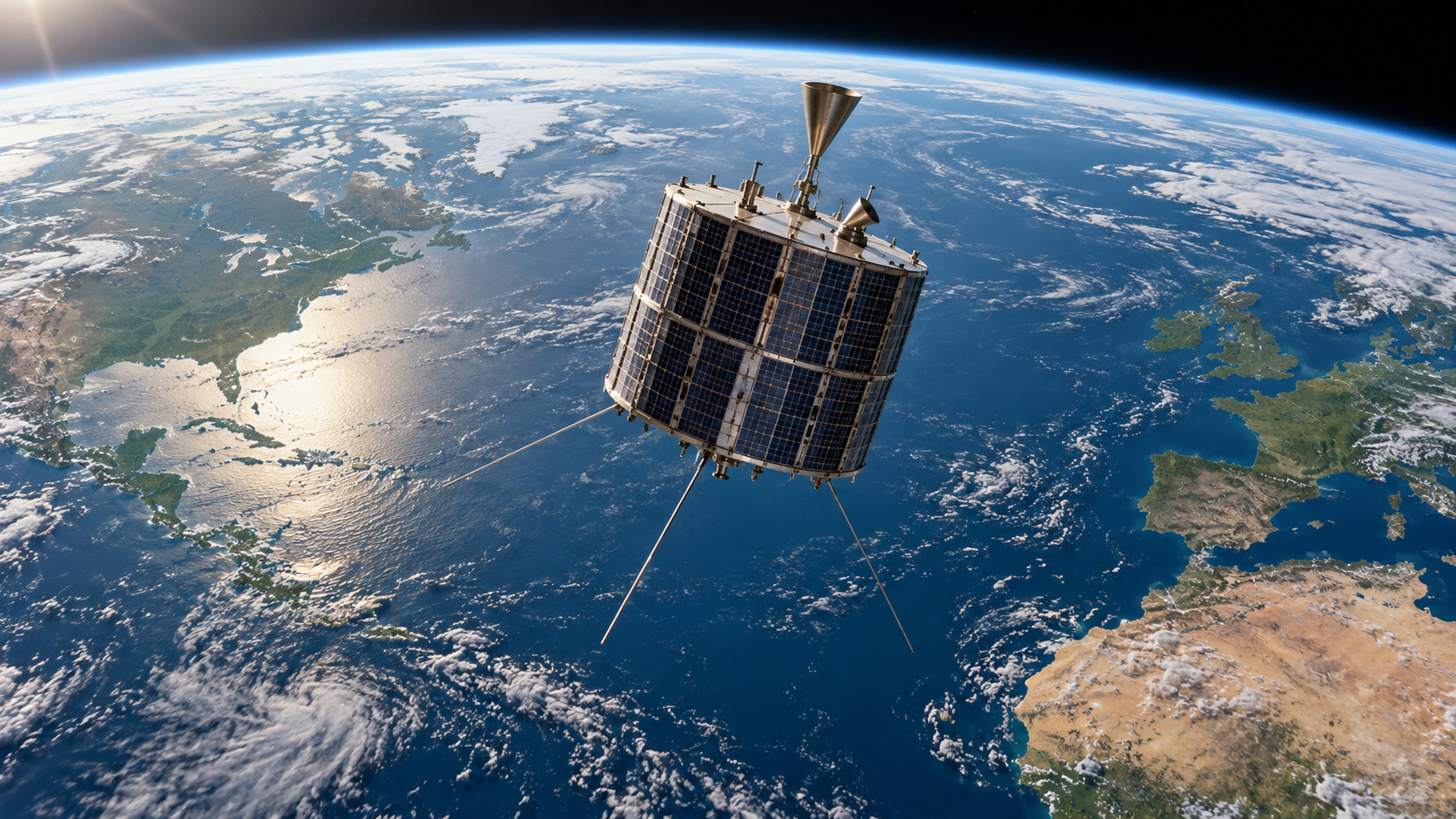
On April 6, 1965, NASA launched Intelsat I, better known as Early Bird, from Cape Canaveral for the Communications Satellite Corporation. The compact spin-stabilized spacecraft became the first commercial communications satellite placed in geosynchronous orbit. From its position over the Atlantic, it could relay telephone, telegraph, and television traffic between North America and Europe without racing across the sky.
A geosynchronous satellite completes an orbit in the same time Earth rotates. When the orbit is nearly circular and above the equator, the spacecraft appears almost fixed from the ground, allowing antennas to remain pointed at one place. Early Bird used body-mounted solar cells, microwave repeaters, and redundant transmitters. Its capacity was small by modern standards but large enough for hundreds of telephone channels or a television link.
Commercial service began in June 1965. The satellite supported transatlantic broadcasts and communications well beyond its expected eighteen-month design life. Its success showed that a shared international space system could carry routine traffic reliably, leading to larger Intelsat generations with greater power, bandwidth, and geographic coverage.
The achievement joined orbital mechanics with global infrastructure. Rockets placed the hardware, radio engineers controlled interference and signal strength, and international organizations coordinated access. Early Bird made a theoretical orbital slot into a practical location for communications, weather observation, broadcasting, and many services now woven into daily life. Seen across a longer timeline, scientific milestones are junctions rather than isolated beginnings. Earlier experiments, tools, and institutions made the work possible, while later teams tested its limits and carried the result into new settings. What survives is a traceable chain of evidence, correction, and application that allows one moment to remain relevant as knowledge and technology continue to change. The anniversary highlights the difference between a first result and a finished understanding. A successful observation can settle one question while opening several harder ones, and even a failed objective can reshape later designs. Preserved data, specimens, photographs, and hardware allow new generations to revisit the work with better tools. Science advances through that continuity rather than stopping on a memorable date. Its calendar date is an entry point, not an endpoint. The people involved worked with the instruments, assumptions, and social conditions of their time, and later research has both extended and corrected their conclusions. Separating what was known that day from what became clear afterward protects the history from myth and shows how cumulative evidence turns an episode into lasting scientific knowledge.
Early Bird matched Earth's rotation in a nearly geostationary orbit over the Atlantic.
Fixed ground antennas could maintain a continuous communications link.
The spacecraft relayed commercial-quality television or hundreds of telephone channels.
Solar cells and redundant microwave equipment supported service beyond its planned life.
International coordination turned one satellite into a regular transatlantic service.
Later Intelsat spacecraft expanded the model into a worldwide communications system.
Explore more of "On This Day ..."
Discover more events from the same date across news, politics, technology, sports, and other fields. Each link highlights significant moments that shaped history on different fronts.