

On This Day in Science: April 11, 1970
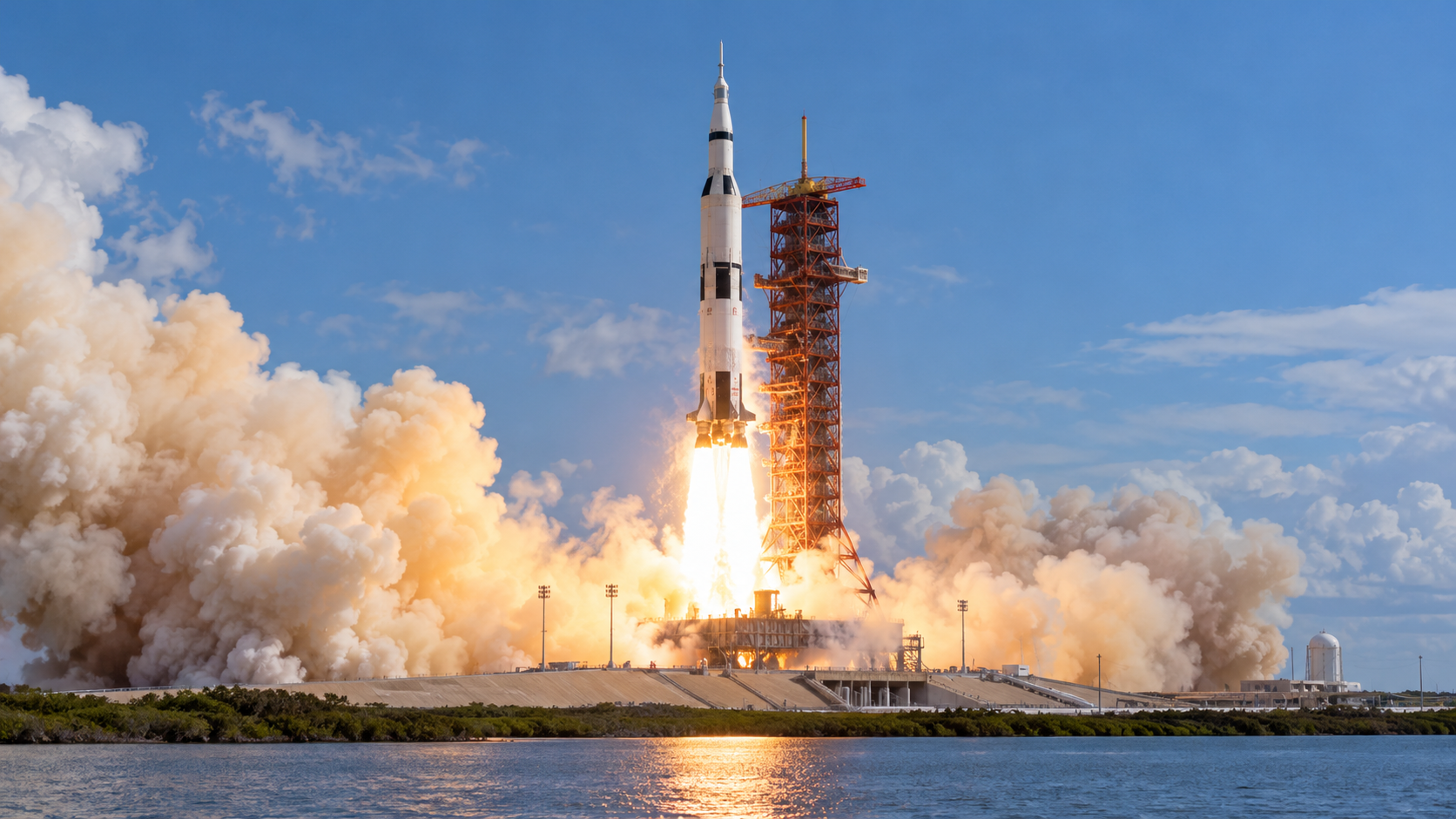
On April 11, 1970, Apollo 13 lifted off from Kennedy Space Center carrying Jim Lovell, Jack Swigert, and Fred Haise. The Saturn V rose from Launch Pad 39A at 2:13 p.m. Eastern time on what was intended to be the third crewed lunar landing. The target was the Fra Mauro highlands, where the astronauts planned to collect rocks and deploy a package of geophysical experiments.
The mission joined the command module Odyssey, service module, and lunar module Aquarius. Swigert had replaced Ken Mattingly shortly before launch after concern about exposure to rubella. During ascent, the center engine of the second stage shut down early, but guidance compensated by extending other engine burns. The spacecraft reached a nearly normal parking orbit and then departed for the Moon.
Public attention was initially lower than for the first landings, and the flight seemed routine. That perception changed two days later when an oxygen tank ruptured in the service module. The launch itself remained a demonstration of the Saturn V’s ability to tolerate an engine loss and still deliver its payload to the required trajectory.
April 11 is the beginning of a mission whose objective would change completely. Its scientific landing plan, crew assignments, propulsion architecture, and stored consumables all shaped the emergency response that followed. The launch matters because rescue was possible only within the capabilities and redundancies carried from Earth. The anniversary highlights the difference between a first result and a finished understanding. A successful observation can settle one question while opening several harder ones, and even a failed objective can reshape later designs. Preserved data, specimens, photographs, and hardware allow new generations to revisit the work with better tools. Science advances through that continuity rather than stopping on a memorable date. Its calendar date is an entry point, not an endpoint. The people involved worked with the instruments, assumptions, and social conditions of their time, and later research has both extended and corrected their conclusions. Separating what was known that day from what became clear afterward protects the history from myth and shows how cumulative evidence turns an episode into lasting scientific knowledge. For science history, the event also shows how evidence moves from an observation or engineered test into a durable body of knowledge. Instruments supplied measurements, specialists debated interpretation, and later work refined what the first result could mean. Archives preserve the early record while new methods let researchers ask different questions of it. That continuing revision is the process through which a dated milestone remains scientifically useful.
Apollo 13 was planned as the third human lunar landing and a geologic exploration mission.
Lovell, Swigert, and Haise launched aboard Saturn V from Kennedy's Pad 39A.
One second-stage engine shut down during ascent.
Guidance extended the remaining burns and still achieved the required parking orbit.
The mission departed Earth on a normal translunar trajectory.
Two days later, the same spacecraft architecture became the basis for an improvised survival plan.
Explore more of "On This Day ..."
Discover more events from the same date across news, politics, technology, sports, and other fields. Each link highlights significant moments that shaped history on different fronts.