

On This Day in Science: April 16, 1972
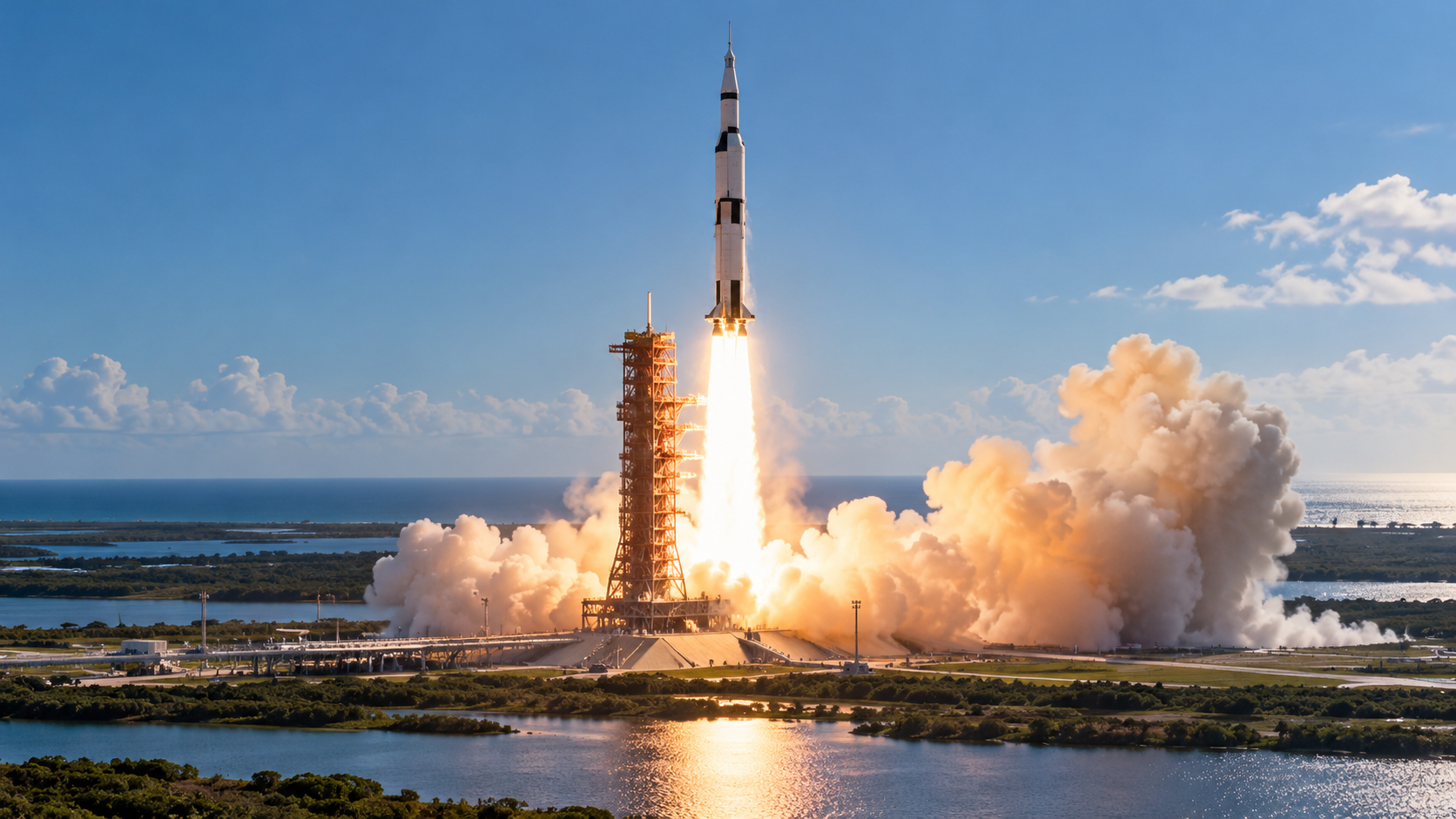
On April 16, 1972, Apollo 16 launched from Kennedy Space Center with John Young, Ken Mattingly, and Charles Duke. The fifth lunar-landing mission targeted the Descartes highlands, a region scientists hoped might contain volcanic material different from the basalt sampled on earlier missions. The Saturn V placed the spacecraft into Earth orbit before a second third-stage burn sent it toward the Moon.
The command module Casper and lunar module Orion carried cameras, spectrometers, a lunar rover, surface experiments, sampling tools, and a small particles-and-fields satellite. During the coast, the crew inspected the spacecraft and practiced procedures. A guidance warning was handled through a software instruction that allowed the computer to ignore an erroneous signal.
In lunar orbit, an oscillation in the command module’s backup steering circuit delayed descent while engineers assessed whether the main engine could be trusted. Mission Control eventually approved the landing. Young and Duke would explore the surface while Mattingly mapped from orbit, combining field geology with remote sensing and later retrieving camera film during a spacewalk on the return home.
The launch began a mission designed around questions rather than merely reaching a destination. Its instruments and sample strategy aimed to test competing geological interpretations of the highlands. Apollo 16 showed how mature exploration shifts from demonstrating access to choosing sites and measurements that can distinguish among scientific models. Its calendar date is an entry point, not an endpoint. The people involved worked with the instruments, assumptions, and social conditions of their time, and later research has both extended and corrected their conclusions. Separating what was known that day from what became clear afterward protects the history from myth and shows how cumulative evidence turns an episode into lasting scientific knowledge. For science history, the event also shows how evidence moves from an observation or engineered test into a durable body of knowledge. Instruments supplied measurements, specialists debated interpretation, and later work refined what the first result could mean. Archives preserve the early record while new methods let researchers ask different questions of it. That continuing revision is the process through which a dated milestone remains scientifically useful. Seen across a longer timeline, scientific milestones are junctions rather than isolated beginnings. Earlier experiments, tools, and institutions made the work possible, while later teams tested its limits and carried the result into new settings. What survives is a traceable chain of evidence, correction, and application that allows one moment to remain relevant as knowledge and technology continue to change.
Apollo 16 aimed for the Descartes region to investigate terrain unlike earlier basaltic landing sites.
Young and Duke carried a rover and tools for extended field geology.
Mattingly operated mapping instruments while the lunar crew sampled and deployed experiments.
The mission combined local observations with regional orbital coverage.
A guidance warning and later engine-control oscillation required careful diagnosis.
Controllers changed procedures and delayed descent rather than treating the schedule as fixed.
Explore more of "On This Day ..."
Discover more events from the same date across news, politics, technology, sports, and other fields. Each link highlights significant moments that shaped history on different fronts.