

On This Day in Science: May 8, 1971
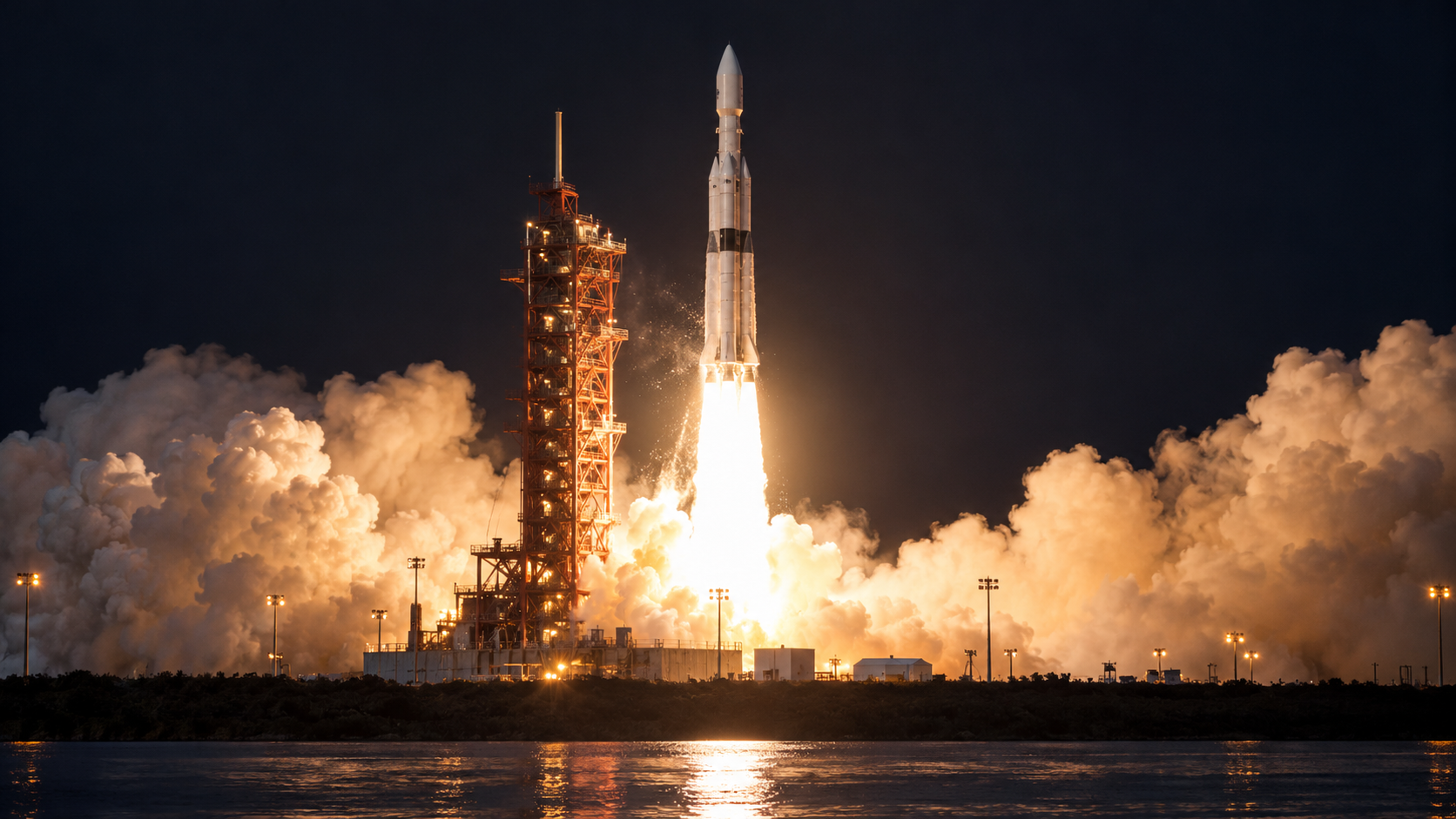
On the evening of May 8, 1971, local time in Florida, NASA launched Mariner 8 from Cape Kennedy on an Atlas-Centaur rocket. The spacecraft was intended to become one of the first orbiters at Mars, mapping the surface and measuring the atmosphere with cameras and infrared and ultraviolet instruments. The launch date is May 9 in Universal Time, but the event occurred before midnight at the launch site.
The Atlas portion of the ascent worked, but shortly after Centaur separation the upper stage lost pitch control. The stack tumbled, its engines shut down, and Mariner 8 fell into the Atlantic north of Puerto Rico. Investigators traced the failure to an integrated circuit in the Centaur guidance system. The spacecraft never reached even a stable Earth orbit.
Mariner 8 had an identical partner, Mariner 9, whose launch was scheduled within the same Mars opportunity. Engineers reviewed the failure while preserving the second mission. Mariner 9 launched on May 30, reached Mars in November, and became the first spacecraft to orbit another planet. Its success recovered many of the science goals originally divided between the pair.
The lost mission shows why planetary programs often use related spacecraft and independent reviews. A small electronic failure in the launch system ended years of work, but a second vehicle and a learnable cause kept the broader exploration plan alive. Its calendar date is an entry point, not an endpoint. The people involved worked with the instruments, assumptions, and social conditions of their time, and later research has both extended and corrected their conclusions. Separating what was known that day from what became clear afterward protects the history from myth and shows how cumulative evidence turns an episode into lasting scientific knowledge. For science history, the event also shows how evidence moves from an observation or engineered test into a durable body of knowledge. Instruments supplied measurements, specialists debated interpretation, and later work refined what the first result could mean. Archives preserve the early record while new methods let researchers ask different questions of it. That continuing revision is the process through which a dated milestone remains scientifically useful. Seen across a longer timeline, scientific milestones are junctions rather than isolated beginnings. Earlier experiments, tools, and institutions made the work possible, while later teams tested limits and carried the result into new settings. What survives is a traceable chain of evidence, correction, and application that allows one moment to remain relevant as knowledge and technology continue to change. The anniversary highlights the difference between a first result and a finished understanding. A successful observation can settle one question while opening several harder ones, and even a failed objective can reshape later designs. Preserved data, specimens, photographs, and hardware allow new generations to revisit the work with better tools. Science advances through that continuity rather than stopping on a memorable date.
Mariner 8 carried cameras and spectrometers for a long orbital survey of Mars.
An upper-stage control failure prevented the spacecraft from reaching Earth orbit.
The Centaur stage began tumbling after losing pitch guidance.
Investigation traced the failure to an integrated circuit in the control system.
Mariner 9 used an identical spacecraft and the same Mars launch opportunity.
Its later success preserved the program's principal orbital-science objectives.
Explore more of "On This Day ..."
Discover more events from the same date across news, politics, technology, sports, and other fields. Each link highlights significant moments that shaped history on different fronts.