

On This Day in Science: May 10, 1860
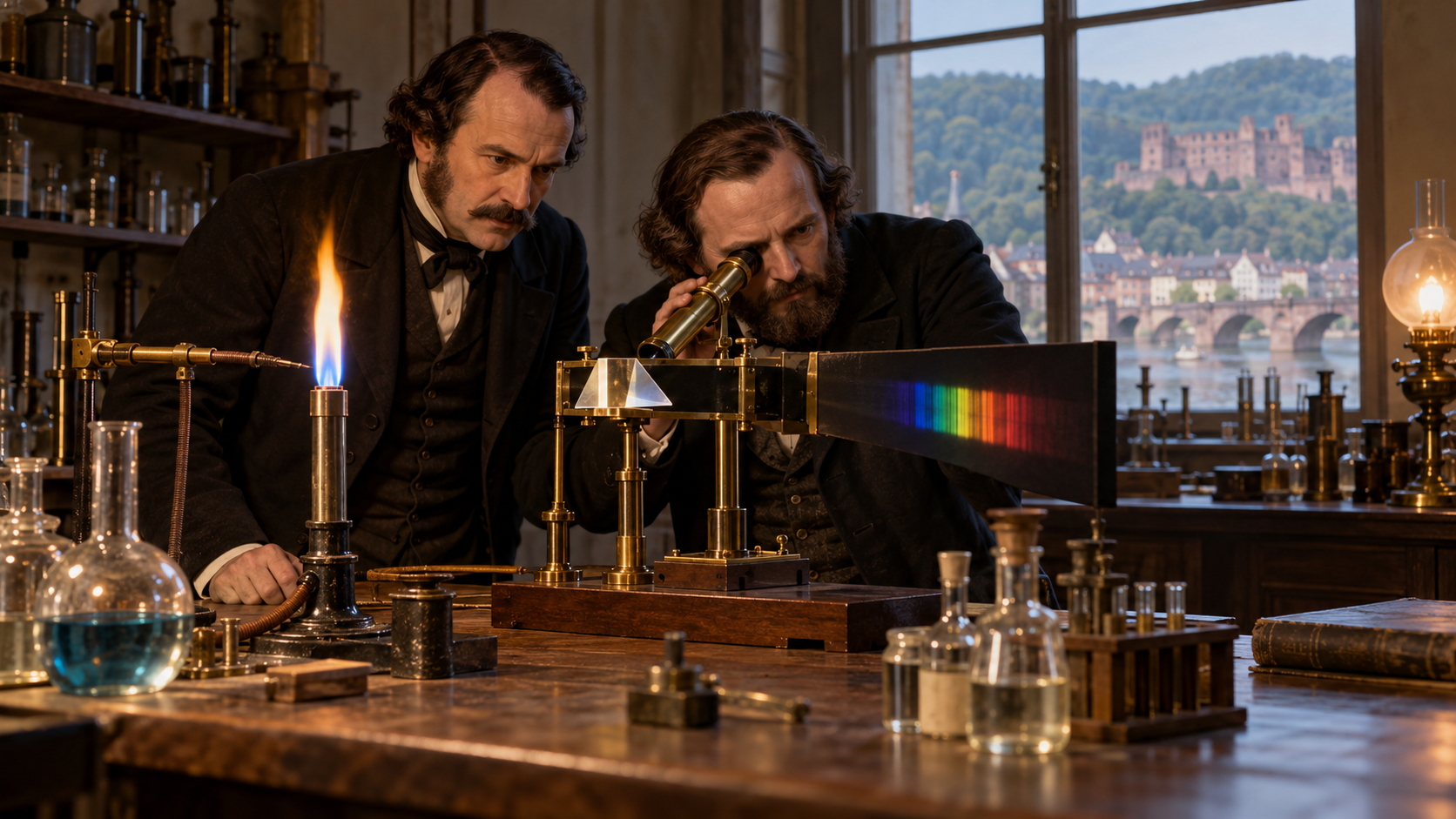
On May 10, 1860, chemists Robert Bunsen and Gustav Kirchhoff observed unfamiliar sky-blue lines while examining light from mineral spring water in Heidelberg. The pair used a spectroscope, which separated the light emitted by a heated sample into distinct colors. Because known elements produced characteristic line patterns, the new signal indicated a previously unidentified element. They named it cesium from the Latin word for sky blue.
The experiment emerged from their systematic development of spectral analysis. Bunsen’s clean gas burner produced a controllable flame, while Kirchhoff’s optical arrangement used a narrow slit, prism, and telescope to compare bright lines precisely. The method could detect tiny quantities even when conventional chemical separation was difficult, turning emitted light into a sensitive fingerprint of composition.
Bunsen and Kirchhoff concentrated large volumes of spring water to study the new element’s compounds, but they did not isolate pure metallic cesium. That was accomplished later by Carl Setterberg using electrolysis. Cesium proved extremely reactive, so the metal required methods and handling beyond the initial spectroscopic discovery.
The blue lines marked more than one addition to the periodic inventory. Spectroscopy soon identified other elements and allowed astronomers to determine the composition of the Sun and stars. Cesium later became central to atomic clocks because a precise microwave transition defines the SI second. Seen across a longer timeline, scientific milestones are junctions rather than isolated beginnings. Earlier experiments, tools, and institutions made the work possible, while later teams tested limits and carried the result into new settings. What survives is a traceable chain of evidence, correction, and application that allows one moment to remain relevant as knowledge and technology continue to change. The anniversary highlights the difference between a first result and a finished understanding. A successful observation can settle one question while opening several harder ones, and even a failed objective can reshape later designs. Preserved data, specimens, photographs, and hardware allow new generations to revisit the work with better tools. Science advances through that continuity rather than stopping on a memorable date. Its calendar date is an entry point, not an endpoint. The people involved worked with the instruments, assumptions, and social conditions of their time, and later research has both extended and corrected their conclusions. Separating what was known that day from what became clear afterward protects the history from myth and shows how cumulative evidence turns an episode into lasting scientific knowledge. For science history, the event also shows how evidence moves from an observation or engineered test into a durable body of knowledge. Instruments supplied measurements, specialists debated interpretation, and later work refined what the first result could mean. Archives preserve the early record while new methods let researchers ask different questions of it. That continuing revision is the process through which a dated milestone remains scientifically useful.
Heated spring-water residues emitted spectral lines that did not match known elements.
Their sky-blue color inspired the name cesium.
A slit and prism separated light into narrow, characteristic wavelengths.
The technique detected trace substances that were difficult to isolate by ordinary reactions.
Pure cesium metal was isolated only after later electrochemical work.
A cesium atomic transition now provides the formal definition of the second.
Explore more of "On This Day ..."
Discover more events from the same date across news, politics, technology, sports, and other fields. Each link highlights significant moments that shaped history on different fronts.