

On This Day in Science: June 1, 1831
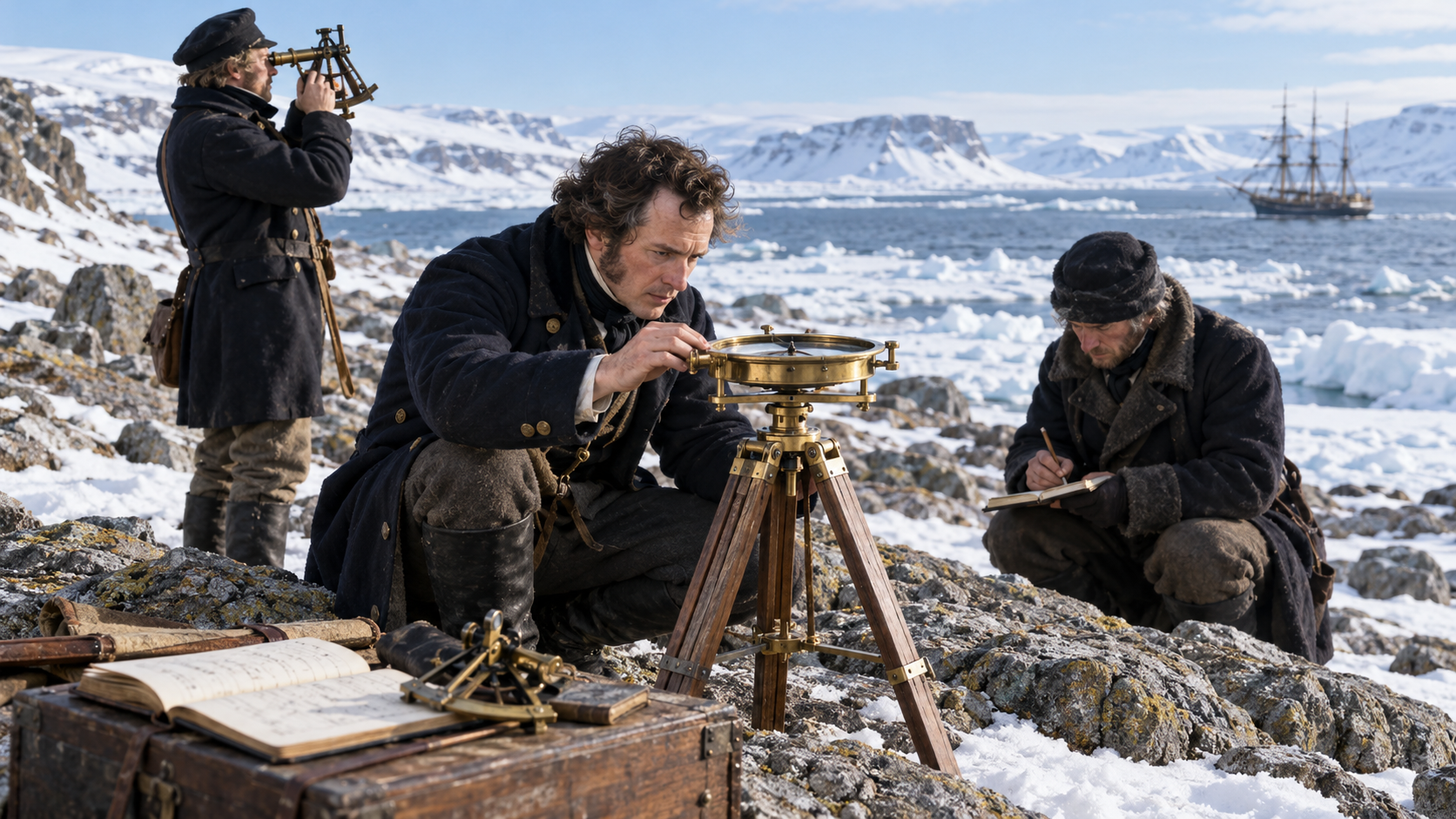
On June 1, 1831, British naval officer and explorer James Clark Ross made observations on Boothia Peninsula in Arctic Canada that fixed the position of Earth’s north magnetic pole as it was then located. Ross had traveled over sea ice from the expedition ship Victory, which was commanded by his uncle John Ross. The site lay on land, not at the geographic North Pole, and the magnetic pole has since moved far from it.
Ross used a dipping needle, an instrument that shows the angle at which Earth’s magnetic field points into the ground. Near a magnetic pole, the needle approaches vertical and a horizontal compass loses useful direction. Repeated measurements, combined with position fixes, let the party identify the region where magnetic inclination was effectively ninety degrees.
The result mattered to both geophysics and navigation. Mariners already knew that magnetic north did not coincide with true north and that compass declination varied by place and time. Ross’s measured location supplied a concrete reference for a field generated deep inside a changing planet rather than a permanent point on a map.
Modern observatories and satellites now track the north magnetic pole as it drifts across the Arctic. The 1831 observation remains a landmark because it joined difficult field travel with quantitative measurement and made Earth’s invisible magnetic geometry observable. For science history, the event also shows how evidence moves from an observation or engineered test into a durable body of knowledge. Instruments supplied measurements, specialists debated interpretation, and later work refined what the first result could mean. Archives preserve the early record while new methods let researchers ask different questions of it. That continuing revision is the process through which a dated milestone remains scientifically useful. Seen across a longer timeline, scientific milestones are junctions rather than isolated beginnings. Earlier experiments, tools, and institutions made the work possible, while later teams tested limits and carried the result into new settings. What survives is a traceable chain of evidence, correction, and application that allows one moment to remain relevant as knowledge and technology continue to change. The anniversary highlights the difference between a first result and a finished understanding. A successful observation can settle one question while opening several harder ones, and even a failed objective can reshape later designs. Preserved data, specimens, photographs, and hardware allow new generations to revisit the work with better tools. Science advances through that continuity rather than stopping on a memorable date. Its calendar date is an entry point, not an endpoint. The people involved worked with the instruments, assumptions, and social conditions of their time, and later research has both extended and corrected their conclusions. Separating what was known that day from what became clear afterward protects the history from myth and shows how cumulative evidence turns an episode into lasting scientific knowledge.
The north magnetic pole is defined by the local direction of Earth's magnetic field, not by the planet's rotation axis.
Changes in the liquid outer core cause its surface position to drift over time.
A dipping needle measures magnetic inclination rather than ordinary compass direction.
Ross looked for the place where the field was nearly vertical and horizontal direction became indeterminate.
Accurate magnetic charts helped mariners correct compass bearings.
The observations also offered evidence about the structure and changing behavior of Earth's field.
Explore more of "On This Day ..."
Discover more events from the same date across news, politics, technology, sports, and other fields. Each link highlights significant moments that shaped history on different fronts.