

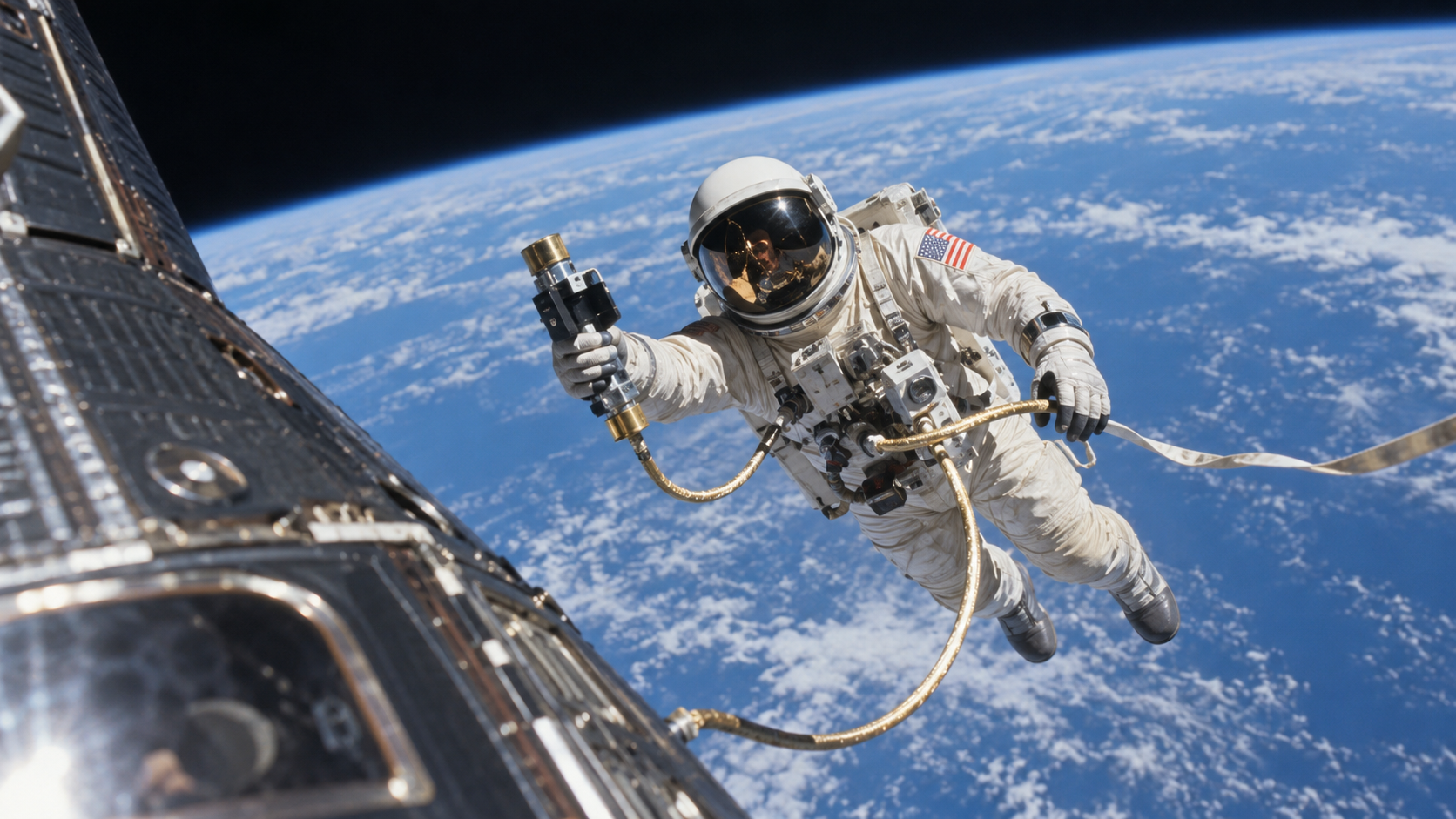
On This Day in Science: June 3, 1965
On June 3, 1965, astronaut Edward H. White II opened the hatch of Gemini 4 and became the first American to perform an extravehicular activity. While James McDivitt remained inside the two-seat capsule, White floated outside for about twenty-three minutes, attached by an umbilical and safety tether as the spacecraft crossed from the Pacific toward the Atlantic.
White used a handheld maneuvering unit that expelled compressed oxygen to change his orientation and motion. The small device worked until its gas supply diminished, after which he pulled and twisted on the tether. A chest-mounted camera and McDivitt’s photographs documented how a suited person moved, while biomedical sensors and voice communications tracked White’s condition.
The spacewalk was exhilarating but also exposed practical difficulties. White’s visor fogged, the stiff suit made motion tiring, and closing the hatch required effort. Gemini 4 lasted nearly four days, so the crew also studied endurance, sleep, food, waste management, and spacecraft systems during a mission far longer than earlier American flights.
Later spacewalks would require handrails, foot restraints, specialized tools, and extensive underwater training. White’s brief excursion was a first engineering trial of working outside a spacecraft, not simply a spectacle, and its lessons shaped the equipment used on Apollo and orbital stations. The anniversary highlights the difference between a first result and a finished understanding. A successful observation can settle one question while opening several harder ones, and even a failed objective can reshape later designs. Preserved data, specimens, photographs, and hardware allow new generations to revisit the work with better tools. Science advances through that continuity rather than stopping on a memorable date. Its calendar date is an entry point, not an endpoint. The people involved worked with the instruments, assumptions, and social conditions of their time, and later research has both extended and corrected their conclusions. Separating what was known that day from what became clear afterward protects the history from myth and shows how cumulative evidence turns an episode into lasting scientific knowledge. For science history, the event also shows how evidence moves from an observation or engineered test into a durable body of knowledge. Instruments supplied measurements, specialists debated interpretation, and later work refined what the first result could mean. Archives preserve the early record while new methods let researchers ask different questions of it. That continuing revision is the process through which a dated milestone remains scientifically useful. Seen across a longer timeline, scientific milestones are junctions rather than isolated beginnings. Earlier experiments, tools, and institutions made the work possible, while later teams tested limits and carried the result into new settings. What survives is a traceable chain of evidence, correction, and application that allows one moment to remain relevant as knowledge and technology continue to change.
White remained connected to Gemini 4 by a life-support umbilical and a safety tether.
McDivitt monitored the spacecraft while photographing and communicating with him.
Compressed oxygen from a maneuvering unit let White translate and turn without touching the capsule.
Once the gas ran low, the tether became his main means of changing position.
The flight showed that free floating and useful work are different challenges.
Later programs added handholds, foot restraints, tools, and task-specific training.
Explore more of "On This Day ..."
Discover more events from the same date across news, politics, technology, sports, and other fields. Each link highlights significant moments that shaped history on different fronts.