

On This Day in Science: July 4, 1997
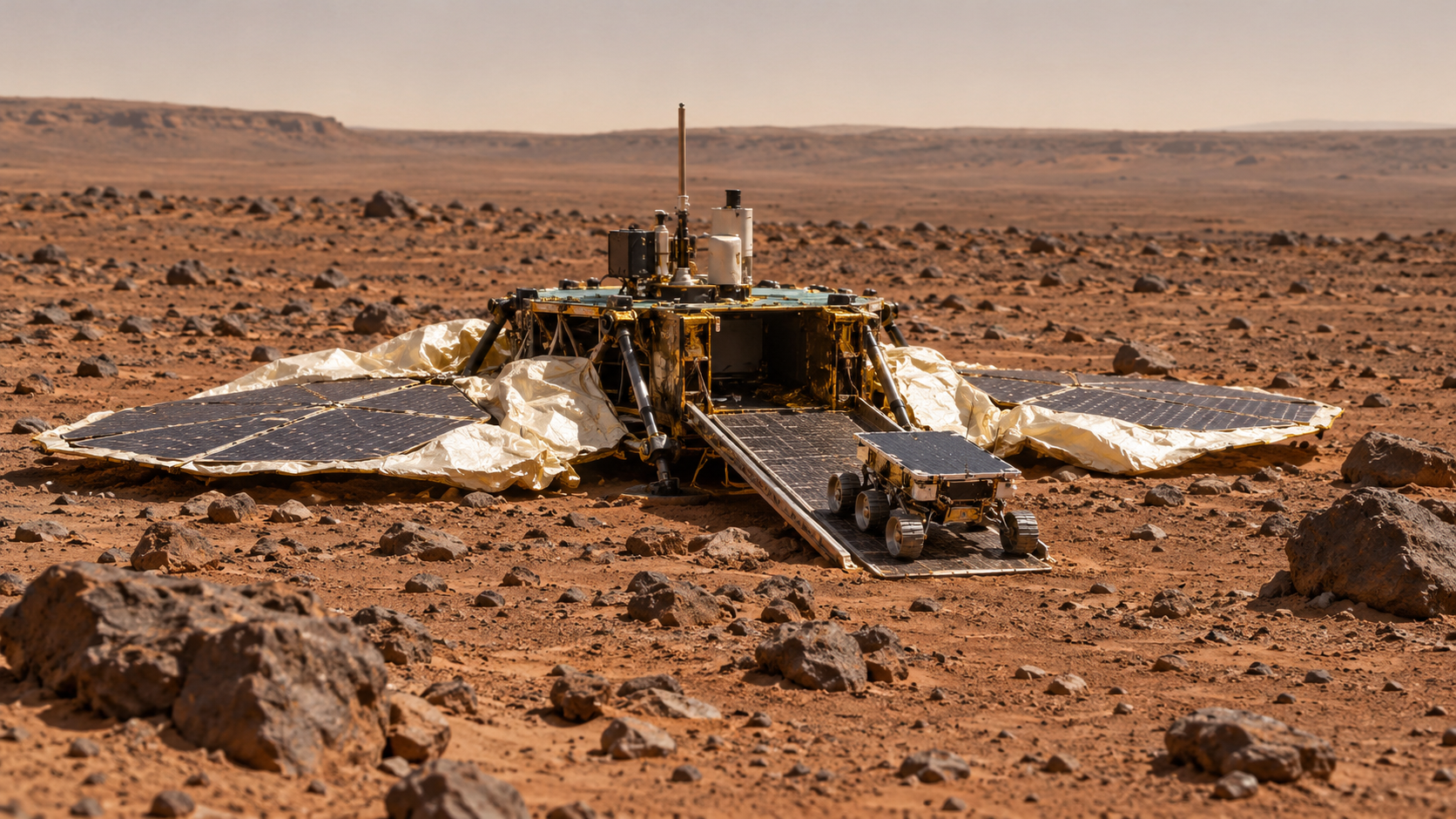
On July 4, 1997, NASA’s Mars Pathfinder spacecraft entered the Martian atmosphere and landed in Ares Vallis. A heat shield, parachute, rockets, and a cocoon of airbags slowed the vehicle. It struck the ground, bounced, rolled, and finally came to rest before its three solar-panel petals opened to expose the lander and the small Sojourner rover.
Pathfinder was built to demonstrate a lower-cost approach to planetary missions as well as to return science. The lander, renamed the Carl Sagan Memorial Station, carried cameras and weather sensors. Sojourner was a microwave-oven-sized rover equipped to analyze rocks and test autonomous obstacle avoidance while staying within communications range of the lander.
The landing sequence succeeded without real-time control because radio signals took minutes to cross interplanetary space. Images soon showed a rock-strewn flood plain, and the rover’s movements became a widely watched public event. Chemical measurements and geology supported the interpretation that catastrophic floods had once shaped the region.
Pathfinder far exceeded its planned lifetime and proved that airbags, compact rovers, and frequent lower-cost missions could work on Mars. Its operational lessons influenced Spirit, Opportunity, and later surface vehicles. Sojourner’s short drives helped turn mobile robotic field geology from a demonstration into a central method of Mars exploration. Its calendar date is an entry point, not an endpoint. The people involved worked with the instruments, assumptions, and social conditions of their time, and later research has both extended and corrected their conclusions. Separating what was known that day from what became clear afterward protects the history from myth and shows how cumulative evidence turns an episode into lasting scientific knowledge. For science history, the event also shows how evidence moves from an observation or engineered test into a durable body of knowledge. Instruments supplied measurements, specialists debated interpretation, and later work refined what the first result could mean. Archives preserve the early record while new methods let researchers ask different questions of it. That continuing revision is the process through which a dated milestone remains scientifically useful. Seen across a longer timeline, scientific milestones are junctions rather than isolated beginnings. Earlier experiments, tools, and institutions made the work possible, while later teams tested limits and carried the result into new settings. What survives is a traceable chain of evidence, correction, and application that allows one moment to remain relevant as knowledge and technology continue to change. The anniversary highlights the difference between a first result and a finished understanding. A successful observation can settle one question while opening several harder ones, and even a failed objective can reshape later designs. Preserved data, specimens, photographs, and hardware allow new generations to revisit the work with better tools. Science advances through that continuity rather than stopping on a memorable date.
A parachute and rockets reduced the descent speed before inflated bags absorbed impact.
The lander bounced across Ares Vallis and then opened protective petals.
Sojourner analyzed rocks and practiced autonomous hazard avoidance.
It relayed data through the stationary Pathfinder lander.
Pathfinder demonstrated a faster and less expensive mission approach.
Its engineering heritage carried into generations of larger Mars rovers.
Explore more of "On This Day ..."
Discover more events from the same date across news, politics, technology, sports, and other fields. Each link highlights significant moments that shaped history on different fronts.