

On This Day in Science: July 6, 1885
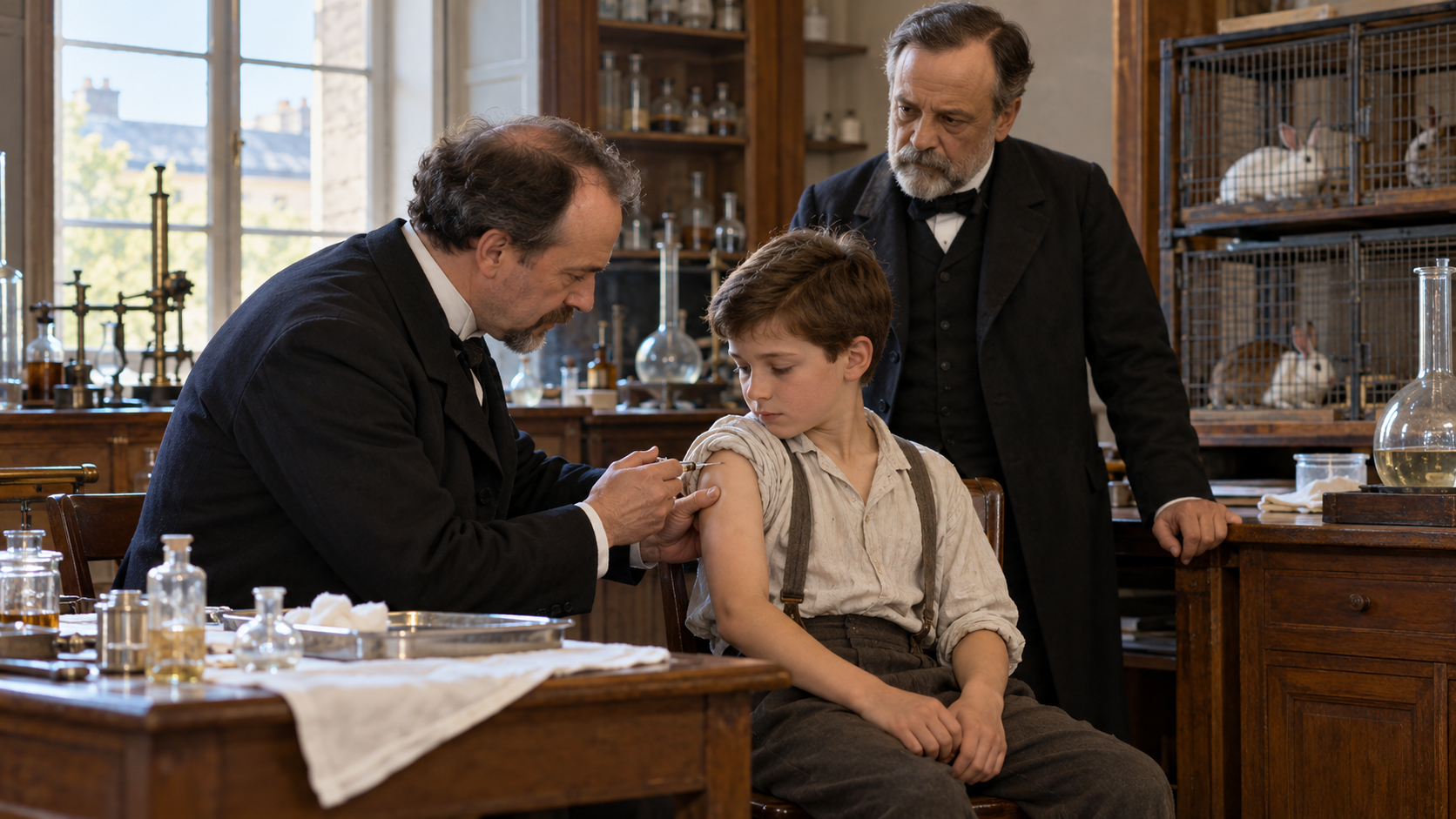
On July 6, 1885, nine-year-old Joseph Meister received the first injection in an experimental course intended to prevent rabies after exposure. He had been bitten repeatedly by a rabid dog and was brought to Louis Pasteur’s laboratory at the École Normale Supérieure in Paris. Because Pasteur was not a physician, doctor Jacques-Joseph Grancher administered the treatment.
Pasteur and his collaborators had studied rabies in animals and prepared material from infected rabbit spinal cords weakened by drying. Meister received a series of thirteen inoculations over ten days, progressing toward more virulent preparations. The strategy aimed to build immunity during the disease’s long incubation period before the virus reached the nervous system.
Meister did not develop rabies. The result encouraged treatment of other exposed patients and helped create demand for a specialized clinic, contributing to the establishment of the Institut Pasteur. The episode also raised ethical and scientific questions because the method had not undergone modern clinical testing and Pasteur’s public account simplified some uncertainties.
Modern rabies post-exposure prophylaxis uses thoroughly tested vaccines and, when indicated, immunoglobulin rather than Pasteur’s spinal-cord material. The 1885 intervention remains pivotal because it translated laboratory work on attenuation and immunity into prevention after a known exposure to an almost invariably fatal infection. Seen across a longer timeline, scientific milestones are junctions rather than isolated beginnings. Earlier experiments, tools, and institutions made the work possible, while later teams tested limits and carried the result into new settings. What survives is a traceable chain of evidence, correction, and application that allows one moment to remain relevant as knowledge and technology continue to change. The anniversary highlights the difference between a first result and a finished understanding. A successful observation can settle one question while opening several harder ones, and even a failed objective can reshape later designs. Preserved data, specimens, photographs, and hardware allow new generations to revisit the work with better tools. Science advances through that continuity rather than stopping on a memorable date. Its calendar date is an entry point, not an endpoint. The people involved worked with the instruments, assumptions, and social conditions of their time, and later research has both extended and corrected their conclusions. Separating what was known that day from what became clear afterward protects the history from myth and shows how cumulative evidence turns an episode into lasting scientific knowledge. For science history, the event also shows how evidence moves from an observation or engineered test into a durable body of knowledge. Instruments supplied measurements, specialists debated interpretation, and later work refined what the first result could mean. Archives preserve the early record while new methods let researchers ask different questions of it. That continuing revision is the process through which a dated milestone remains scientifically useful.
Rabies often has a long incubation period before neurological symptoms appear.
Pasteur's team sought to induce protection during that interval.
Grancher administered preparations made from progressively fresher infected tissue.
The historical method differs fundamentally from modern purified vaccines.
Meister survived and additional patients came for treatment.
The demand helped motivate a permanent center for research, care, and teaching.
Explore more of "On This Day ..."
Discover more events from the same date across news, politics, technology, sports, and other fields. Each link highlights significant moments that shaped history on different fronts.