

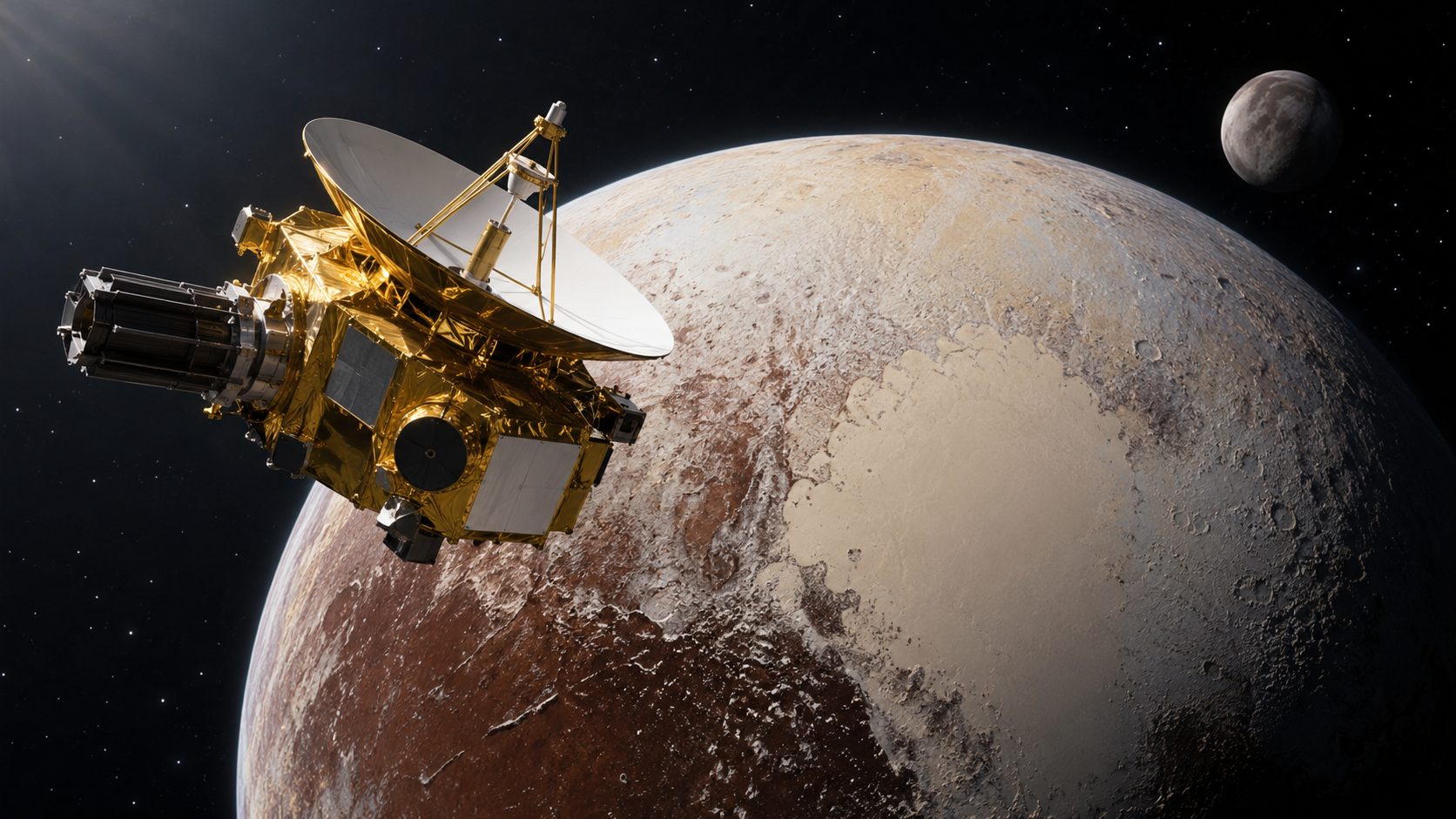
On This Day in Science: July 14, 2015
On July 14, 2015, NASA’s New Horizons spacecraft passed about 12,500 kilometers above Pluto, completing the first close reconnaissance of the distant world. Traveling too fast to enter orbit, it carried out a tightly timed flyby that also examined Pluto’s large moon Charon and four smaller moons.
The spacecraft’s cameras and spectrometers mapped bright nitrogen-ice plains, mountains of water ice, haze layers, and complex surface colors. The heart-shaped region later named Tombaugh Regio contained the broad Sputnik Planitia basin, where convection and flowing volatile ices showed a geologically active surface. Charon displayed deep canyons and a dark polar region.
During closest approach New Horizons pointed away from Earth to gather data, so controllers waited through a planned communications silence for a signal confirming survival. Because the radio link was weak and distant, returning the complete dataset took more than a year. Careful sequencing had been uploaded long before the encounter.
The flyby transformed Pluto from a blurred point into a complex planetary system. It also revealed that small, cold bodies can remain dynamic billions of years after formation. New Horizons later continued into the Kuiper Belt, extending the mission from one historic encounter to a broader study of the solar system’s outer population. Seen across a longer timeline, scientific milestones are junctions rather than isolated beginnings. Earlier experiments, tools, and institutions made the work possible, while later teams tested limits and carried the result into new settings. What survives is a traceable chain of evidence, correction, and application that allows one moment to remain relevant as knowledge and technology continue to change. The anniversary highlights the difference between a first result and a finished understanding. A successful observation can settle one question while opening several harder ones, and even a failed objective can reshape later designs. Preserved data, specimens, photographs, and hardware allow new generations to revisit the work with better tools. Science advances through that continuity rather than stopping on a memorable date. Its calendar date is an entry point, not an endpoint. The people involved worked with the instruments, assumptions, and social conditions of their time, and later research has both extended and corrected their conclusions. Separating what was known that day from what became clear afterward protects the history from myth and shows how cumulative evidence turns an episode into lasting scientific knowledge. For science history, the event also shows how evidence moves from an observation or engineered test into a durable body of knowledge. Instruments supplied measurements, specialists debated interpretation, and later work refined what the first result could mean. Archives preserve the early record while new methods let researchers ask different questions of it. That continuing revision is the process through which a dated milestone remains scientifically useful.
New Horizons could not brake into orbit at Pluto.
Its instruments followed a preplanned sequence during a single close pass.
Nitrogen ice circulates across Sputnik Planitia.
Water-ice mountains and layered haze revealed unexpected geological and atmospheric complexity.
The spacecraft stored observations during the encounter.
A low-rate radio link required more than a year to return the full dataset.
Explore more of "On This Day ..."
Discover more events from the same date across news, politics, technology, sports, and other fields. Each link highlights significant moments that shaped history on different fronts.