

On This Day in Science: July 16, 1969
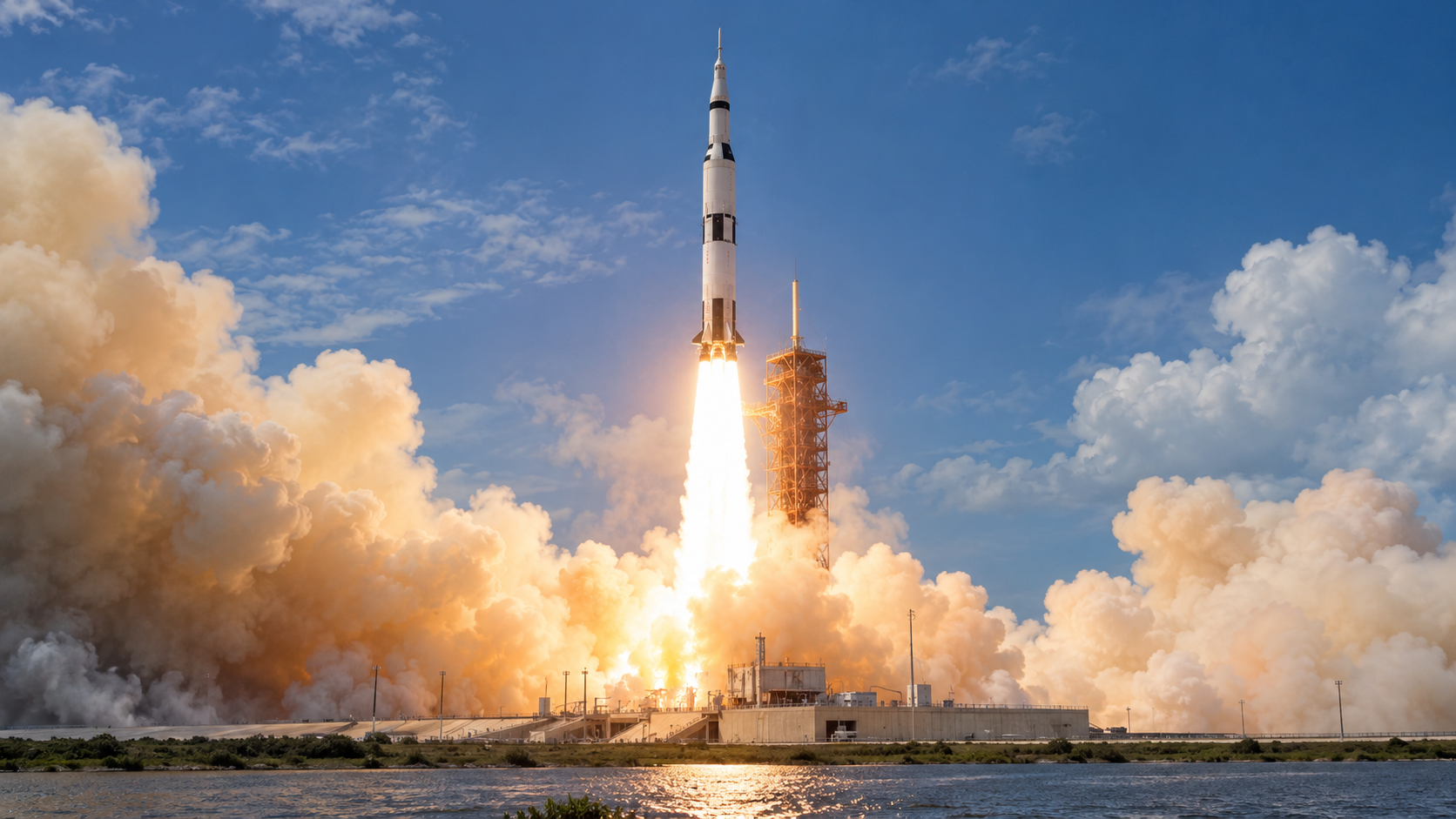
On July 16, 1969, the Saturn V carrying Apollo 11 lifted from Kennedy Space Center’s Launch Pad 39A. Neil Armstrong, Edwin “Buzz” Aldrin, and Michael Collins began a mission intended to land people on the Moon and return them safely to Earth, fulfilling a national goal announced eight years earlier.
The three-stage rocket produced about 7.5 million pounds of thrust at liftoff. After reaching Earth orbit, the third stage restarted to send Apollo toward the Moon. Collins separated the command-service module Columbia, turned it around, docked with the lunar module Eagle, and extracted it from the adapter that had protected it during launch.
The flight built on the Mercury and Gemini programs, uncrewed tests, Apollo 8’s lunar orbit, and Apollo 10’s landing rehearsal. It also depended on hundreds of thousands of workers across government, universities, contractors, tracking stations, and recovery teams. The crew represented the visible point of an enormous technical system.
Four days after launch, Armstrong and Aldrin landed in the Sea of Tranquility while Collins remained in lunar orbit. The July 16 ascent was the irreversible beginning of that attempt, combining propulsion, guidance, communications, life support, and mission control into one tightly sequenced departure from Earth. Its calendar date is an entry point, not an endpoint. The people involved worked with the instruments, assumptions, and social conditions of their time, and later research has both extended and corrected their conclusions. Separating what was known that day from what became clear afterward protects the history from myth and shows how cumulative evidence turns an episode into lasting scientific knowledge. For science history, the event also shows how evidence moves from an observation or engineered test into a durable body of knowledge. Instruments supplied measurements, specialists debated interpretation, and later work refined what the first result could mean. Archives preserve the early record while new methods let researchers ask different questions of it. That continuing revision is the process through which a dated milestone remains scientifically useful. Seen across a longer timeline, scientific milestones are junctions rather than isolated beginnings. Earlier experiments, tools, and institutions made the work possible, while later teams tested limits and carried the result into new settings. What survives is a traceable chain of evidence, correction, and application that allows one moment to remain relevant as knowledge and technology continue to change. The anniversary highlights the difference between a first result and a finished understanding. A successful observation can settle one question while opening several harder ones, and even a failed objective can reshape later designs. Preserved data, specimens, photographs, and hardware allow new generations to revisit the work with better tools. Science advances through that continuity rather than stopping on a memorable date.
Three rocket stages accelerated Apollo from the launch pad to Earth orbit and beyond.
The third stage performed the burn that committed the crew to the Moon.
The lunar module rode beneath the command-service module during launch.
A turning and docking maneuver assembled the spacecraft for the coast outward.
Apollo 11 depended on years of flights, tests, manufacturing, and tracking.
The three astronauts operated within a vast network of people and machines.
Explore more of "On This Day ..."
Discover more events from the same date across news, politics, technology, sports, and other fields. Each link highlights significant moments that shaped history on different fronts.