

On This Day in Science: July 20, 1969
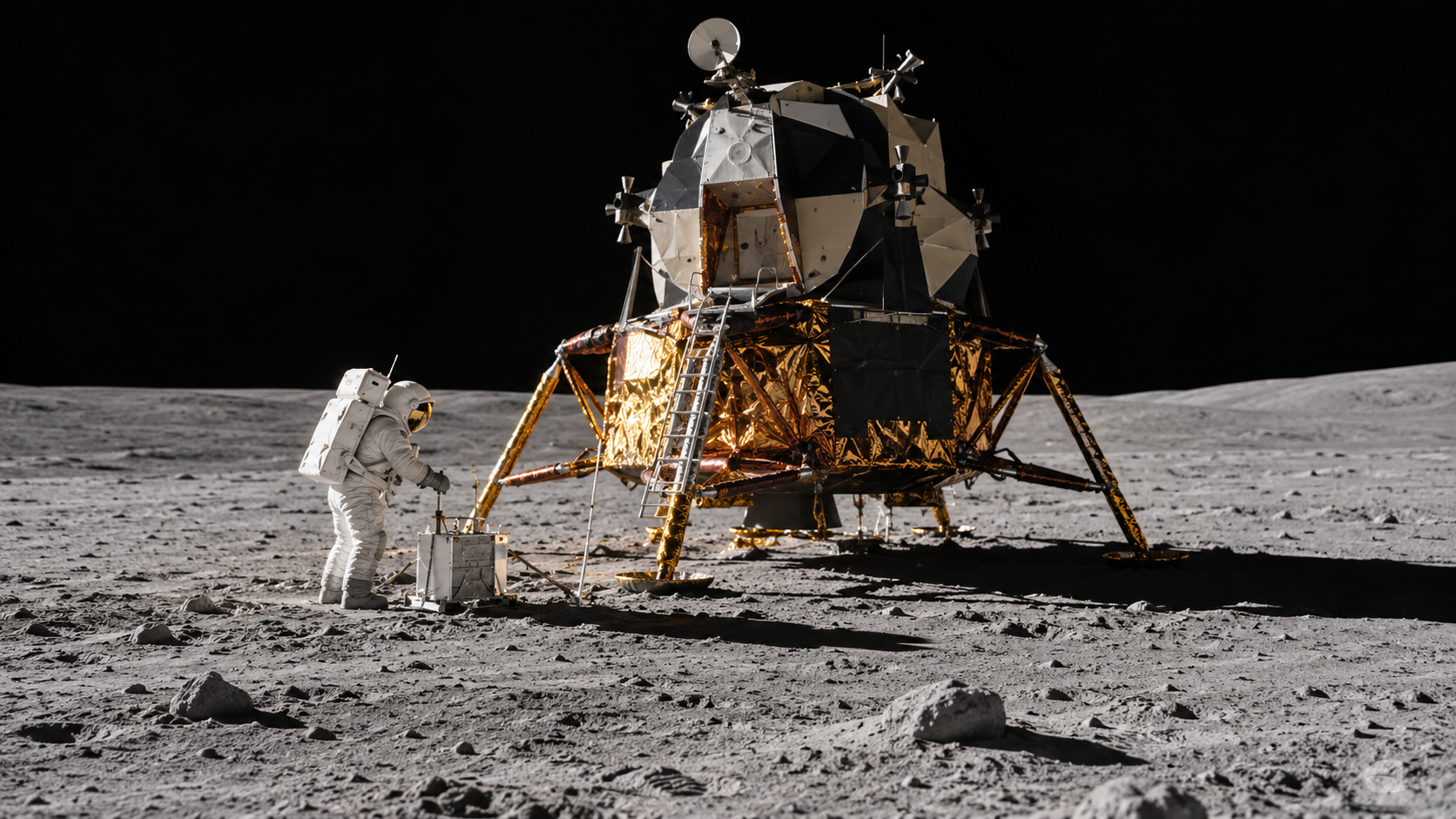
On July 20, 1969, the Apollo 11 lunar module Eagle landed in the Moon’s Sea of Tranquility. Neil Armstrong and Buzz Aldrin descended from lunar orbit while Michael Collins continued circling in the command module Columbia. Armstrong took manual control late in the approach to avoid a field of rocks and craters.
Eagle touched down with limited fuel remaining. Mission control confirmed the landing after hearing Armstrong’s report from Tranquility Base. The crew checked the spacecraft, prepared for an early departure if necessary, and then began plans for the surface excursion. About six and a half hours after landing, Armstrong climbed down the ladder and became the first person to step onto another world.
Armstrong and Aldrin spent roughly two and a half hours outside. They photographed the site, deployed a seismometer and laser-ranging reflector, collected rock and soil, and planted a solar-wind experiment. Their movements and equipment were constrained by the pressure suits, one-sixth gravity, limited time, and the need to protect Eagle.
The landing fulfilled Apollo’s central goal but depended on earlier robotic surveys, test flights, computing, tracking, manufacturing, and the work of hundreds of thousands of people. The samples and instruments produced scientific results for decades, while the mission also became a lasting symbol of both technological achievement and the political competition that drove it. Its calendar date is an entry point, not an endpoint. The people involved worked with the instruments, assumptions, and social conditions of their time, and later research has both extended and corrected their conclusions. Separating what was known that day from what became clear afterward protects the history from myth and shows how cumulative evidence turns an episode into lasting scientific knowledge. For science history, the event also shows how evidence moves from an observation or engineered test into a durable body of knowledge. Instruments supplied measurements, specialists debated interpretation, and later work refined what the first result could mean. Archives preserve the early record while new methods let researchers ask different questions of it. That continuing revision is the process through which a dated milestone remains scientifically useful. Seen across a longer timeline, scientific milestones are junctions rather than isolated beginnings. Earlier experiments, tools, and institutions made the work possible, while later teams tested limits and carried the result into new settings. What survives is a traceable chain of evidence, correction, and application that allows one moment to remain relevant as knowledge and technology continue to change. The anniversary highlights the difference between a first result and a finished understanding. A successful observation can settle one question while opening several harder ones, and even a failed objective can reshape later designs. Preserved data, specimens, photographs, and hardware allow new generations to revisit the work with better tools. Science advances through that continuity rather than stopping on a memorable date.
Armstrong saw that the automatic target area was unsafe.
He flew past the hazards and selected a clearer landing spot.
The landing created the first temporary human outpost beyond Earth.
Checks after touchdown ensured the crew could leave quickly if conditions demanded.
The astronauts collected samples and deployed compact instruments.
Returned rocks transformed understanding of lunar history and the early solar system.
Explore more of "On This Day ..."
Discover more events from the same date across news, politics, technology, sports, and other fields. Each link highlights significant moments that shaped history on different fronts.