

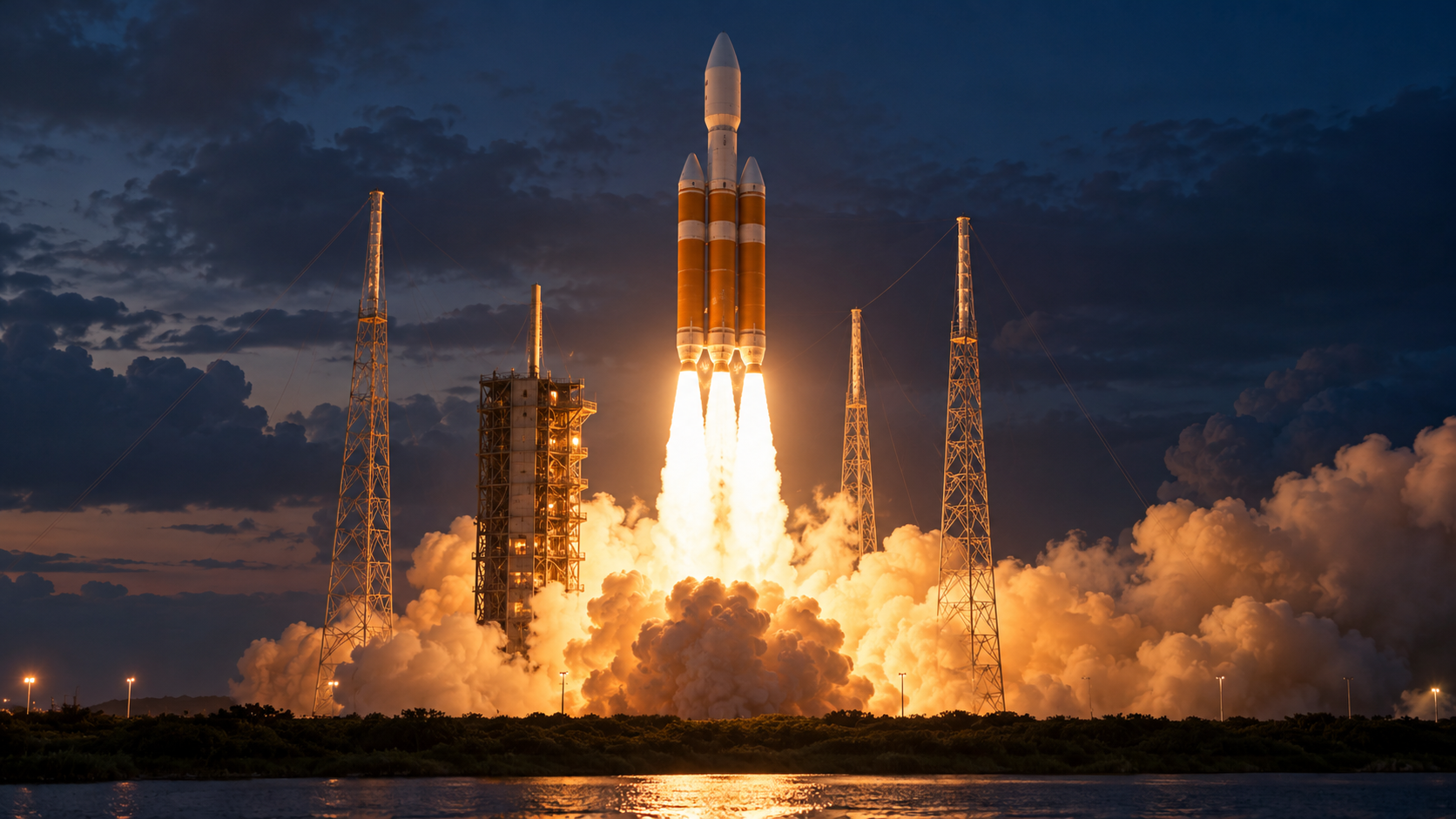
On This Day in Science: August 12, 2018
On August 12, 2018, NASA’s Parker Solar Probe launched from Cape Canaveral aboard a Delta IV Heavy. The mission was designed to fly closer to the Sun than any previous spacecraft and directly sample the outer solar atmosphere. It was named for physicist Eugene Parker, who predicted the solar wind in 1958.
Reaching the Sun is energetically difficult because a spacecraft must shed much of Earth’s sideways orbital speed. Parker uses repeated flybys of Venus to tighten its orbit. At each perihelion it races through the corona, where temperatures and radiation would destroy an unprotected vehicle.
A carbon-composite heat shield keeps most instruments in shadow while autonomous guidance maintains orientation. Field and particle sensors measure magnetic structure, plasma waves, ions, and electrons; a wide-field camera images the environment beside the spacecraft. These observations investigate why the corona is hotter than the visible surface and how the solar wind accelerates.
The launch began a long sequence of increasingly close passes rather than one encounter. Parker has crossed the Alfvén critical surface, sampling regions magnetically connected to the Sun, and its measurements are linking small-scale turbulence and magnetic switching to space weather throughout the solar system. Its calendar date is an entry point, not an endpoint. The people involved worked with the instruments, assumptions, and social conditions of their time, and later research has both extended and corrected their conclusions. Separating what was known that day from what became clear afterward protects the history from myth and shows how cumulative evidence turns an episode into lasting scientific knowledge. For science history, the event also shows how evidence moves from an observation or engineered test into a durable body of knowledge. Instruments supplied measurements, specialists debated interpretation, and later work refined what the first result could mean. Archives preserve the early record while new methods let researchers ask different questions of it. That continuing revision is the process through which a dated milestone remains scientifically useful. Seen across a longer timeline, scientific milestones are junctions rather than isolated beginnings. Earlier experiments, tools, and institutions made the work possible, while later teams tested limits and carried the result into new settings. What survives is a traceable chain of evidence, correction, and application that allows one moment to remain relevant as knowledge and technology continue to change. The anniversary highlights the difference between a first result and a finished understanding. A successful observation can settle one question while opening several harder ones, and even a failed objective can reshape later designs. Preserved data, specimens, photographs, and hardware allow new generations to revisit the work with better tools. Science advances through that continuity rather than stopping on a memorable date.
Earth’s orbital motion gives a spacecraft enormous sideways speed.
Venus flybys remove energy and shrink Parker’s orbit step by step.
The carbon-composite barrier faces the Sun during close passes.
Most electronics operate in its narrow protective shadow.
Parker measures fields and particles where the solar wind is born.
Direct data test competing explanations for coronal heating and acceleration.
Explore more of "On This Day ..."
Discover more events from the same date across news, politics, technology, sports, and other fields. Each link highlights significant moments that shaped history on different fronts.