

On This Day in Science: August 14, 1894
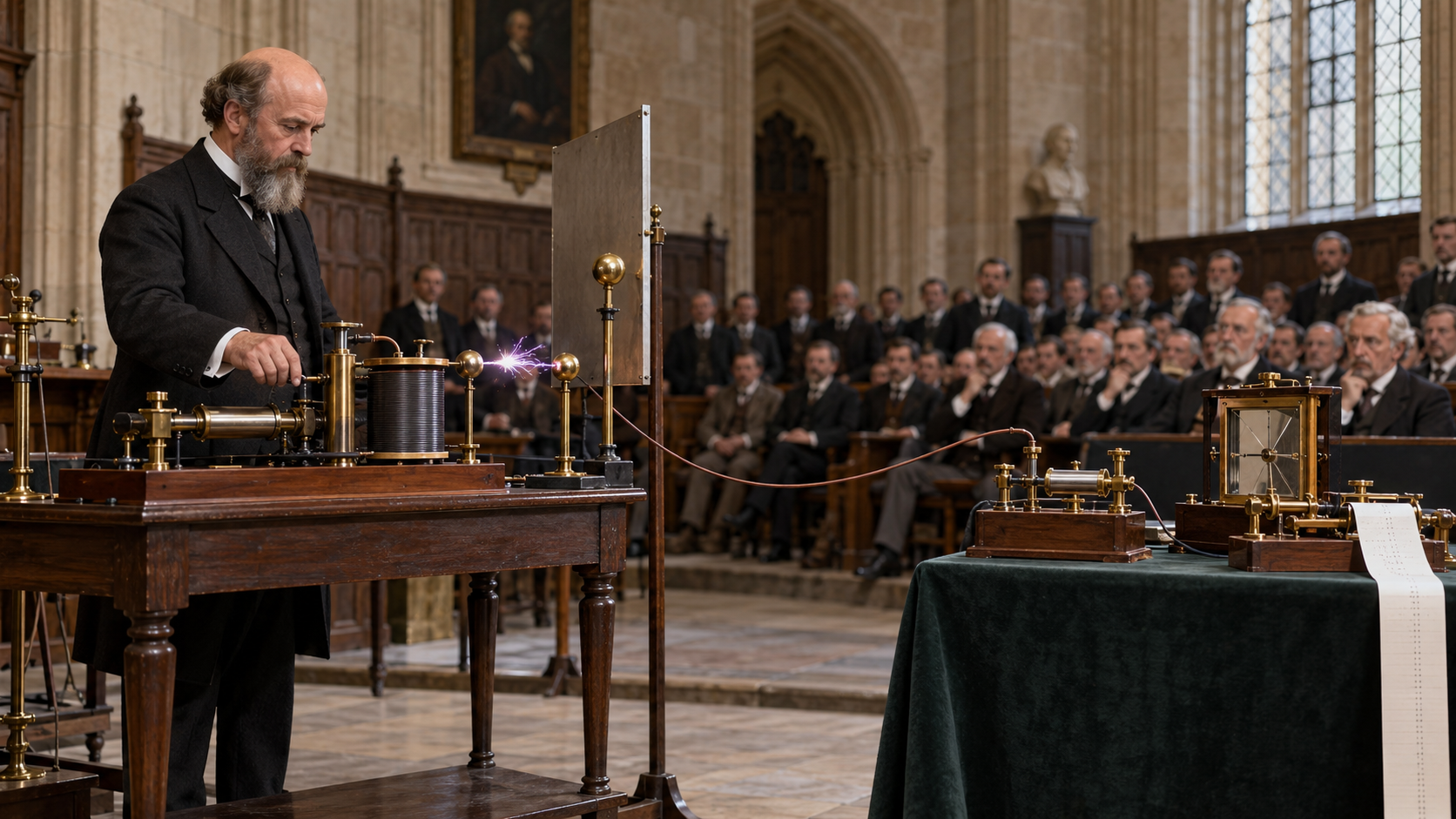
On August 14, 1894, physicist Oliver Lodge demonstrated wireless signaling during a British Association meeting at Oxford University. His apparatus transmitted electromagnetic pulses between buildings and detected them with an improved filings tube that he named the coherer. A relay could convert the detections into recorded signal marks.
Heinrich Hertz had already shown that electromagnetic waves predicted by James Clerk Maxwell could be produced and detected. Lodge explored reflection, refraction, polarization, and practical reception. The Oxford demonstration extended those laboratory effects into signaling over dozens of meters through walls and open space.
The event did not by itself create a complete radio communications service. Lodge’s priorities were scientific demonstration and lecture work, while Guglielmo Marconi soon combined components into longer-range, increasingly reliable telegraph systems and built the business and operational networks that made wireless practical. Priority later became contentious.
The demonstration remains important because it showed how invisible electromagnetic waves could carry deliberately coded information. Radio would grow through many inventors, better detectors, tuned circuits, antennas, amplification, and regulation, but the Oxford experiment made a clear public bridge from Maxwellian physics to communication without wires. Seen across a longer timeline, scientific milestones are junctions rather than isolated beginnings. Earlier experiments, tools, and institutions made the work possible, while later teams tested limits and carried the result into new settings. What survives is a traceable chain of evidence, correction, and application that allows one moment to remain relevant as knowledge and technology continue to change. The anniversary highlights the difference between a first result and a finished understanding. A successful observation can settle one question while opening several harder ones, and even a failed objective can reshape later designs. Preserved data, specimens, photographs, and hardware allow new generations to revisit the work with better tools. Science advances through that continuity rather than stopping on a memorable date. Its calendar date is an entry point, not an endpoint. The people involved worked with the instruments, assumptions, and social conditions of their time, and later research has both extended and corrected their conclusions. Separating what was known that day from what became clear afterward protects the history from myth and shows how cumulative evidence turns an episode into lasting scientific knowledge. For science history, the event also shows how evidence moves from an observation or engineered test into a durable body of knowledge. Instruments supplied measurements, specialists debated interpretation, and later work refined what the first result could mean. Archives preserve the early record while new methods let researchers ask different questions of it. That continuing revision is the process through which a dated milestone remains scientifically useful.
Earlier experiments proved that electromagnetic waves existed.
Lodge used controlled pulses to carry recognizable information.
Metal filings changed electrical resistance when radio energy arrived.
A mechanical tap restored the detector for the next signal.
Useful radio required tuning, antennas, power, operators, and networks.
Lodge’s work was one contribution among several that made wireless practical.
Explore more of "On This Day ..."
Discover more events from the same date across news, politics, technology, sports, and other fields. Each link highlights significant moments that shaped history on different fronts.