

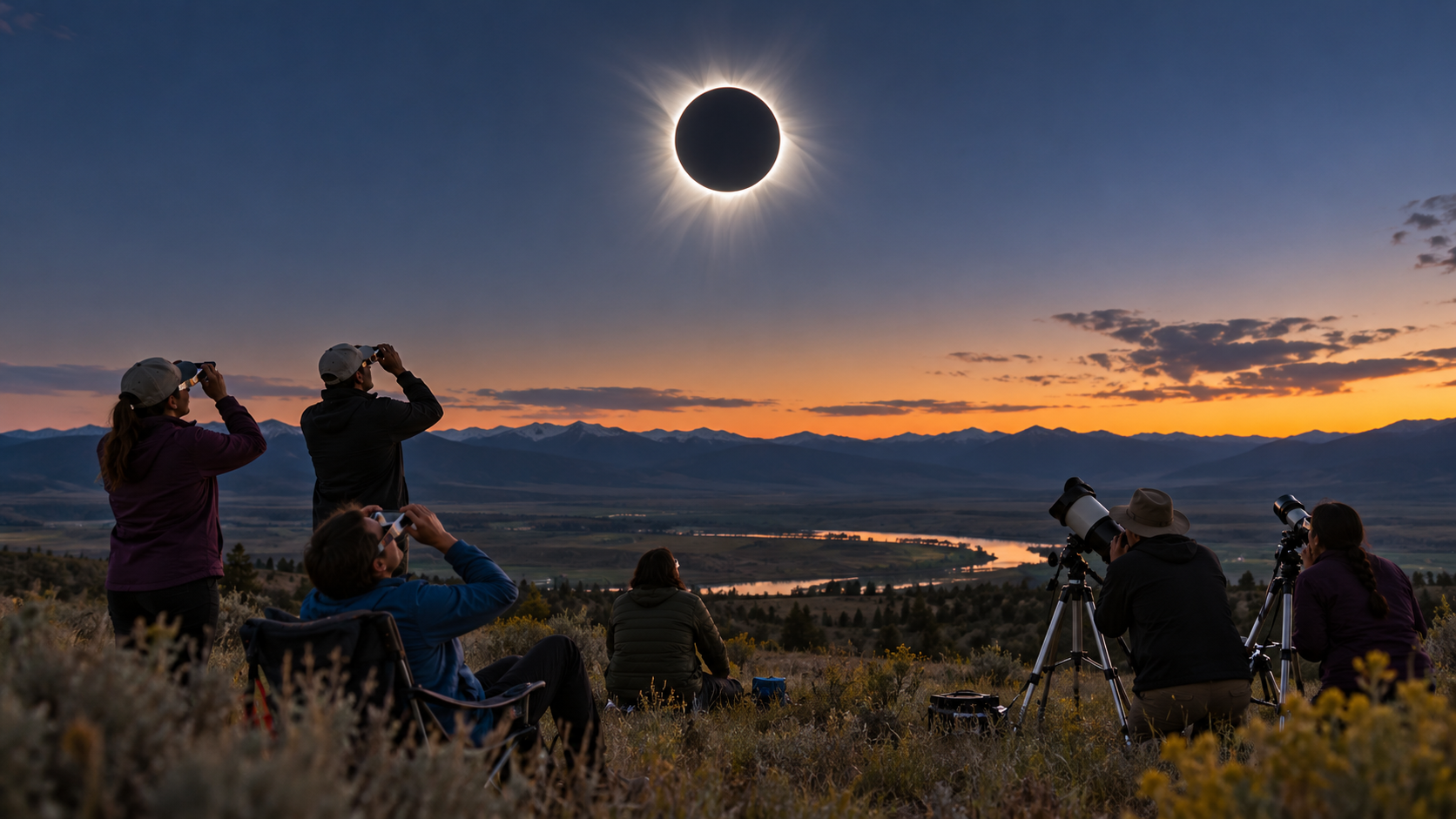
On This Day in Science: August 21, 2017
On August 21, 2017, a total solar eclipse crossed the contiguous United States from Oregon to South Carolina. The Moon’s central shadow traveled coast to coast in roughly an hour and a half, while a partial eclipse was visible across the entire country. It was the first total eclipse visible from the mainland United States since 1979.
Millions traveled into the path of totality, and schools, parks, museums, and observatories organized viewing. Safe solar filters were required before and after totality. During the brief fully covered phase, viewers could look directly at the corona, see bright planets and stars, and experience a rapid drop in light and temperature.
Scientists observed from the ground, balloons, aircraft, and spacecraft. Projects measured coronal structure, magnetic fields, atmospheric responses, animal behavior, and changes in Earth’s ionosphere. Citizen-science networks turned the long national path into coordinated observations that no single instrument could make.
The eclipse was scientifically predictable centuries in advance yet locally dependent on weather and precise geometry. Its scale made orbital mechanics and solar physics tangible to a broad public while producing data that connected the corona to space weather and Earth’s upper atmosphere. For science history, the event also shows how evidence moves from an observation or engineered test into a durable body of knowledge. Instruments supplied measurements, specialists debated interpretation, and later work refined what the first result could mean. Archives preserve the early record while new methods let researchers ask different questions of it. That continuing revision is the process through which a dated milestone remains scientifically useful. Seen across a longer timeline, scientific milestones are junctions rather than isolated beginnings. Earlier experiments, tools, and institutions made the work possible, while later teams tested limits and carried the result into new settings. What survives is a traceable chain of evidence, correction, and application that allows one moment to remain relevant as knowledge and technology continue to change. The anniversary highlights the difference between a first result and a finished understanding. A successful observation can settle one question while opening several harder ones, and even a failed objective can reshape later designs. Preserved data, specimens, photographs, and hardware allow new generations to revisit the work with better tools. Science advances through that continuity rather than stopping on a memorable date. Its calendar date is an entry point, not an endpoint. The people involved worked with the instruments, assumptions, and social conditions of their time, and later research has both extended and corrected their conclusions. Separating what was known that day from what became clear afterward protects the history from myth and shows how cumulative evidence turns an episode into lasting scientific knowledge.
The umbra entered Oregon and left the mainland through South Carolina.
Only locations inside a narrow path saw the Sun fully covered.
Certified filters protected eyes during all partial phases.
Filters could be removed only for the brief interval of complete totality.
Researchers used aircraft, balloons, cameras, and radio receivers.
Citizen projects sampled effects across thousands of kilometers.
Explore more of "On This Day ..."
Discover more events from the same date across news, politics, technology, sports, and other fields. Each link highlights significant moments that shaped history on different fronts.