

On This Day in Science: August 23, 1966
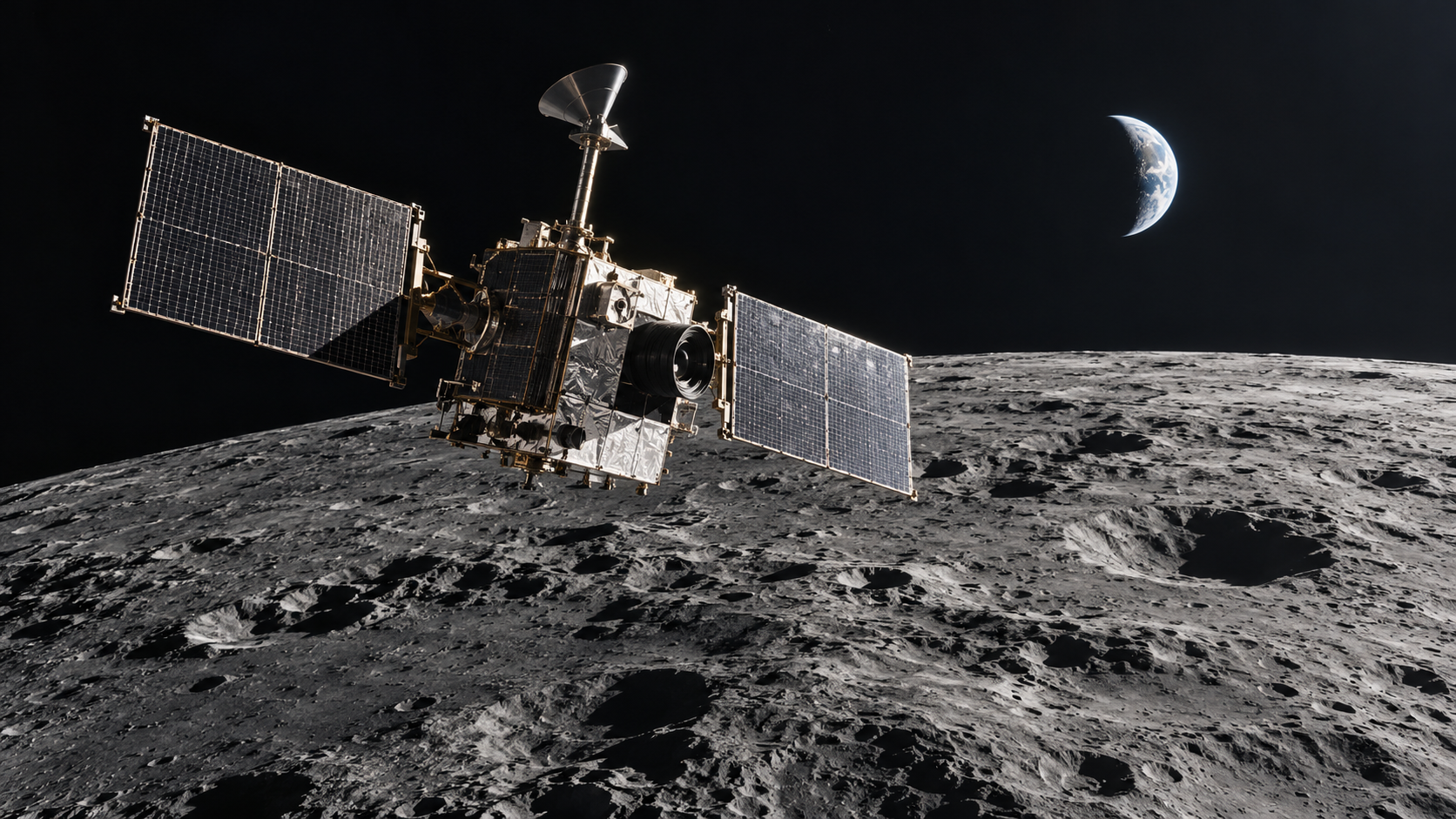
On August 23, 1966, NASA’s Lunar Orbiter 1 turned its camera away from its primary mapping targets and photographed a crescent Earth above the Moon’s horizon. The unplanned image was the first picture of Earth taken from the vicinity of the Moon and offered a new planetary perspective two years before Apollo 8’s famous color Earthrise.
Lunar Orbiter 1 was designed to photograph potential Apollo landing sites. Its imaging system exposed film onboard, chemically processed it, scanned it electronically, and transmitted the signal to Earth. The original frame therefore arrived as lines of analog data rather than as a digital camera file.
The black-and-white view showed the Moon’s foreground and the distant partly illuminated Earth. It was not the mission’s highest-resolution scientific product, but it became one of its most influential images. Modern recovery teams later digitized the original data tapes to reveal additional detail.
The photograph expanded the purpose of a survey mission by placing Earth inside the lunar landscape. It helped prepare the visual language of later crewed exploration while Lunar Orbiter’s systematic maps supplied engineers with the terrain evidence needed to choose and assess landing sites. The anniversary highlights the difference between a first result and a finished understanding. A successful observation can settle one question while opening several harder ones, and even a failed objective can reshape later designs. Preserved data, specimens, photographs, and hardware allow new generations to revisit the work with better tools. Science advances through that continuity rather than stopping on a memorable date. Its calendar date is an entry point, not an endpoint. The people involved worked with the instruments, assumptions, and social conditions of their time, and later research has both extended and corrected their conclusions. Separating what was known that day from what became clear afterward protects the history from myth and shows how cumulative evidence turns an episode into lasting scientific knowledge. For science history, the event also shows how evidence moves from an observation or engineered test into a durable body of knowledge. Instruments supplied measurements, specialists debated interpretation, and later work refined what the first result could mean. Archives preserve the early record while new methods let researchers ask different questions of it. That continuing revision is the process through which a dated milestone remains scientifically useful. Seen across a longer timeline, scientific milestones are junctions rather than isolated beginnings. Earlier experiments, tools, and institutions made the work possible, while later teams tested limits and carried the result into new settings. What survives is a traceable chain of evidence, correction, and application that allows one moment to remain relevant as knowledge and technology continue to change.
The spacecraft exposed and developed photographic film in lunar orbit.
An electronic scanner converted each frame into a radio signal for Earth.
Controllers reoriented the spacecraft beyond its downward mapping geometry.
The result placed a distant Earth above the Moon’s curved horizon.
The frame preceded the better-known color photograph taken by Apollo 8.
It introduced the home planet as a small object in deep space.
Explore more of "On This Day ..."
Discover more events from the same date across news, politics, technology, sports, and other fields. Each link highlights significant moments that shaped history on different fronts.