

On This Day in Science: August 26, 1978
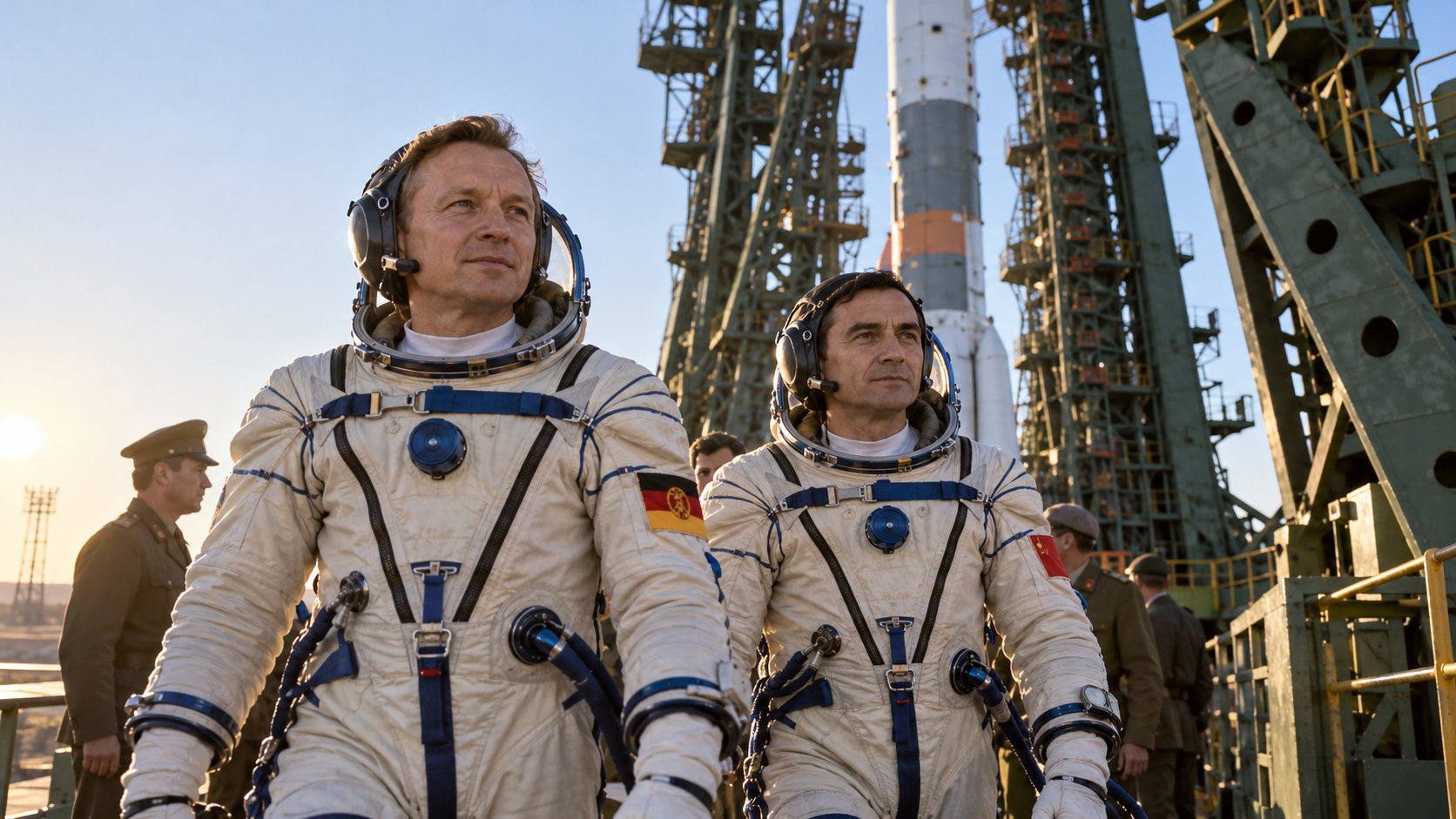
On August 26, 1978, Soyuz 31 launched from Baikonur carrying Soviet commander Valery Bykovsky and East German research cosmonaut Sigmund Jähn. The flight was part of the Intercosmos program, which included crew members and experiments from allied nations. Jähn became the first German to travel into space.
The Soyuz docked with the Salyut 6 station, where the visitors joined the resident crew. During nearly eight days in orbit, Jähn conducted twenty-five experiments in remote sensing, medicine, biology, materials science, and geophysics. A multispectral camera supported studies of Earth resources and environmental features.
The visiting crew returned in Soyuz 29, leaving their newer Soyuz 31 spacecraft for the long-duration residents. Such exchanges extended the safe return capability for station crews and became an important operational feature of Salyut missions.
The launch joined a national milestone to a broader international research program. Jähn’s flight was celebrated differently on each side of divided Germany, but after reunification he worked as a consultant linking Russian and European human-spaceflight programs, giving the mission a longer cooperative legacy. Seen across a longer timeline, scientific milestones are junctions rather than isolated beginnings. Earlier experiments, tools, and institutions made the work possible, while later teams tested limits and carried the result into new settings. What survives is a traceable chain of evidence, correction, and application that allows one moment to remain relevant as knowledge and technology continue to change. The anniversary highlights the difference between a first result and a finished understanding. A successful observation can settle one question while opening several harder ones, and even a failed objective can reshape later designs. Preserved data, specimens, photographs, and hardware allow new generations to revisit the work with better tools. Science advances through that continuity rather than stopping on a memorable date. Its calendar date is an entry point, not an endpoint. The people involved worked with the instruments, assumptions, and social conditions of their time, and later research has both extended and corrected their conclusions. Separating what was known that day from what became clear afterward protects the history from myth and shows how cumulative evidence turns an episode into lasting scientific knowledge. For science history, the event also shows how evidence moves from an observation or engineered test into a durable body of knowledge. Instruments supplied measurements, specialists debated interpretation, and later work refined what the first result could mean. Archives preserve the early record while new methods let researchers ask different questions of it. That continuing revision is the process through which a dated milestone remains scientifically useful.
Bykovsky provided veteran command experience.
Jähn flew as a research cosmonaut representing the German Democratic Republic.
Experiments covered human physiology, materials, biology, and Earth observation.
The short visiting mission worked alongside a resident station crew.
The visitors returned in the older Soyuz already docked to the station.
The resident crew kept Soyuz 31 as a fresher return vehicle.
Explore more of "On This Day ..."
Discover more events from the same date across news, politics, technology, sports, and other fields. Each link highlights significant moments that shaped history on different fronts.