

On This Day in Science: September 26, 1991
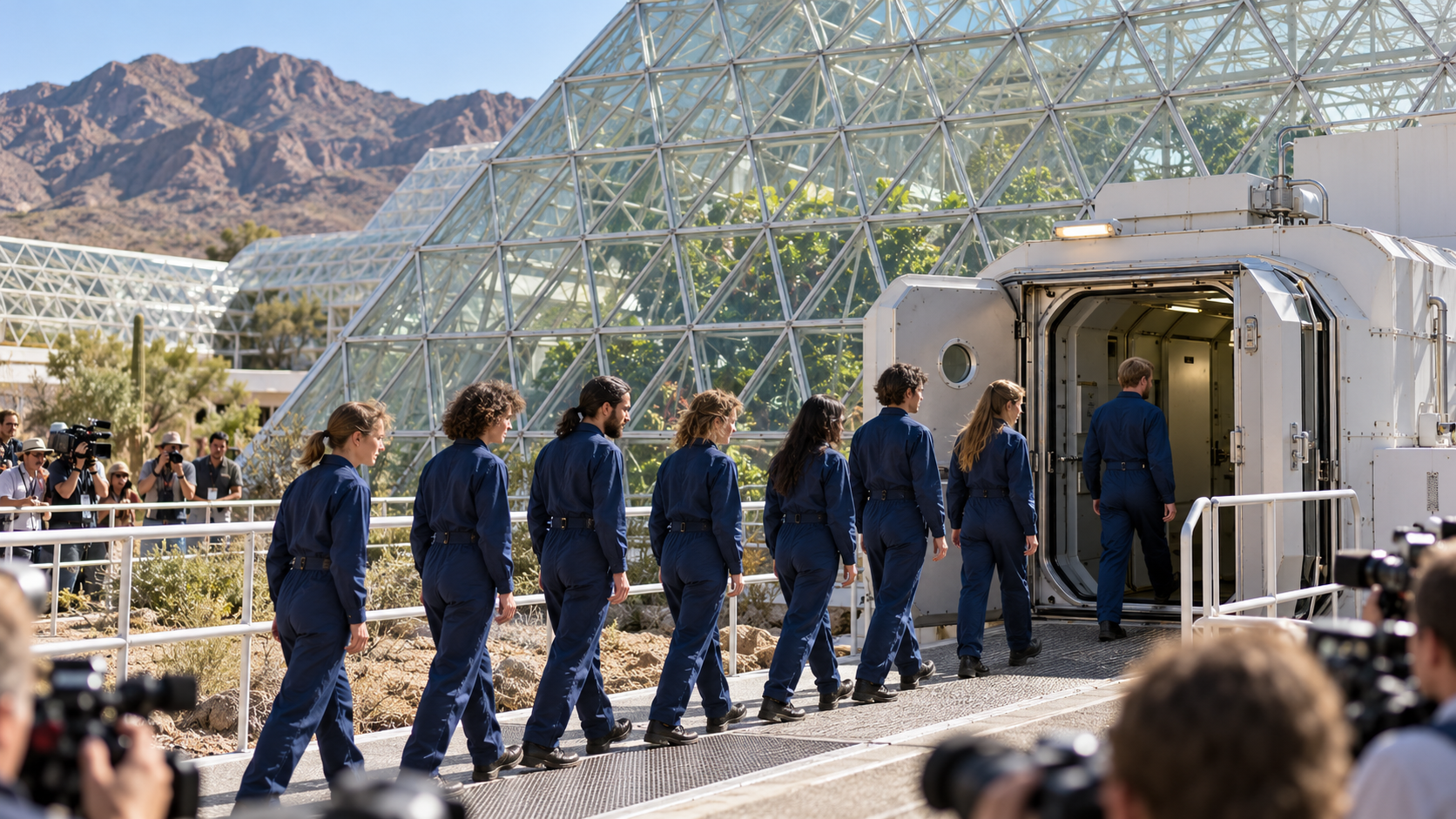
On September 26, 1991, eight people entered Biosphere 2 near Oracle, Arizona, and the glass-and-steel complex was sealed for a planned two-year mission. The facility contained agricultural areas and several constructed ecosystems, including rainforest, desert, savanna, marsh, and an ocean with a coral reef.
The experiment sought to explore how a materially closed ecological system could support people while recycling air, water, nutrients, and waste. Crew members grew much of their food, maintained machinery, conducted research, and recorded the rapid responses of plants, animals, microbes, soils, and atmosphere inside the enclosure.
Unexpected oxygen decline became the mission’s defining challenge. Respiration by soil organisms and reactions with exposed concrete removed oxygen faster than photosynthesis replaced it, while the structure allowed more gas exchange than initially presented. Managers eventually added oxygen, and some species flourished as others disappeared.
The crew completed the mission in 1993, but the project drew criticism over scientific controls, management, and publicity. Its successes and failures nevertheless produced valuable lessons about closed systems, ecosystem complexity, human factors, and the difficulty of balancing a small artificial biosphere. Seen across a longer timeline, scientific milestones are junctions rather than isolated beginnings. Earlier experiments, tools, and institutions made the work possible, while later teams tested limits and carried the result into new settings. What survives is a traceable chain of evidence, correction, and application that allows one moment to remain relevant as knowledge and technology continue to change. The anniversary highlights the difference between a first result and a finished understanding. A successful observation can settle one question while opening several harder ones, and even a failed objective can reshape later designs. Preserved data, specimens, photographs, and hardware allow new generations to revisit the work with better tools. Science advances through that continuity rather than stopping on a memorable date. Its calendar date is an entry point, not an endpoint. The people involved worked with the instruments, assumptions, and social conditions of their time, and later research has both extended and corrected their conclusions. Separating what was known that day from what became clear afterward protects the history from myth and shows how cumulative evidence turns an episode into lasting scientific knowledge. For science history, the event also shows how evidence moves from an observation or engineered test into a durable body of knowledge. Instruments supplied measurements, specialists debated interpretation, and later work refined what the first result could mean. Archives preserve the early record while new methods let researchers ask different questions of it. That continuing revision is the process through which a dated milestone remains scientifically useful.
The enclosure combined farms, living quarters, laboratories, and multiple constructed biomes.
Matter was meant to cycle internally while sunlight and electricity entered from outside.
Microbial respiration and concrete chemistry removed oxygen from the air.
The decline exposed interactions that designers had underestimated.
The crew completed two years, but management and scientific controls were disputed.
Biosphere 2 remains useful precisely because its unexpected behavior was so instructive.
Explore more of "On This Day ..."
Discover more events from the same date across news, politics, technology, sports, and other fields. Each link highlights significant moments that shaped history on different fronts.