

On This Day in Science: October 25, 1671
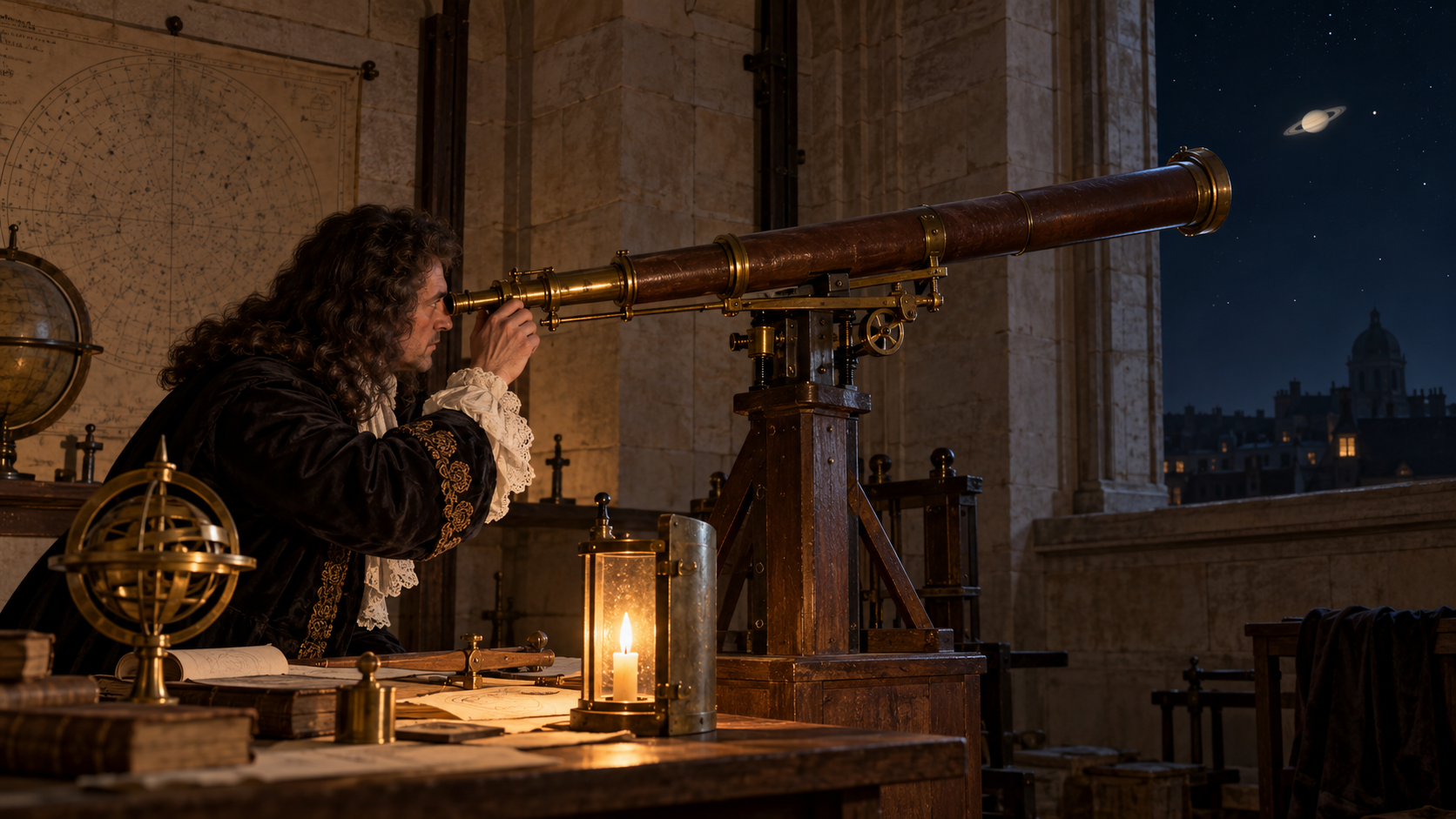
On October 25, 1671, astronomer Giovanni Domenico Cassini discovered a new moon of Saturn from the Paris Observatory. He could see the object west of the planet but repeatedly failed to find it on the eastern side of its orbit.
Cassini correctly suspected that the moon kept one face toward Saturn and that its two hemispheres differed greatly in brightness. With improved telescopes he eventually observed it on both sides. The moon was later named Iapetus and joined Titan in Cassini’s growing Saturnian system.
Modern spacecraft revealed one of the Solar System’s strongest surface contrasts. Dark material coats the leading hemisphere while the trailing side remains bright with ice. Thermal effects move water ice away from warmer dark regions, sharpening a pattern initially seeded by imported dust.
Cassini’s intermittent seventeenth-century sightings became an early example of inferring physical properties from a changing light signal. The Cassini spacecraft later showed Iapetus’s enormous equatorial ridge and ancient battered terrain, deepening a mystery first noticed through a small telescope. The anniversary also illustrates how a scientific milestone becomes useful through records that later researchers can inspect. Instruments, notebooks, images, specimens, and engineering reports preserve more than a celebratory date: they show what was actually measured, what remained uncertain, and how conclusions changed as better methods became available. Placed in a longer timeline, the event was a junction rather than a finished answer. Earlier discoveries and technical work made it possible, while later teams tested its limits and applied the result in new settings. That traceable sequence of evidence and revision is what turns one day into a durable part of scientific history. The episode also separates a first demonstration from mature understanding. A successful observation or flight can settle one question while exposing harder problems in reliability, interpretation, safety, and scale. Preserved data allow later generations to revisit the achievement without confusing what was known on the date with what became clear afterward. Its calendar date is an entry point rather than an endpoint. The people involved worked with the tools, assumptions, institutions, and social conditions of their time. Later research has extended some conclusions and corrected others, showing how science advances by keeping evidence open to comparison instead of treating a memorable event as final. What makes the event scientifically important is not only priority, but the ability of others to check, repeat, compare, or build on the result. That process can reveal limitations hidden by the excitement of a first success. It also explains why careful archives and transparent measurements matter as much as the date remembered by the public.
Iapetus was easy to see on one side of Saturn and difficult on the other.
Cassini used that repeating pattern to infer a dark and a bright hemisphere.
The moon rotates once during each orbit and keeps the same face toward its planet.
That geometry preserves a leading side and a trailing side.
Spacecraft images exposed a mountain chain around much of the equator.
Dust, heating, and migrating ice help explain the remarkable color divide.
Explore more of "On This Day ..."
Discover more events from the same date across news, politics, technology, sports, and other fields. Each link highlights significant moments that shaped history on different fronts.