

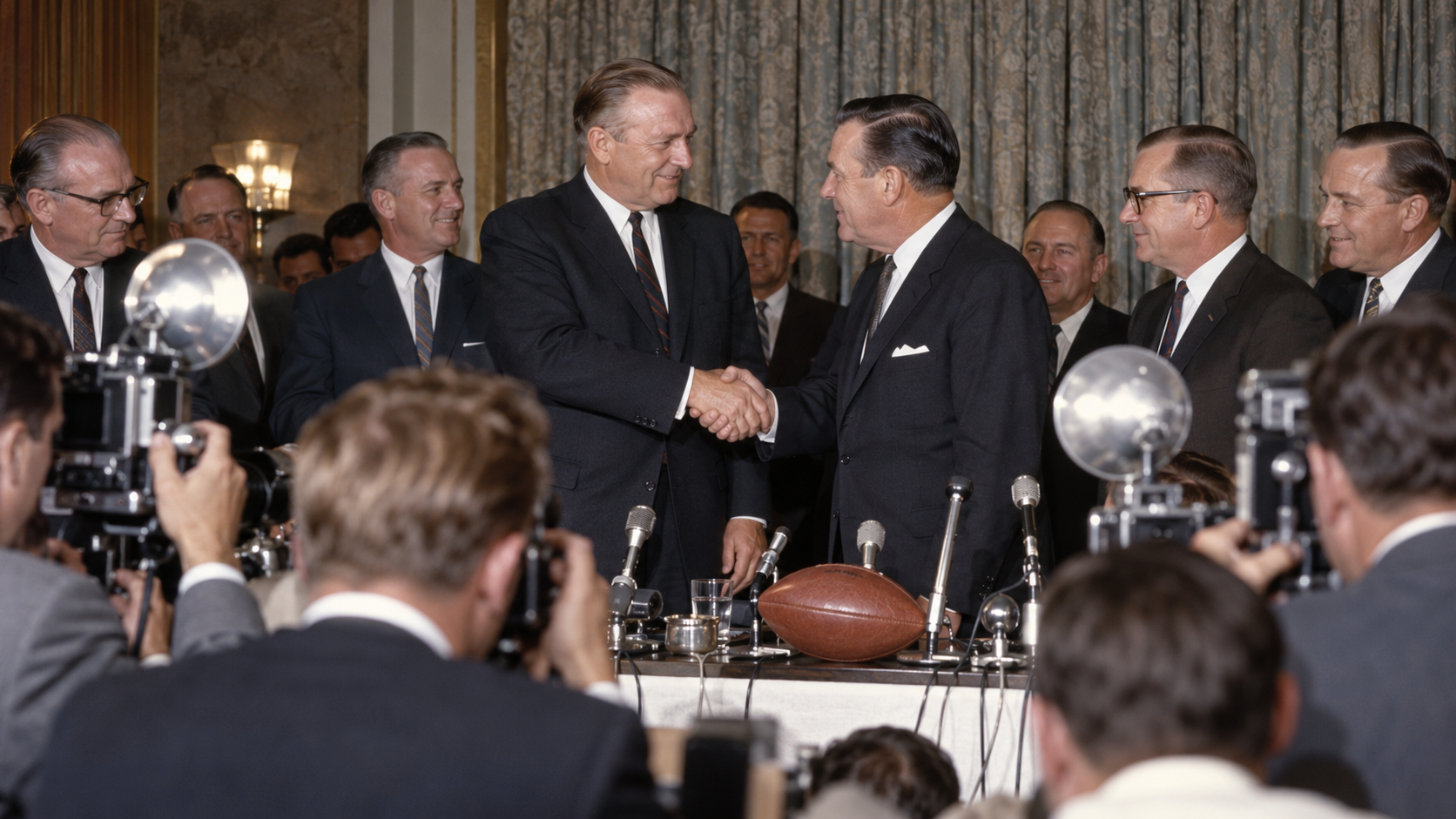
On This Day in Sports: June 8, 1966
On June 8, 1966, the American Football League and National Football League announced an agreement to merge. The rival leagues had spent years competing for players, television audiences and markets. Their settlement created a path toward one 24-team organization, a common college draft and an annual championship game between league winners. The public record fixes the central details with unusual clarity: The merger was announced on June 8, 1966. The combined structure included 24 teams. Together, those facts explain why June 8, 1966 stands apart from the ordinary flow of a season and deserves to be remembered as a distinct historical moment.
NFL commissioner Pete Rozelle retained leadership of the combined operation, while AFL founder Lamar Hunt and Dallas Cowboys general manager Tex Schramm were central negotiators. The leagues kept separate regular-season schedules for several years but stopped bidding against each other for draft choices, reducing the escalating financial pressure of their talent war. Two further details help reconstruct how the achievement unfolded: Pete Rozelle remained commissioner. The leagues adopted a common draft. They move the story beyond a headline by showing the pressure, setting and competitive choices that shaped the decisive action in real time.
The first AFL-NFL World Championship Game followed the 1966 season and was later renamed the Super Bowl. The New York Jets’ victory over Baltimore two years later proved the younger league could compete at the highest level. Full integration arrived in 1970 through the American and National Football Conferences. The wider context is equally important. An annual championship game was established. Full integration arrived in 1970. Those points connect one day’s performance to a longer career, institution or rivalry and clarify why the event continued to matter after the immediate celebration had ended.
The merger stabilized professional football and helped transform its championship into a dominant American cultural event. Expansion markets gained permanence, shared broadcasting grew more valuable and the combined league presented a clear national hierarchy. What began as a business truce reshaped the sport’s competitive map and created the institutional framework the NFL still uses. Seen from today, the milestone remains compelling because it joins a measurable result with the uncertainty of live competition. Nothing about the outcome was guaranteed beforehand. That combination of preparation, opportunity and execution is what transformed the date from another entry on the schedule into lasting sports history. It also reveals how records and championships depend on teammates, opponents, officials, venues and rules that shape the opportunity. Preserving those surrounding details helps explain both the achievement itself and the reason later generations still discuss it.
The merger was announced on June 8, 1966.
The combined structure included 24 teams.
Pete Rozelle remained commissioner.
The leagues adopted a common draft.
An annual championship game was established.
Full integration arrived in 1970.
Explore more "On This Day in Sports"
Discover more landmark games, records, championships, and turning points from sports history. Each day revisits the athletes, teams, and moments that shaped competition and culture.