

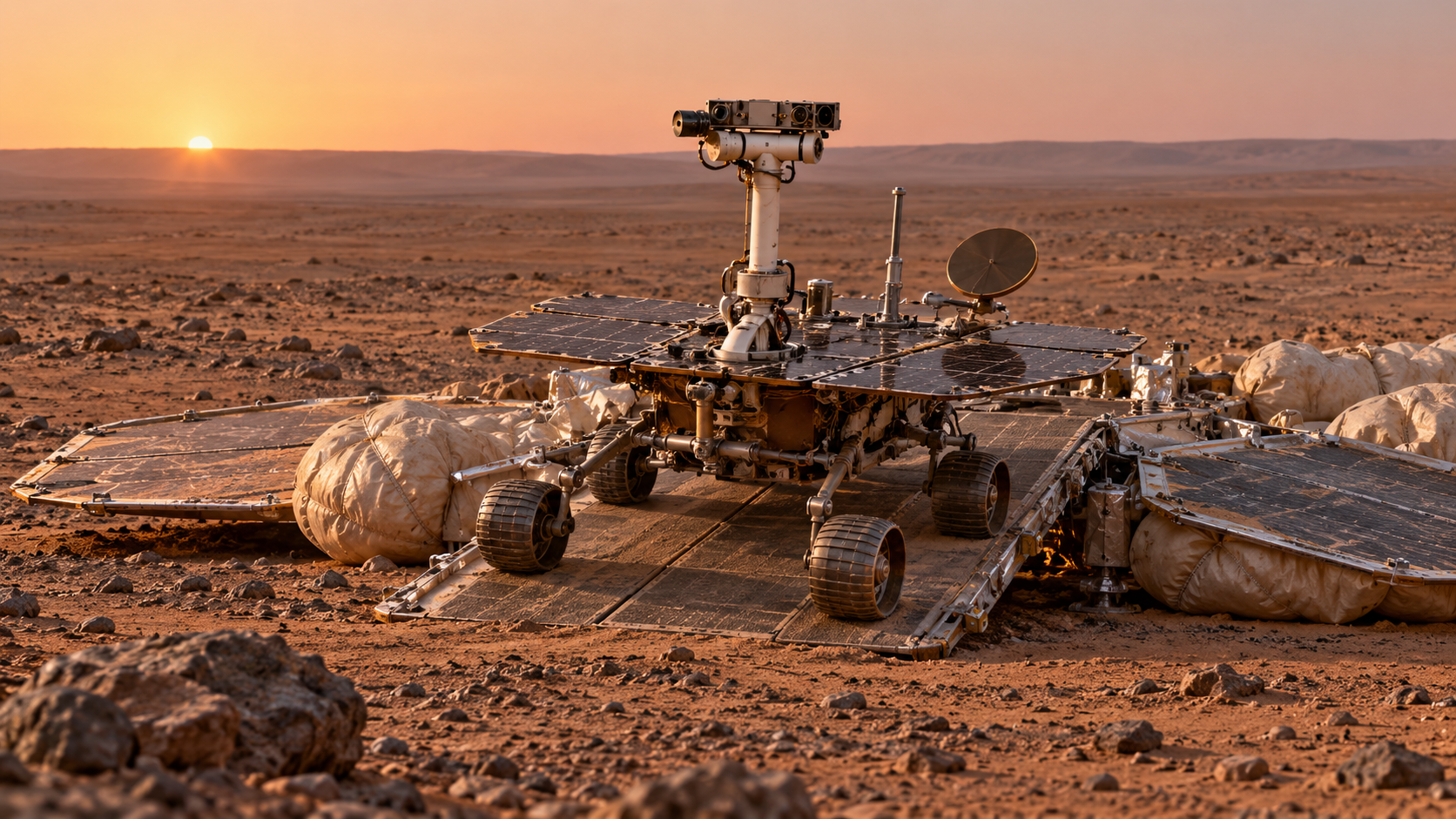
On This Day in Tech: January 25, 2004
On January 25, 2004, the unmanned rover Opportunity touched down on the Martian surface — a milestone moment in interplanetary exploration. The rover landed at Meridiani Planum, sending back its first images within hours. What was planned as a 90-day mission would extend into a remarkable 15-plus years, during which Opportunity travelled roughly 28 miles across the planet’s stark, dusty terrain.
From its first black-and-white thumbnails showing rocky outcroppings and portions of the lander, Opportunity provided the world with never-before-seen perspectives of Mars. Scientists and the public alike were captivated by those early images, which paved the way for new understandings of Martian geology, climate history, and the planet’s potential for having once harbored water. Over time, Opportunity uncovered evidence of ancient water activity — from mineral formations to rock layers suggestive of past watery environments — fueling hopes that Mars may once have been more habitable.
Beyond scientific discovery, Opportunity’s endurance was a testament to human engineering and ambition. Against a harsh landscape, extreme temperatures, dust storms, and technical constraints, the rover exceeded every expectation. Its longevity enabled extensive mapping of the Martian surface, long-term environmental monitoring, and public engagement with planetary science on a global scale. The mission’s success inspired subsequent Mars projects and helped reinforce the value of long-duration robotic explorers.
Even after decades of dreaming about Mars, Opportunity’s landing and mission still resonate. For many, January 25, 2004 stands as a defining moment in humanity’s expanding reach into space — a day when Mars felt just a little closer, and the unknown a bit more knowable.
On January 25, 2004, NASA's Opportunity rover successfully landed on Mars at Meridiani Planum. This event marked the beginning of an ambitious mission that would last over 15 years, far exceeding its initial 90-day expectations. Opportunity’s primary goal was to investigate the geology of Mars and determine whether the planet had ever been capable of supporting life.
After its successful landing, Opportunity sent back its first images of the Martian surface. These images, which included stunning panoramic views, sparked excitement among both the scientific community and the public. The rover's ability to survive for over 15 years and travel approximately 28 miles across the Martian terrain was a testament to the durability and innovation of NASA's engineering.
The Opportunity rover delivered a wealth of scientific data, including evidence of past water activity on Mars. Its discoveries included rock formations and mineral deposits that suggested ancient water flow, reshaping our understanding of Mars as a once potentially habitable planet. The mission helped lay the foundation for future exploration of Mars, particularly the search for life on the planet.
Opportunity’s success also highlighted the growing role of robotic exploration in space science. The rover's longevity and achievements proved that long-duration missions were viable and significantly advanced the field of planetary geology.
The Opportunity mission played a pivotal role in NASA's ongoing exploration of Mars, and its findings have informed subsequent missions, including the Curiosity and Perseverance rovers. Opportunity's success in detecting evidence of ancient water laid the groundwork for the Mars Science Laboratory's focus on the potential for life on the Red Planet.
Moreover, Opportunity’s extended mission demonstrated the effectiveness of autonomous rovers in harsh extraterrestrial environments. The knowledge gained continues to shape how scientists approach the exploration of distant planets and moons, not just in terms of geology but also in the search for life beyond Earth.
Explore more of "On This Day ..."
Discover more events from the same date across news, politics, technology, sports, and other fields. Each link highlights significant moments that shaped history on different fronts.