

On This Day in Tech: September 1, 1979
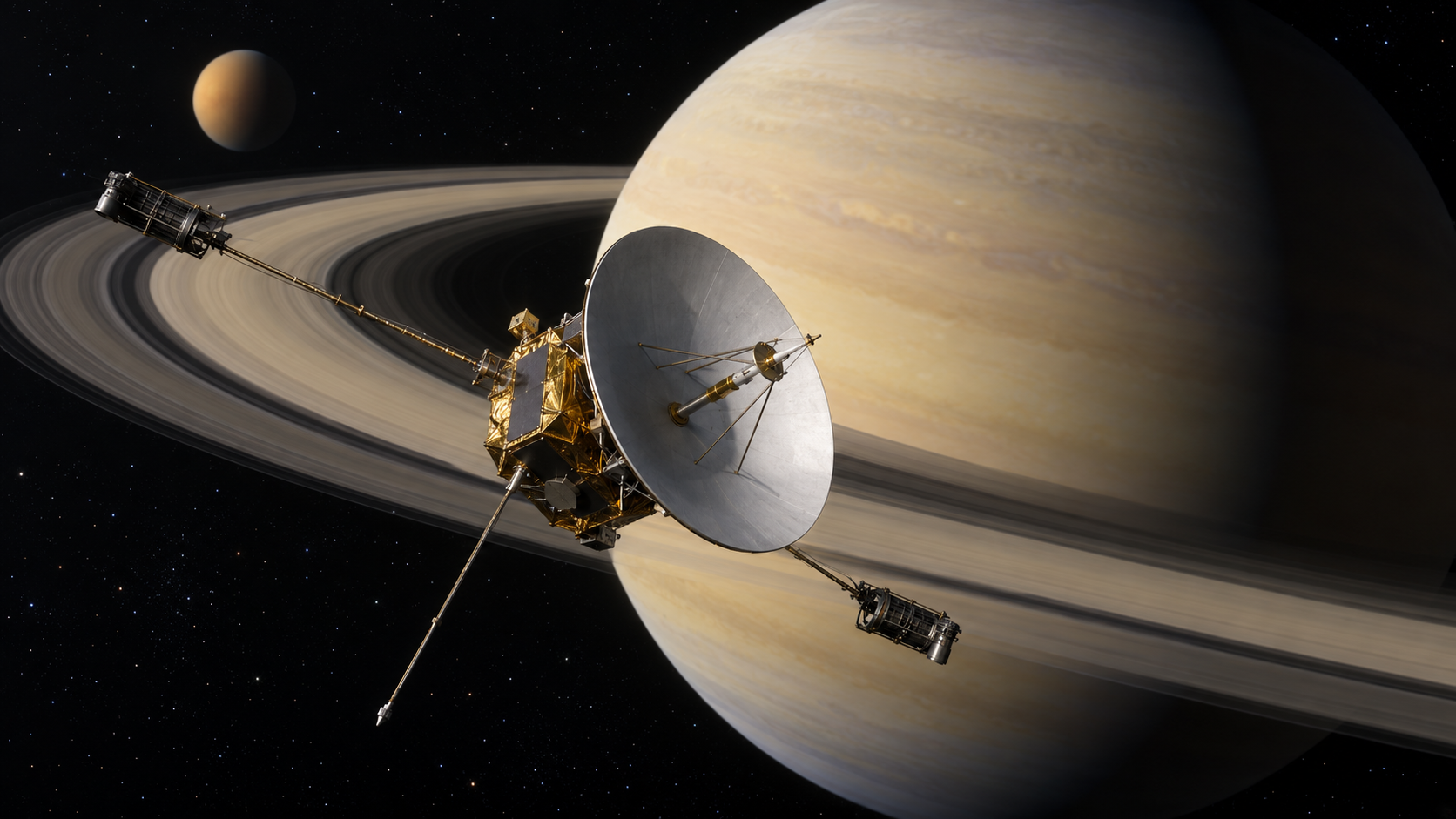
On September 1, 1979, NASA’s Pioneer 11 swept past Saturn and became the first spacecraft to examine the ringed planet at close range. Managed through NASA’s Ames Research Center with tracking and navigation support from the Jet Propulsion Laboratory, the probe passed about 13,000 miles above Saturn’s cloud tops while traveling roughly 71,000 miles per hour. That encounter turned a point of light studied from Earth into a world that could be measured directly. Pioneer 11 returned data about Saturn’s atmosphere, magnetic field, radiation environment, rings and moons, giving scientists their first in-place look at a planetary system more than a billion kilometers from Earth.
The spacecraft had not been built only for Saturn. Launched on April 6, 1973, Pioneer 11 first crossed the asteroid belt and reached Jupiter in December 1974. Controllers used Jupiter’s gravity to bend the spacecraft onto a path toward Saturn, a precise maneuver that also tested whether a probe could survive the giant planet’s intense radiation. Pioneer 11 carried a suite of compact instruments rather than a modern digital camera. Its spinning body and large dish antenna supported measurements from charged-particle detectors, magnetometers and an imaging photopolarimeter that assembled pictures line by line as the spacecraft rotated.
During the September 1 flyby, Pioneer 11 crossed Saturn’s ring plane and passed inside the orbit of several known moons. It sent back about 440 images during the encounter sequence and detected a narrow outer ring later called the F ring. The data also pointed to a previously unknown small moon and showed that Saturn possesses a strong magnetic field and radiation belts. Measurements of Titan helped establish that the large moon was extremely cold beneath its thick, hazy atmosphere. The route was scientifically productive but risky: before Pioneer arrived, engineers did not know how much dust and debris occupied the gaps around Saturn’s rings.
Pioneer 11’s observations were limited by the modest resolution and data rates of 1970s hardware, and some early interpretations required later confirmation. Voyager 1 and Voyager 2 returned far more detailed views of Saturn in 1980 and 1981, expanding the ring and moon discoveries that Pioneer had opened. Even so, the first encounter demonstrated that navigation through the outer solar system could be controlled across immense distances. The spacecraft continued outward after Saturn, and NASA maintained contact until 1995. Its September 1979 flyby remains a pathfinding achievement: a small probe reached an unfamiliar planetary system first, sampled its hazards and gave the missions behind it a clearer map.
Pioneer 11 began as a Jupiter mission, but Jupiter’s gravity redirected it toward Saturn. That gravity assist converted a successful planetary flyby into the first two-giant-planet trajectory attempted by a spacecraft.
The probe’s spinning design let a photopolarimeter scan narrow strips of a scene. Ground processing combined those measurements into images, a slower and lower-resolution method than the digital camera systems carried by later missions.
The flyby revealed the narrow F ring and evidence of a small moon while measuring Saturn’s magnetic and radiation environment. The findings gave planners their first direct assessment of conditions near the planet.
Pioneer 11’s limited transmitter, instruments and line-scanned images could not settle every question. Voyager’s later encounters supplied sharper pictures and additional measurements, refining several of Pioneer’s preliminary results.
The mission showed that gravity assists and precise deep-space navigation could connect encounters separated by years. Those techniques became essential tools for later exploration of the outer solar system.
After Saturn, Pioneer 11 traveled on an escape path from the Sun. Contact ended in 1995, but the probe’s first reconnaissance reduced uncertainty for the spacecraft that followed it.
Explore more of "On This Day ..."
Discover more events from the same date across news, politics, technology, sports, and other fields. Each link highlights significant moments that shaped history on different fronts.