

On This Day in Tech: September 8, 1888
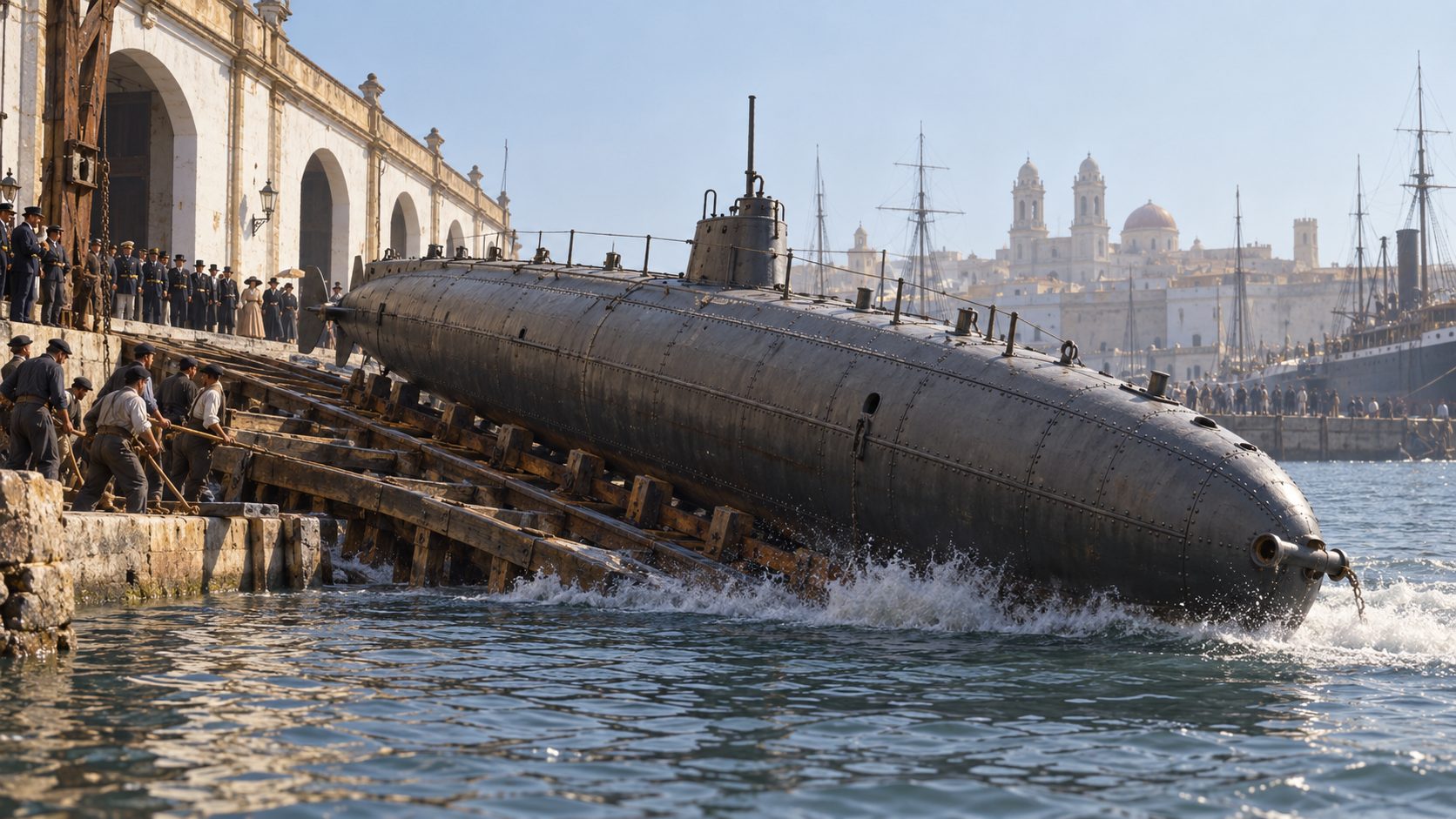
On September 8, 1888, the Spanish Navy launched Isaac Peral’s experimental submarine at the La Carraca naval arsenal near Cadiz. Its dark, riveted hull looked unlike the surface warships surrounding it: roughly 22 meters long, less than three meters across, and designed to operate without a smokestack or sails. Peral, a Spanish naval officer and engineer, intended the vessel to approach an enemy while submerged and attack with a torpedo. The launch placed a radical combination of electric power, underwater navigation, and purpose-built weaponry into the water as a single working craft.
The submarine carried large accumulator batteries that supplied three dynamos and two electric motors rated at about 30 horsepower each. Electric propulsion was especially suited to submerged travel because it consumed no air and produced no exhaust inside the hull. Peral also integrated a torpedo tube, a periscope-like optical system, a compensated magnetic compass, and mechanisms intended to control depth and trim. Individually, many of these ideas had precedents. What made the craft exceptional was the attempt to combine them into a practical military system rather than a short-lived diving demonstration.
Launching was only the beginning. Trials conducted in 1889 and 1890 examined the submarine’s handling, speed, endurance, underwater control, and ability to fire a torpedo. Batteries imposed strict limits, and the compact hull left little room for crew or machinery, but the vessel proved that electric motors could move a sizable submarine silently beneath the surface. During submerged runs, the crew also had to balance buoyancy, heading, visibility, and battery use at the same time, turning each trial into a test of the whole system rather than one isolated device. Its form anticipated the logic of later undersea craft: a streamlined pressure hull, stored electrical energy, controlled ballast, an optical view above the water, and a weapon aligned with the boat’s direction of travel.
Spain did not turn Peral’s prototype into an operational fleet, and the project ended despite promising tests. Submarine development continued elsewhere through different designs, especially boats that used engines on the surface and batteries underwater. That later pattern should not obscure the importance of the 1888 launch. Peral’s boat demonstrated, years before submarines became standard naval weapons, that electric propulsion could support a coordinated underwater combat system. Preserved today as a museum artifact, the vessel is a reminder that transformative machines are often assembled from technologies that already exist. The breakthrough comes from making those parts work together in a new environment.
Accumulator batteries supplied the submarine’s electrical system, including two propulsion motors of about 30 horsepower each. Electric power let the boat travel underwater without using air or filling the hull with engine exhaust.
Battery weight and limited capacity restricted range and endurance. Even so, the trials showed that stored electricity could propel a substantial military submarine beneath the surface.
The vessel combined electric propulsion with a torpedo tube, underwater viewing equipment, a compensated compass, and systems for managing depth and trim. It treated the submarine as an integrated weapons platform.
Its streamlined hull and quiet motors also anticipated features that became fundamental to later submarines, even though later boats adopted different arrangements for longer range.
No production class followed the prototype. The program ended after the 1889–1890 trials, amid technical limits, institutional disagreement, and changing naval priorities.
The original craft survived and is preserved in Cartagena, Spain. It remains one of the clearest physical records of late-19th-century electric submarine engineering.
Explore more of "On This Day ..."
Discover more events from the same date across news, politics, technology, sports, and other fields. Each link highlights significant moments that shaped history on different fronts.