

On This Day in Tech: September 25, 1956
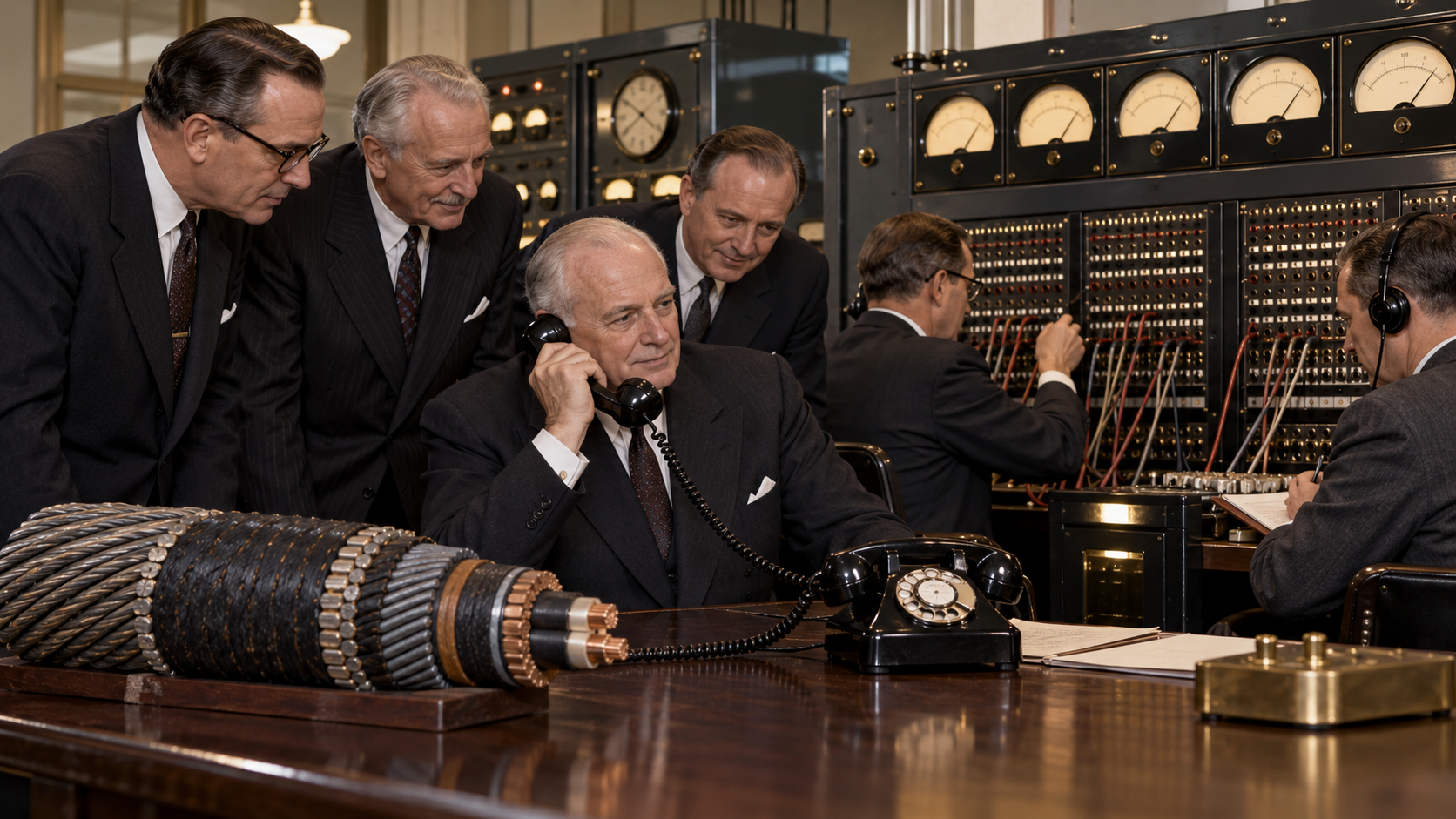
On September 25, 1956, officials in New York, Ottawa, and London joined an inaugural call carried by TAT-1, the first telephone cable to cross the Atlantic Ocean. The event connected North America and Europe through a physical voice circuit beneath the sea rather than through shortwave radio. For callers, that distinction mattered. Radio links could fade, suffer atmospheric interference, and vary with time and weather. A cable promised a steadier, clearer connection and helped make an international conversation feel less like an experiment and more like a dependable service.
TAT-1 was a joint undertaking involving AT&T, the British Post Office, and the Canadian Overseas Telecommunication Corporation. Two coaxial cables, one for each direction of transmission, ran between Scotland and Newfoundland, with additional connections carrying traffic onward. Repeaters placed at intervals along the seabed amplified the signal across the immense distance. The system initially provided 36 simultaneous telephone channels. Engineers also had to manage the pressure, corrosion, and mechanical strain of laying cable over a varied seabed. That number seems tiny beside modern fiber-optic capacity, but in 1956 it represented a major engineering achievement: durable electronics and cable had to operate for years in deep water where repairs were difficult and expensive.
The cable did not make transatlantic calling ordinary or inexpensive overnight. Capacity remained scarce, calls were carefully routed, and international service was still beyond the casual reach of many households. Yet the improvement in consistency was immediately valuable to governments, news organizations, businesses, and families separated by the ocean. It also reduced the need to wait for a radio channel with favorable conditions. TAT-1 demonstrated that submerged repeaters and long coaxial systems could support reliable intercontinental communication. Engineers could now build on operating experience rather than rely only on laboratory tests and shorter routes.
TAT-1 began a new phase in global communications infrastructure. Later cables added channels and improved transmission, while satellites introduced another path across oceans. Each generation depended on specialized cable ships, careful route surveys, shore stations, and international cooperation. Fiber-optic systems eventually transformed the scale entirely, carrying vast streams of calls, messages, video, and Internet data. The materials and electronics changed, but the strategic idea remained: invest in resilient physical links that make distant communication routine. The ceremonial three-way conversation of September 25 marked the moment a cable under the Atlantic became a working public bridge, setting a precedent for the dense undersea networks that now connect continents.
Before TAT-1, transatlantic telephone calls depended largely on radio, which could fade or suffer atmospheric interference. Engineers sought a physical route that would deliver steadier voice quality across the ocean.
On September 25, 1956, officials in New York, Ottawa, and London participated in an inaugural call over the new cable system. The event opened the first direct transatlantic telephone cable service.
TAT-1 used two coaxial cables, one for each direction, and submerged repeaters to strengthen signals along the route. Its 36 voice channels were limited but significantly more dependable than the available radio links.
Governments, businesses, news organizations, and families gained a clearer connection between North America and Europe. Scarce capacity and high cost still prevented international calls from becoming casual everyday purchases.
The project proved that complex amplified cable systems could survive and operate across an ocean. Later coaxial cables expanded capacity, and their operating experience informed future undersea engineering.
Modern fiber-optic cables carry enormously more traffic, including most intercontinental Internet data. TAT-1 established the enduring model of a resilient physical communications bridge beneath the sea.
Explore more of "On This Day ..."
Discover more events from the same date across news, politics, technology, sports, and other fields. Each link highlights significant moments that shaped history on different fronts.