

On This Day in Tech: October 3, 1950
On October 3, 1950, the U.S. Patent Office issued Patent 2,524,035 to John Bardeen and Walter Brattain for a three-electrode circuit element using semiconductive material. Assigned to Bell Telephone Laboratories, the document described the operating principles and construction of the point-contact transistor they had developed. The application had been filed on June 17, 1948, following their breakthrough at Bell Labs the previous December. Although the patent title did not use the still-new word transistor, it protected a device that could amplify or switch electrical signals without the heated cathode required by a vacuum tube.
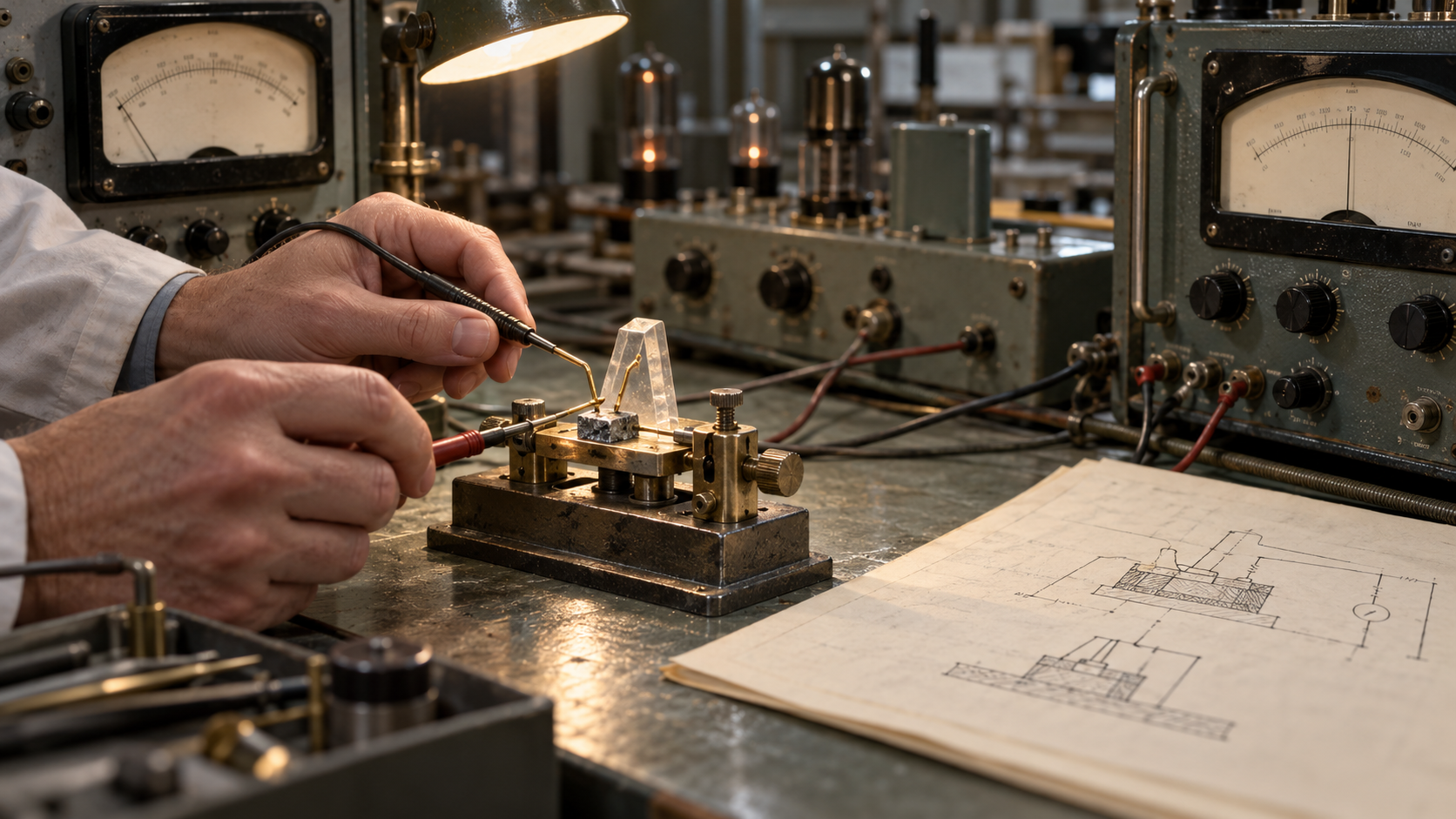
The patented device grew from an effort to find a smaller and more reliable replacement for fragile, power-hungry tubes in telephone equipment. Bardeen’s work on the behavior of electrons at a semiconductor surface helped explain why earlier field-effect experiments had failed. Brattain then devised practical tests using germanium. In December 1947, the pair pressed two closely spaced gold contacts against a small slab of high-purity germanium. Changing the electrical condition at one contact altered the current at the other, producing useful amplification. Bell Labs demonstrated the result internally and announced it publicly in June 1948.
Patent 2,524,035 presented several configurations, but the central idea was a compact solid-state element with three connections. The invention could respond immediately when powered, operate without a glowing filament, and be made far smaller than a comparable vacuum-tube circuit. The first point-contact units were delicate and demanding to manufacture, so they did not become the final form used in most electronics. William Shockley’s junction transistor, conceived soon afterward, offered a more robust path to mass production. Together, the inventions showed that semiconductor crystals could perform the essential jobs of amplification and electronic switching.
The patent grant did not create the transistor industry overnight, yet it formalized one of the foundational ideas of modern electronics. During the 1950s, improved materials and manufacturing methods made transistors reliable enough for radios, telephone systems, military equipment, and computers. Engineers later combined many transistors on integrated circuits, driving dramatic reductions in size, cost, and power consumption. That scaling also transformed communications, scientific instruments, industrial controls, and information processing. Modern processors contain billions of transistor structures, radically different in scale from Bardeen and Brattain’s bench-top device but connected to the same principle: carefully controlled semiconductor regions can direct electrical current. The October 1950 patent stands as a legal and technical record of that transition away from the vacuum-tube era.
Bell Labs wanted a compact, durable alternative to vacuum tubes used for telephone amplification. John Bardeen and Walter Brattain focused on how electrical charges behaved at semiconductor surfaces.
On October 3, 1950, U.S. Patent 2,524,035 was granted for their three-electrode semiconductor circuit element, based on an application filed in June 1948.
The point-contact device used two gold contacts placed close together on germanium. A signal at one contact controlled current at the other, producing electronic amplification.
Unlike a vacuum tube, the transistor needed no heated cathode and responded immediately. Early point-contact models were delicate, but they proved that solid-state amplification was practical.
More manufacturable junction transistors followed, allowing solid-state components to spread through radios, communications equipment, and computers during the 1950s.
Integrated circuits later placed many transistors on one chip. Today's processors use billions, linking modern computing to the semiconductor control principle recorded in the 1950 patent.
Explore more of "On This Day ..."
Discover more events from the same date across news, politics, technology, sports, and other fields. Each link highlights significant moments that shaped history on different fronts.