

Computer Vision Explainer
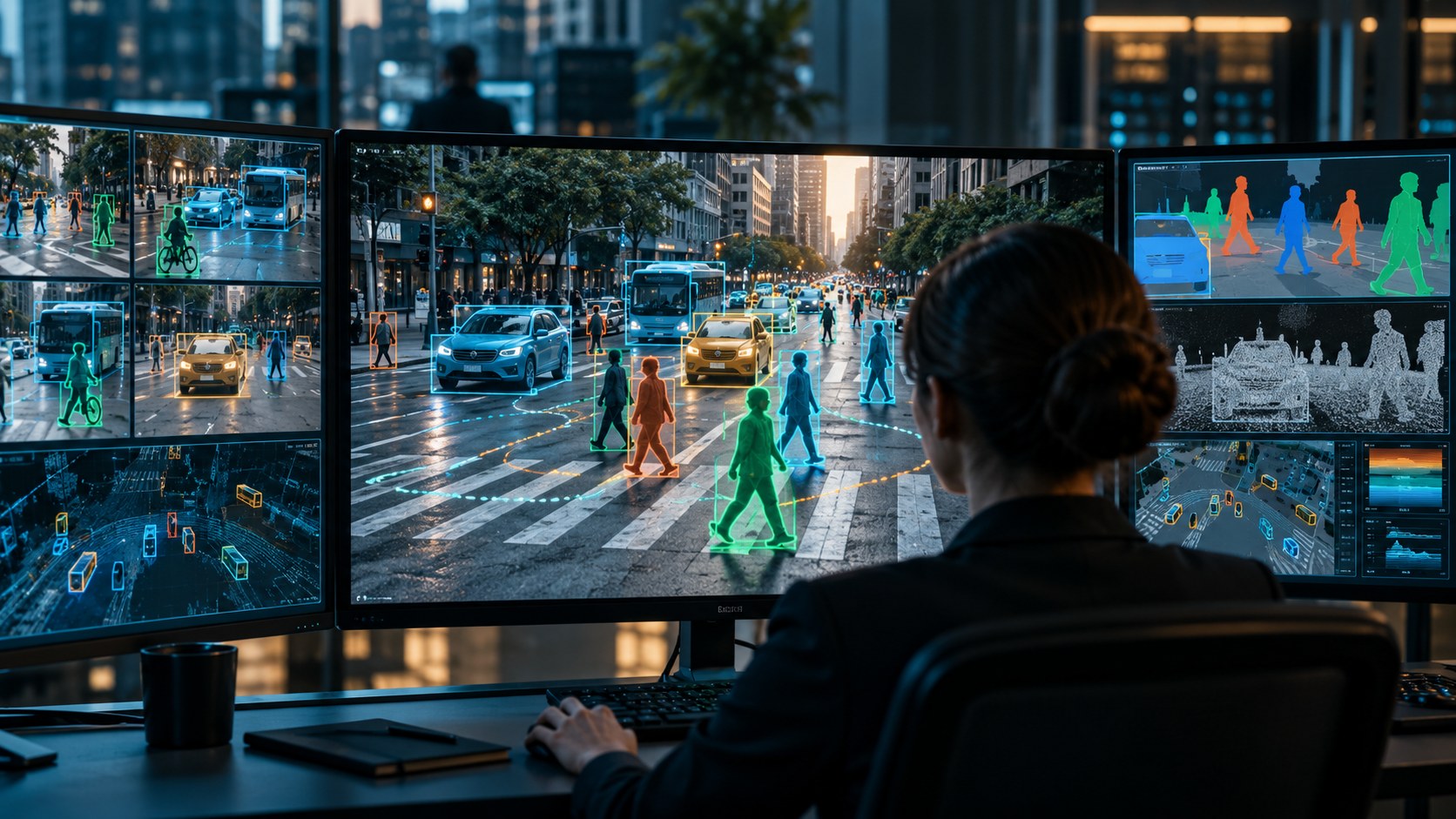
Computer vision is the field of building systems that extract useful information from images and video. A vision system might classify an entire image, locate objects, divide pixels into meaningful regions, read text, estimate motion, or track an object across frames.
The pipeline begins with pixels, which may be resized, normalized, cropped, or otherwise prepared. A trained model converts visual patterns into features and outputs scores, boxes, masks, landmarks, or text. Modern systems often use convolutional networks, vision transformers, or multimodal models.
Computer vision supports medical imaging, manufacturing inspection, accessibility, mapping, agriculture, security, and consumer photography. Its accuracy depends on the camera, lighting, viewpoint, resolution, labels, and how closely deployment conditions match the training data.
A high benchmark score can hide uneven performance. Systems may fail on underrepresented skin tones, unusual weather, rare objects, adversarial patterns, or scenes with occlusion. Visual data can also reveal identities and private surroundings. Use requires representative testing, privacy limits, human review, and clear rules about uncertainty.
Computer vision uses algorithms and machine learning to extract useful information from images and video.
Key terms include computer vision, image classification, object detection, segmentation, optical character recognition, feature, bounding box, confidence score and tracking.
<a href="https://developers.google.com/edge/mediapipe/solutions/vision/image_classifier" target="_blank" rel="noopener noreferrer">Google AI Edge: Image Classifier</a> and <a href="https://cloud.google.com/vision/docs" target="_blank" rel="noopener noreferrer">Google Cloud Vision Documentation</a> provide the primary references for this explainer.
Classification labels a whole image, detection adds locations, segmentation labels pixels, and tracking follows objects across video frames.
Each task needs suitable training labels and evaluation metrics; success on one does not imply success on the others.
Lighting, angle, blur, occlusion, camera quality, rare cases, and biased training samples can all change performance.
High-stakes vision should expose confidence, preserve audit trails, protect privacy, and give qualified people authority to override the system.
Explore more "Explainers"
Discover additional explainers across politics, science, business, technology, and other fields. Each explainer breaks down a complex idea into clear, everyday language—helping you better understand how major concepts, systems, and debates shape the world around us.