

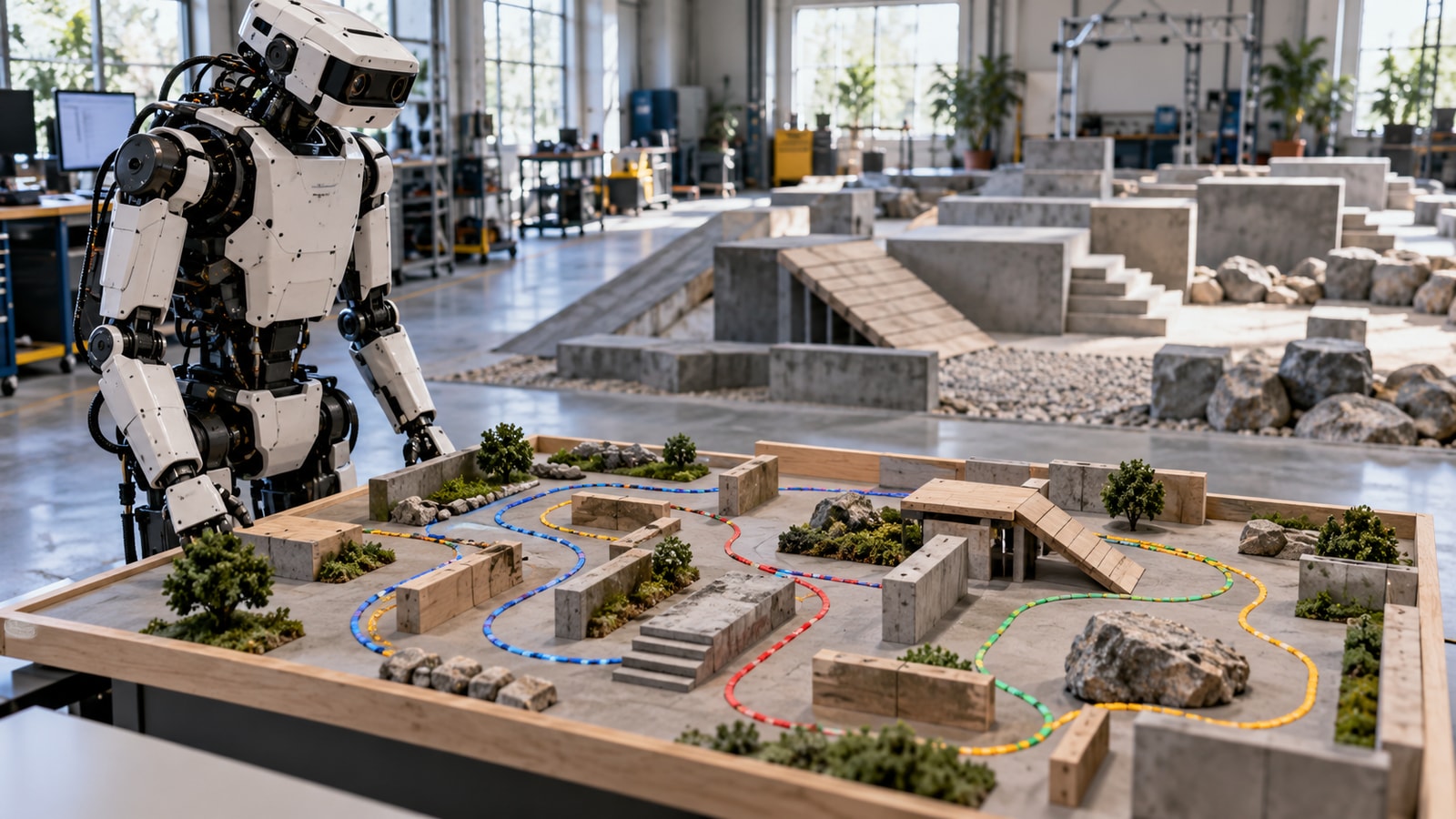
Model-Based Reinforcement Learning Explainer
Model-based reinforcement learning uses an environment model to support an agent’s decisions. The model may be provided in advance or learned from experience, and it predicts how states, rewards, or observations change after actions.
The agent can plan by searching possible action sequences, optimize behavior through imagined trajectories, or generate simulated experience for a separate policy or value function. Real observations are used to correct the model and guide future data collection.
Because each real interaction can inform many simulated trials, model-based methods may be more data-efficient than purely model-free learning. That advantage matters when physical experiments are slow, expensive, dangerous, or limited by equipment.
Incorrect dynamics can make planning confidently wrong, especially over long horizons. Systems manage this with uncertainty estimates, short model rollouts, ensembles, conservative objectives, and repeated comparison between simulated predictions and real outcomes.
Model-based reinforcement learning uses a known or learned environment model to predict outcomes and improve decisions.
Key terms include environment model, dynamics, planning, policy, value function, imagined trajectory, sample efficiency and model bias.
A dynamics model turns experience into predictions about possible future actions.
Planning or simulated training then uses those predictions to improve the policy.
Small inaccuracies can push a long simulated trajectory far from reality.
Short rollouts, uncertainty-aware planning, and regular real-world checks reduce model bias.
Explore more "Explainers"
Discover additional explainers across politics, science, business, technology, and other fields. Each explainer breaks down a complex idea into clear, everyday language—helping you better understand how major concepts, systems, and debates shape the world around us.