

Audiometry Explainer
Audiometry measures how well a person hears sounds at different pitches and loudness levels. It helps establish whether hearing loss is present, how much hearing is affected and what pattern it follows. The results can guide further assessment and treatment. It is more informative than simply deciding whether someone can hear a loud noise. A person may hear certain tones clearly yet struggle to understand conversation, especially when several people are talking or there is background noise.
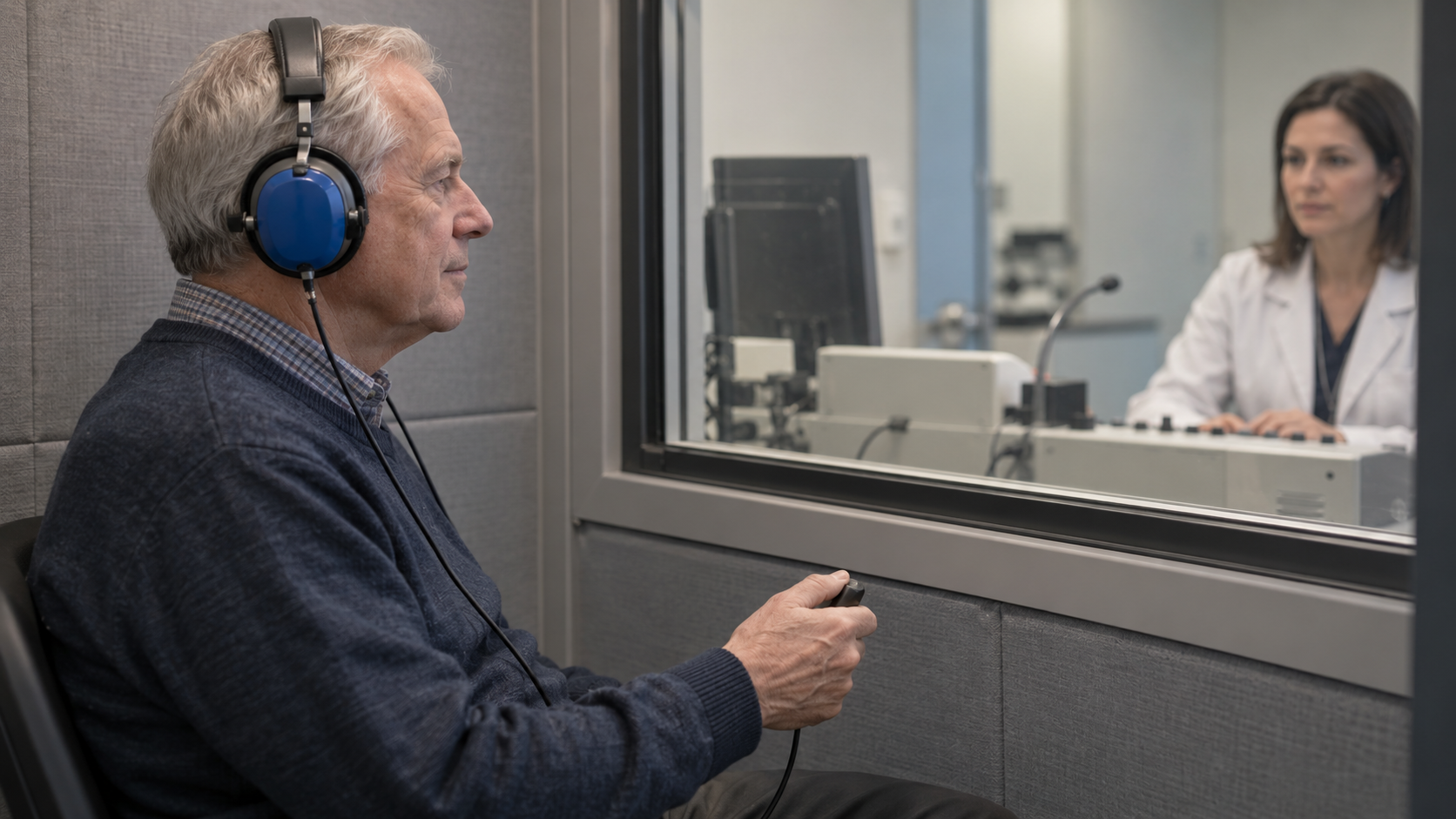
During a pure-tone test, headphones deliver sounds to each ear separately. The person signals when a tone is heard, often by pressing a button. The quietest levels detected at different pitches are recorded on an audiogram. Other tests may assess understanding of spoken words or compare hearing through the ear canal with hearing through vibrations conducted by bone. These parts of the assessment supply different clues, helping distinguish a hearing difficulty from its likely location and practical effect.
Hearing problems can arise when sound is blocked or reduced in the outer or middle ear, or when the inner ear or auditory nerve is affected. Some people have a combination. A hearing assessment can help identify those patterns, while an examination and other tests may be needed to find the cause. Treatment is therefore not automatically a hearing aid. A blockage or another treatable medical problem may require a different approach from long-term hearing loss.
Sudden hearing loss needs immediate medical assessment, particularly when it develops in one ear over hours or a few days. It may be accompanied by fullness, ringing or dizziness, and can be mistaken for earwax or congestion. Do not wait for a routine hearing appointment or try to prove the problem with repeated online tests. Prompt diagnosis and treatment can matter to the outcome. Audiometry helps measure the change, but the first step is seeking urgent care.
An audiologist will ask about symptoms, noise exposure and relevant medical history. Formal testing usually takes place in a quiet or sound-treated setting, with instructions explained before the sounds begin. Respond when you hear the sound rather than guessing a pattern. Tell the examiner if equipment feels uncomfortable or instructions are unclear so the measurement reflects your hearing as accurately as possible.
A speech test checks more than the ability to detect a tone. It may ask you to repeat words presented at different levels or with competing sound. A bone-conduction device can supply additional information about the path sound takes to the inner ear. Together, these tests help explain why someone may manage a quiet conversation yet find a busy room much harder.
An audiogram charts hearing thresholds across frequencies and distinguishes the ears. It provides useful detail, but the numbers need explanation in relation to symptoms and everyday communication. Ask which sounds are affected, whether further medical assessment is needed and what options fit the findings. A test result should support a practical plan rather than leave someone with a chart they cannot interpret.
Age-related hearing loss often develops gradually in both ears. People may start turning up the television or feel that others mumble before recognizing a hearing change. Assessment can identify the extent of the problem and discuss devices or communication strategies. Gradual loss should not be treated as a reason to abandon help, and a sudden change should not be assumed to follow the same harmless timetable.
Hearing loss can make conversation, safety warnings and medical instructions more difficult. Hearing aids, other assistive devices and communication adjustments may help depending on the findings. Family members can reduce background noise, face the person speaking and avoid talking from another room. Those simple measures support understanding while the person explores treatment, and they remain useful even after a device is fitted.
Protect hearing from damaging noise by reducing exposure and using suitable ear protection when needed. Testing can document a problem, but it cannot undo every injury. Mention workplace or recreational noise and any sudden change at the appointment. If symptoms are complex or one ear behaves differently, ask whether specialist assessment is appropriate. The aim is useful communication and timely care, not just a better score on a tone test.
Explore more "Explainers"
Discover additional explainers across politics, science, business, technology, and other fields. Each explainer breaks down a complex idea into clear, everyday language—helping you better understand how major concepts, systems, and debates shape the world around us.