

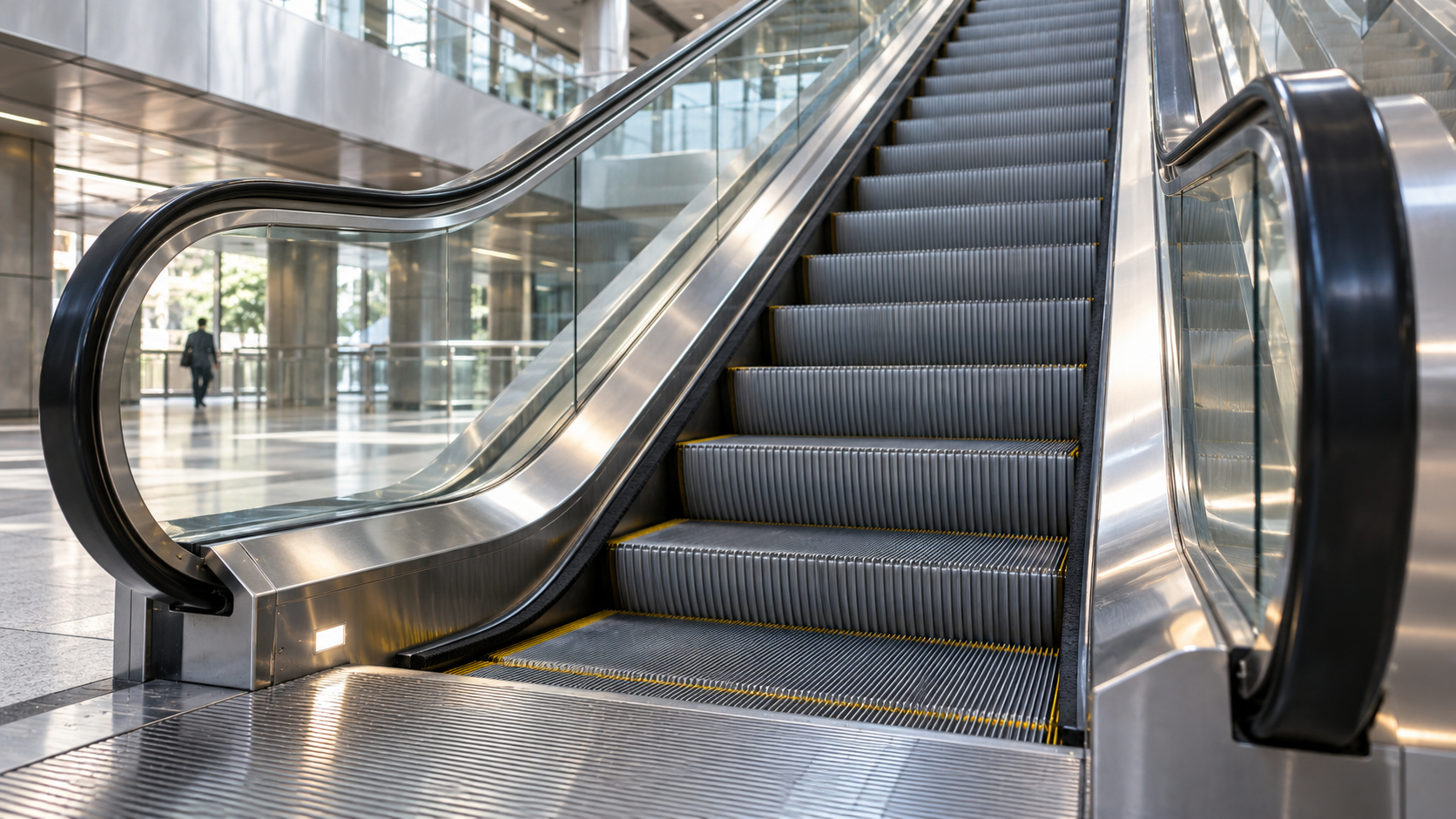
Escalator Step-Chain Explainer
An escalator is a continuous loop of rigid steps connected near their sides to two synchronized step chains. An electric motor and reduction gearbox turn drive sprockets at the upper landing. Those sprockets pull the chains and attached steps up the incline while returning them underneath the visible staircase. Each step rides on wheels that follow fixed guide tracks. The shape and spacing of the tracks control the step’s orientation throughout the circuit.
On the incline, front and rear step wheels run on separated tracks, keeping every tread approximately horizontal while the risers form a moving staircase. Near each landing, the tracks converge so adjacent steps flatten into a short moving platform. The treads then pass beneath a toothed comb plate whose fingers fit the step grooves. After disappearing under the landing, the steps rotate around a sprocket and travel back through the enclosed truss.
The handrail is its own endless belt. A drive system couples it to the escalator so it travels close to step speed, giving riders a stable moving grip. Rollers guide it around the balustrade and through the return path. Small speed differences, contamination, wear, or poor tension can make a handrail lag. Maintenance personnel inspect the belt, step rollers, chains, bearings, drive components, and lubrication points before misalignment becomes a passenger hazard.
Multiple safety devices monitor operation. A service brake stops the drive when power is removed or a fault is detected, and additional brakes may guard against unintended movement. Sensors can detect excessive speed, chain problems, missing or displaced steps, handrail issues, and obstructions near the comb plate. Skirt brushes and narrow clearances discourage feet and objects from approaching the step sides, but they do not remove the need for attentive riding.
Passengers should face forward, hold the handrail, keep footwear and loose clothing away from the sides, and step off promptly at the landing. Strollers, carts, wheelchairs, and large luggage belong in an elevator because wheels can lodge at transitions and loads can destabilize riders. The emergency stop button is for an immediate safety problem, not convenience. Children need close supervision and should not sit, play, or ride the handrail.
An escalator’s steps never pile up at the top because the visible staircase is only one segment of a closed mechanical path. The tracks create level treads on the incline, flatten them for boarding, and steer them through the hidden return. Chains provide coordinated motion, the motor supplies energy, and brakes and sensors supervise the system. What appears to be a staircase emerging from the floor is a precisely guided conveyor built from interlocking platforms.
Motor-driven chains pull linked steps whose front and rear wheels follow shaped tracks. The tracks form level treads on the incline and flatten them at landings. Key terms include truss, step chain, sprocket, guide track, comb plate, handrail, brake, and sensor.
The front and rear wheel tracks converge near the landing, bringing adjacent steps to the same height before they pass under the comb plate.
Their wheels and loads can catch at comb plates or side gaps, block the landing, or destabilize a rider on moving steps.
Explore more "Explainers"
Discover additional explainers across politics, science, business, technology, and other fields. Each explainer breaks down a complex idea into clear, everyday language—helping you better understand how major concepts, systems, and debates shape the world around us.