

Automatic Watch Winding Explainer
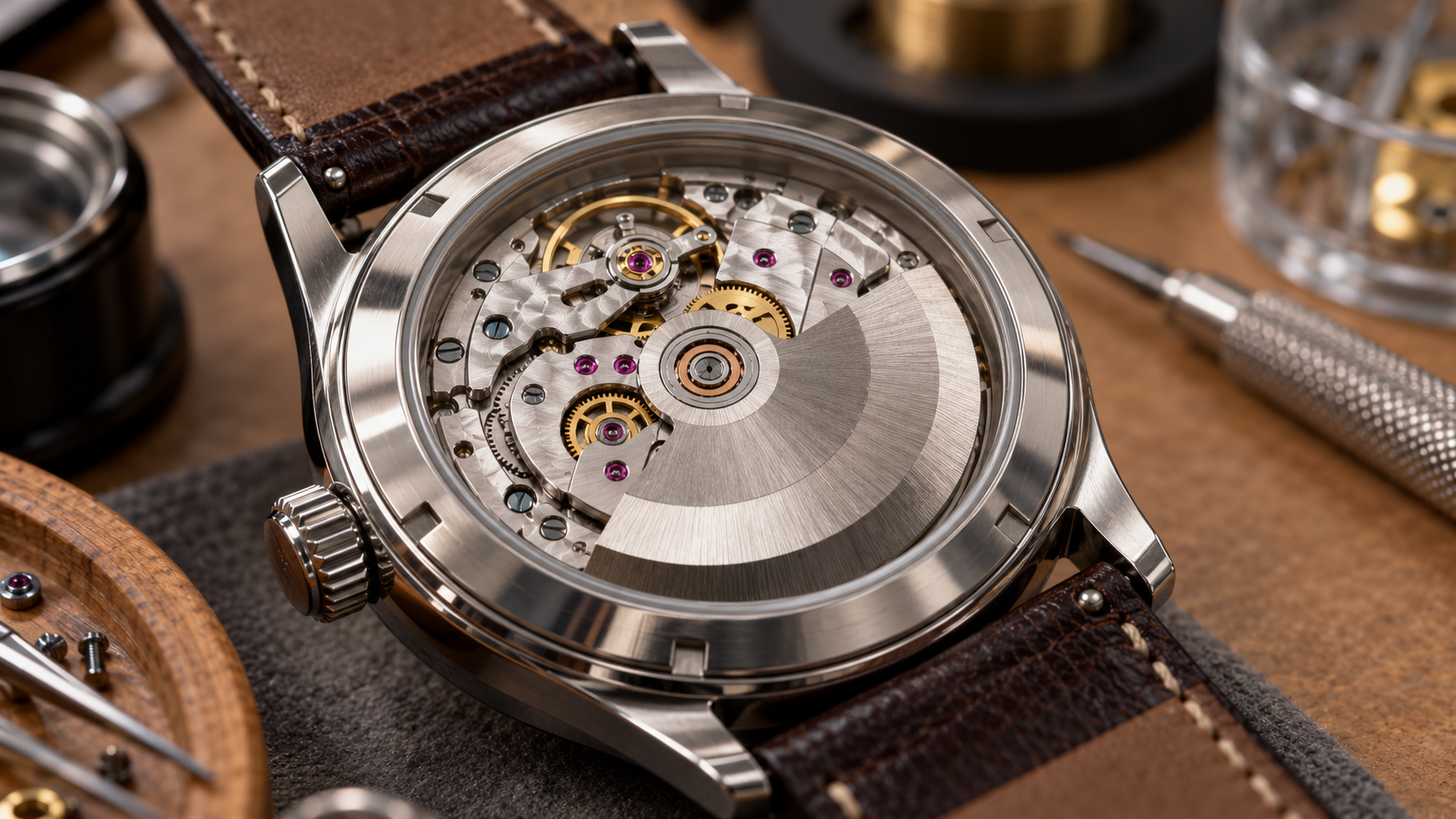
An automatic mechanical watch is powered by a coiled mainspring but uses ordinary wrist motion to keep that spring wound. A semicircular weight called the rotor pivots freely around the movement. When the case changes direction, inertia makes the rotor lag or swing relative to it. A winding train captures that rotation, reduces its speed, and turns the arbor or barrel mechanism that tightens the mainspring. The stored spring energy then runs the watch when the wrist is still.
Different movements wind in one rotor direction or both. Reverser wheels and clutches can redirect clockwise and counterclockwise rotor motion into one useful winding direction while allowing parts to freewheel when appropriate. Reduction gearing trades rotor travel for the higher torque needed at the mainspring. The rotor may spin through a full circle or sweep between stops. Its mass is concentrated near the outer edge so modest wrist movements produce useful rotational energy.
The mainspring does not drive the hands directly. It turns a barrel and gear train that delivers torque to the escapement. At each oscillation of the balance wheel, the escapement releases a small, measured step of gear motion. The balance and its hairspring set the pace, while the gear ratios convert those steps into seconds, minutes, and hours. Automatic winding supplies energy; the same regulating system used by a hand-wound mechanical watch controls timekeeping.
Most modern automatic barrels use a slipping bridle at the outer end of the mainspring. When winding reaches a designed level, the bridle slides along the barrel wall instead of letting the spring tighten without limit. This means normal wear does not “overwind” a healthy movement, though continuous high-speed winding devices should still follow watch guidance. The available running time from a fully wound spring is the power reserve and varies substantially among designs.
A watch can stop if it receives too little motion, even when worn, because desk work may not replace all the energy consumed. Many models can be started with manual crown winding; vigorous shaking is unnecessary and can add shock. Rate accuracy depends on position, temperature, magnetism, lubrication, wear, and balance adjustment. The rotor can also reveal trouble through scraping, unusual noise, or a loose sensation, all of which deserve professional inspection.
Automatic winding is best viewed as energy harvesting at human scale. The wearer’s changing motion moves a weighted rotor, gears rectify and reduce that movement, and the mainspring stores it for gradual use. No battery is needed, but the mechanism is not a perpetual-motion machine: if the watch rests long enough, friction and the escapement consume the reserve and it stops. Regular motion simply replenishes what the movement continuously spends.
Wrist motion swings a weighted rotor. Reversing and reduction gears use that rotation to wind the mainspring, which powers the movement. Key terms include rotor, inertia, reverser, winding train, mainspring, barrel, slipping bridle, escapement, and power reserve.
A typical modern automatic barrel uses a slipping bridle that slides once the spring reaches its designed winding level, preventing unlimited tightening.
Very low wrist activity may add less energy than the movement consumes. Power reserve, movement efficiency, condition, and daily motion all matter.
Explore more "Explainers"
Discover additional explainers across politics, science, business, technology, and other fields. Each explainer breaks down a complex idea into clear, everyday language—helping you better understand how major concepts, systems, and debates shape the world around us.