

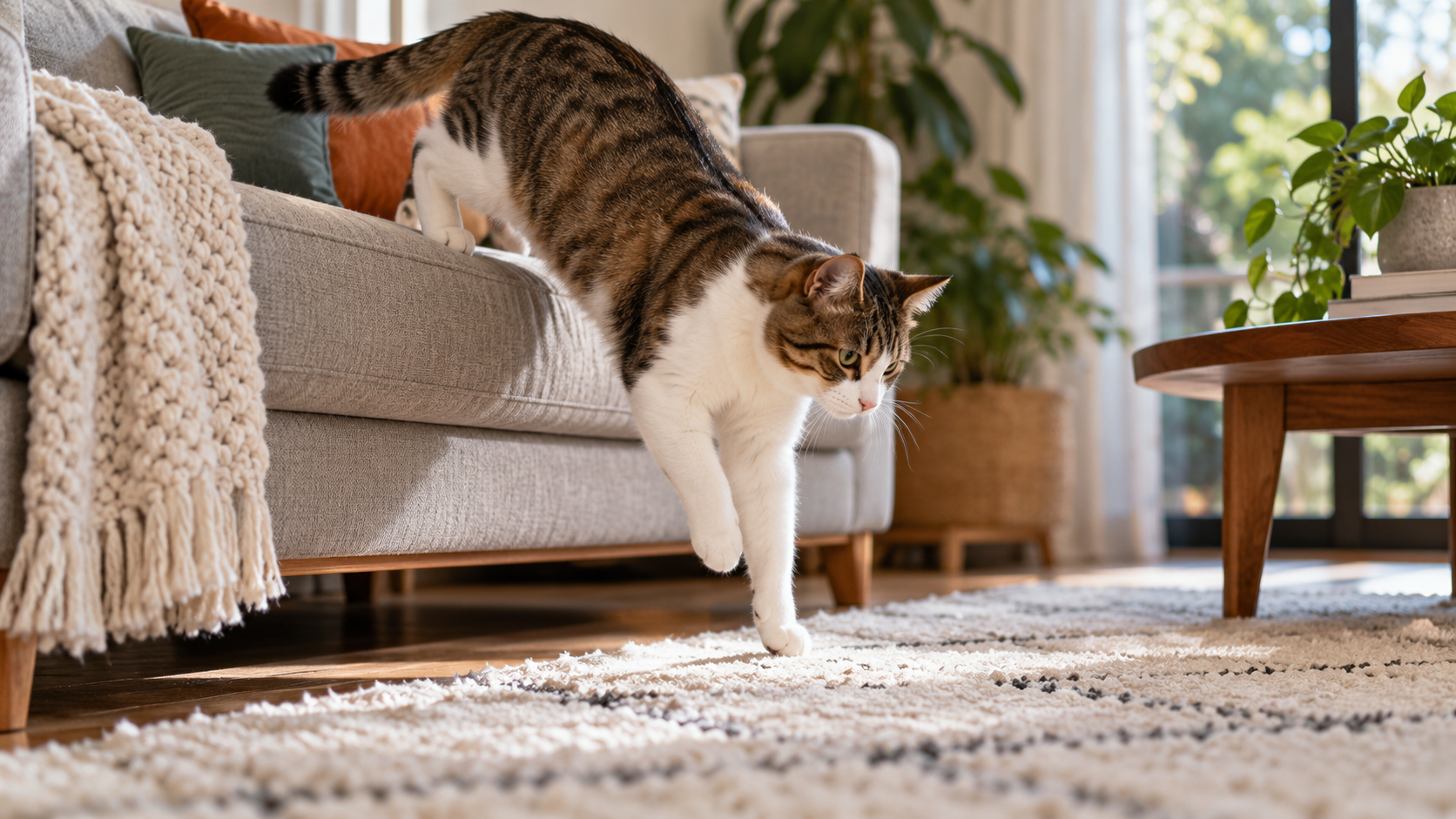
Cat Righting Reflex Explainer
A cat’s aerial righting reflex is a rapid sequence that helps orient its feet toward the ground after an unexpected fall. The vestibular organs of the inner ear and visual cues tell the nervous system which way is up. The cat bends its flexible spine so the front and rear halves can rotate somewhat independently. It then changes the rotational inertia of each half by tucking one pair of legs and extending the other, allowing different amounts of turning.
The maneuver obeys conservation of angular momentum. A cat does not need to push on the surrounding air or violate physical laws. When the front half makes itself compact, it can rotate through a larger angle while the extended rear half counter-rotates only a little. The cat reverses the leg configuration to bring the rear around while limiting reversal of the front. The two internal twists exchange angular momentum, yet total angular momentum can remain near zero.
High-speed observations show that the exact motion is more complex than a single textbook two-cylinder model. The spine bends and twists, legs move in several planes, and the tail may contribute in some circumstances. A tail is not essential: tailless cats can right themselves. The process begins only after sensory detection and muscle activation, so there must be enough falling time for the sequence to develop. Very short drops can end before full orientation is achieved.
Landing feet-first does not make a fall safe. The cat spreads its legs and body, which can increase air resistance and prepare joints to absorb impact, but bones, chest, jaw, and internal organs can still be seriously injured. The relationship between height and injury is complicated by surface, body position, obstacles, individual health, and incomplete case reporting. Claims that cats are unharmed from a particular floor or become safer above a threshold oversimplify the evidence.
A cat that falls should receive veterinary assessment when there is pain, limping, breathing change, hiding, bleeding, reduced appetite, or any doubt about impact. Internal injuries may not be immediately obvious. Prevention is far better than relying on the reflex: secure window screens, enclosed balconies, and controlled openings keep animals from reaching exposed edges. A standard insect screen may not withstand a determined pet unless it is designed and installed for that load.
The righting reflex is impressive because the cat reconfigures its own mass to steer orientation in midair. Sensory systems define the desired direction, the flexible body creates two controllable segments, and timed limb motion changes how readily each segment rotates. It improves the chance of a feet-first landing but cannot cancel gravity or impact energy. The scientifically accurate lesson is both mechanical and practical: righting is real, while invulnerability is a myth.
The inner ear senses orientation, the spine divides the body into flexible segments, and alternating tucked and extended legs let those segments counter-rotate. Key terms include vestibular system, righting reflex, angular momentum, rotational inertia, counter-rotation, spine flexion, drag, and landing.
No. The tail can influence rotation, but cats without tails can right by changing the shapes and rotations of their front and rear body segments.
No. Orientation may improve landing, but impact can still cause fractures and internal injury. Prevention and veterinary evaluation remain important.
Explore more "Explainers"
Discover additional explainers across politics, science, business, technology, and other fields. Each explainer breaks down a complex idea into clear, everyday language—helping you better understand how major concepts, systems, and debates shape the world around us.