

Kitchen Blender Vortex Explainer
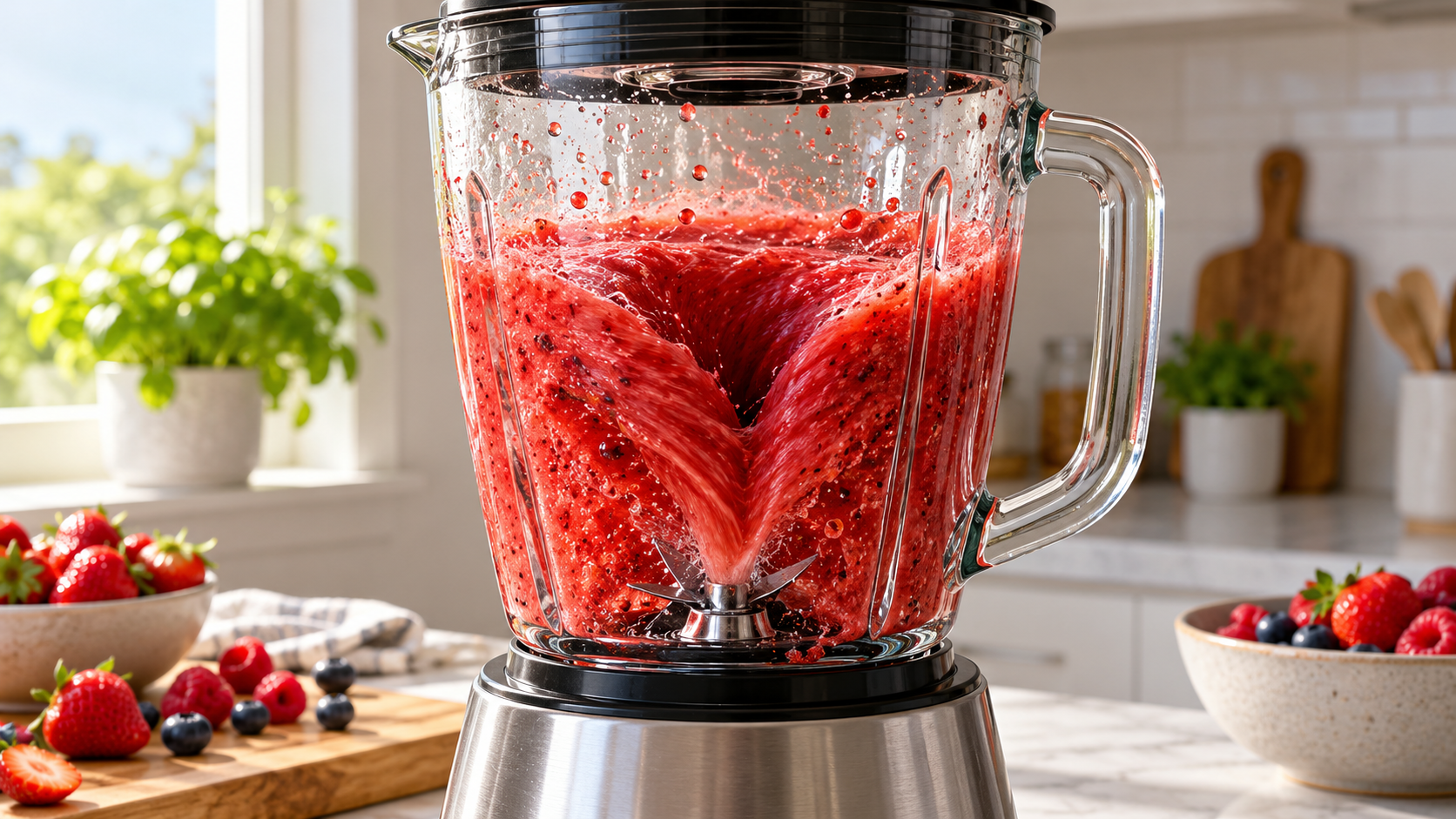
A countertop blender does not process the whole jar in one pass. Its motor spins angled blades at high speed near the bottom, accelerating nearby liquid and food. The moving fluid is pushed outward by the rotating flow and redirected by the jar walls. Lower pressure develops near the center above the blades, so material from the surface moves downward into that region. The visible funnel is part of a recirculating path that repeatedly carries ingredients through the fast-moving cutting zone.
Blade edges cut and tear solids, but fluid motion performs much of the mixing. Ingredients leaving the blade tips travel outward, rise along the walls, and return toward the middle. Ribs and corners in the jar interrupt simple spinning and create additional turbulence. If everything merely rotated as one solid mass, there would be little relative motion and poor blending. Designers therefore coordinate blade pitch, tip speed, jar diameter, and wall geometry to keep material exchanging between regions.
Liquid level changes the flow. Too little liquid may leave dry pieces bouncing above the blades, while an overfilled jar lacks headspace and can force hot or foamy contents toward the lid. Thick mixtures resist circulation and may form an air pocket around the blades called cavitation in everyday blender usage, though it is often simply a dry void rather than true vapor cavitation. Pulsing, reducing the batch, adding liquid, or using an approved tamper can restore contact.
Motor speed determines both circulation and stress. High speed produces strong shear that can break fibers, disperse droplets, and incorporate air. Lower speed gives coarse control and may be better for initial movement. Ice and hard pieces create impact loads, so they should match the appliance rating and be added in the recommended order. A coupling between motor and blade assembly transmits torque; some couplings are designed to fail before an overloaded motor or jam causes more expensive damage.
Hot liquid requires special caution. Steam expansion and trapped pressure can lift a lid and eject scalding contents, so jar capacity, venting, starting speed, and manufacturer instructions matter. Hands and utensils must stay away from the blade area, even when power is off, because edges are sharp and the jar can shift. A stalled blender should be unplugged before clearing. Leaking seals, a cracked jar, worn bearings, or a damaged drive coupling call for repair or replacement.
The vortex is therefore a transport system, not just a visual effect. Rotating blades add momentum, the jar redirects the flow, and a pressure gradient pulls material through the center. Every circuit exposes food to cutting edges and fluid shear, making the mixture progressively smaller and more uniform. Successful blending depends on enough mobile liquid, suitable batch size, and a flow path that stays continuous rather than trapping ingredients above or beside the working zone.
Angled blades accelerate liquid outward; the jar redirects it upward while lower pressure near the center pulls ingredients down through the blades. Key terms include vortex, shear, turbulence, blade pitch, circulation, coupling, headspace, and cavitation.
The blades may spin inside an air pocket while the mixture clings to the walls. Reducing the batch, adding suitable liquid, pulsing, or using an approved tamper can restore circulation.
They interrupt simple circular spinning and redirect flow, helping ingredients move between the wall, surface, center, and blade zone.
Explore more "Explainers"
Discover additional explainers across politics, science, business, technology, and other fields. Each explainer breaks down a complex idea into clear, everyday language—helping you better understand how major concepts, systems, and debates shape the world around us.