

Oscillating Fan Gearbox Explainer
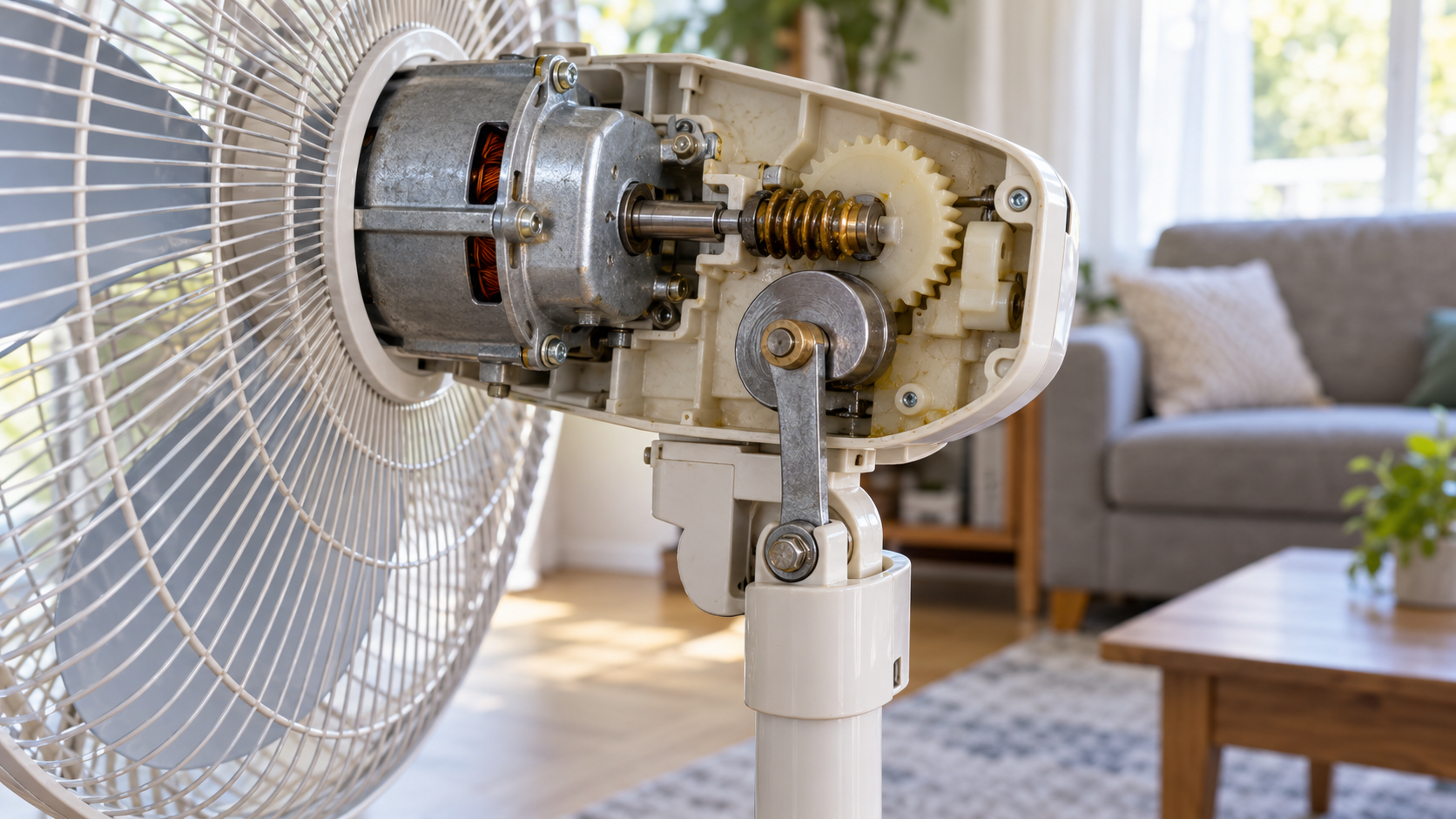
A traditional oscillating fan uses one electric motor for two very different motions. The main shaft spins the blades quickly to move air. A small worm on that shaft also drives a reduction gearbox at the rear of the motor housing. The gear train lowers speed and increases available turning force. Its final gear rotates slowly, providing a manageable input for the mechanism that swings the entire fan head around a vertical pivot.
A crank pin sits away from the center of the final gear. As the gear makes a full circle, the pin pushes and pulls a connecting link. The other end of that link attaches to an arm fixed relative to the fan stand. Because the head can rotate on its neck pivot, the changing distance and angle of the link make the head swing left, slow near the end, reverse, and swing right.
This is a rotary-to-reciprocating linkage. The motor never reverses direction; the crank geometry creates the reversal twice during every turn. The oscillation angle depends on the distance of the crank pin from the gear center and the attachment geometry. Some fans provide adjustable sweep by moving a pivot point or changing effective crank radius. Modern designs may use a separate motor or electronic control, but the mechanical purpose remains similar.
A knob commonly engages or disengages a clutch in the gearbox. Pushing or pulling it moves a toothed member into or out of the drive path, allowing the blades to run while the head remains stationary. The worm reduction is compact and can resist forces from the head, but it needs suitable lubrication. Plastic gears reduce noise and cost, while metal shafts and bushings maintain alignment under repeated changes of direction.
Clicking, hesitation, or a fan that stops at one edge can result from hardened lubricant, worn gear teeth, a loose link, a bent pivot, or an unbalanced head. Fingers and tools stay outside the guard and gearbox while power is connected. Electrical repair and internal service follow the manufacturer’s instructions, because stored capacitors, wiring, and moving blades add hazards beyond the visible oscillation parts.
The sweeping motion is therefore produced by a chain of conversions. Fast motor rotation enters a worm and gear train, slow gear rotation moves an off-center crank, and the link turns that circular path into alternating motion around the stand pivot. The blade motor can continue rotating steadily while the head reverses smoothly. Gear reduction, linkage proportions, lubrication, and balanced support determine how quietly and evenly the fan scans the room.
Reduction gears slow the blade motor’s rotation, and an eccentric crank with a connecting link converts it into alternating movement around the head pivot. Key terms include worm, gear train, crank pin, connecting link, pivot, clutch, reciprocating motion, and sweep angle.
Usually not. The motor and final gear keep turning one way; the off-center crank and link create two direction reversals per gear rotation.
A clutch or separate drive path disengages the slow oscillation gearbox while leaving the main blade shaft powered.
Explore more "Explainers"
Discover additional explainers across politics, science, business, technology, and other fields. Each explainer breaks down a complex idea into clear, everyday language—helping you better understand how major concepts, systems, and debates shape the world around us.