

Dryer Sheet Antistatic Explainer
Static cling develops as fabrics tumble, rub, and separate in the dryer. Different materials can exchange electrons through the triboelectric effect, leaving one surface more positive and another more negative. Dry air and nearly dry fabric provide poor paths for charge to leak away, so opposite charges attract and similar charges repel. Lightweight garments then cling together, stick to the drum, or produce small shocks when handled.
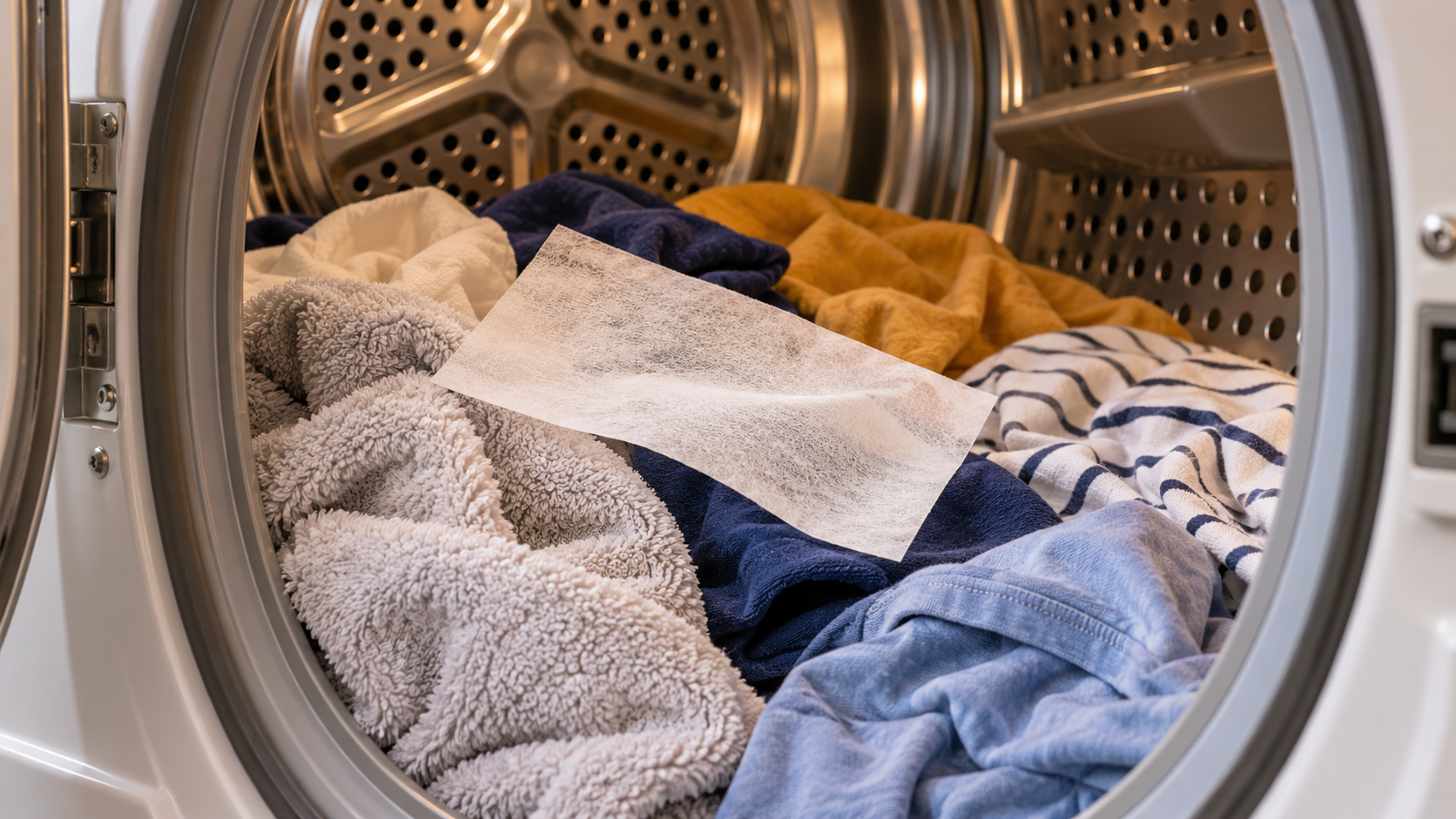
A dryer sheet is a nonwoven carrier coated with fabric-conditioning compounds. Dryer heat softens the coating, and repeated contact during tumbling transfers a very thin layer onto textile fibers. Many formulations use cationic surfactants, molecules with positively charged portions that are attracted to commonly negative fiber surfaces. The deposited layer makes surfaces more electrically conductive or easier to discharge and reduces the friction that generates new charge.
The coating also changes feel. Its long hydrocarbon portions create a lubricating surface between fibers, so cloth can feel softer and slide with less resistance. Fragrance may be included, but scent is separate from antistatic action. The sheet must circulate through the load to contact different garments; one stuck at the lint screen or trapped in a single item cannot distribute conditioner as evenly.
Static becomes worse when clothing is overdried because the remaining moisture that helps charge dissipate has been removed. Mixed loads of synthetic and natural fibers can exchange charge readily. Stopping when the load is dry, maintaining appropriate humidity, or separating strongly dissimilar materials can reduce the problem. A dryer sheet lowers static under common conditions but cannot guarantee zero charge for every fabric combination and drying cycle.
The deposited material creates tradeoffs. Repeated conditioning can reduce the absorbency or moisture-wicking behavior of some towels and athletic fabrics, and residue can affect certain dryer sensors or lint screens. Use follows garment and appliance instructions, including any warnings for flame-resistant sleepwear, microfiber, or specialty textiles. More sheets are not automatically better; excess coating can spot fabric or accumulate on surfaces.
The sheet works by changing the surfaces where static begins. Heat releases the conditioner, tumbling spreads it, cationic and lubricating components reduce charge imbalance and friction, and residual moisture provides additional leakage paths. The result is less attraction between dry garments and a softer hand. Because performance depends on contact, temperature, load composition, dryness, and fabric finish, static control is a system effect rather than a sheet absorbing electricity like a battery.
Dryer heat and tumbling transfer antistatic fabric conditioner from the sheet to fibers, reducing friction and helping charge dissipate. Key terms include triboelectric effect, cationic surfactant, coating, friction, charge, humidity, conductivity, and cling.
Very dry fabric and air provide fewer conductive paths for charge to leak away, while continued tumbling keeps rubbing and separating materials.
The conditioning layer can make some fibers more water-repellent, so repeated use may reduce absorbency or moisture-wicking performance.
Explore more "Explainers"
Discover additional explainers across politics, science, business, technology, and other fields. Each explainer breaks down a complex idea into clear, everyday language—helping you better understand how major concepts, systems, and debates shape the world around us.