

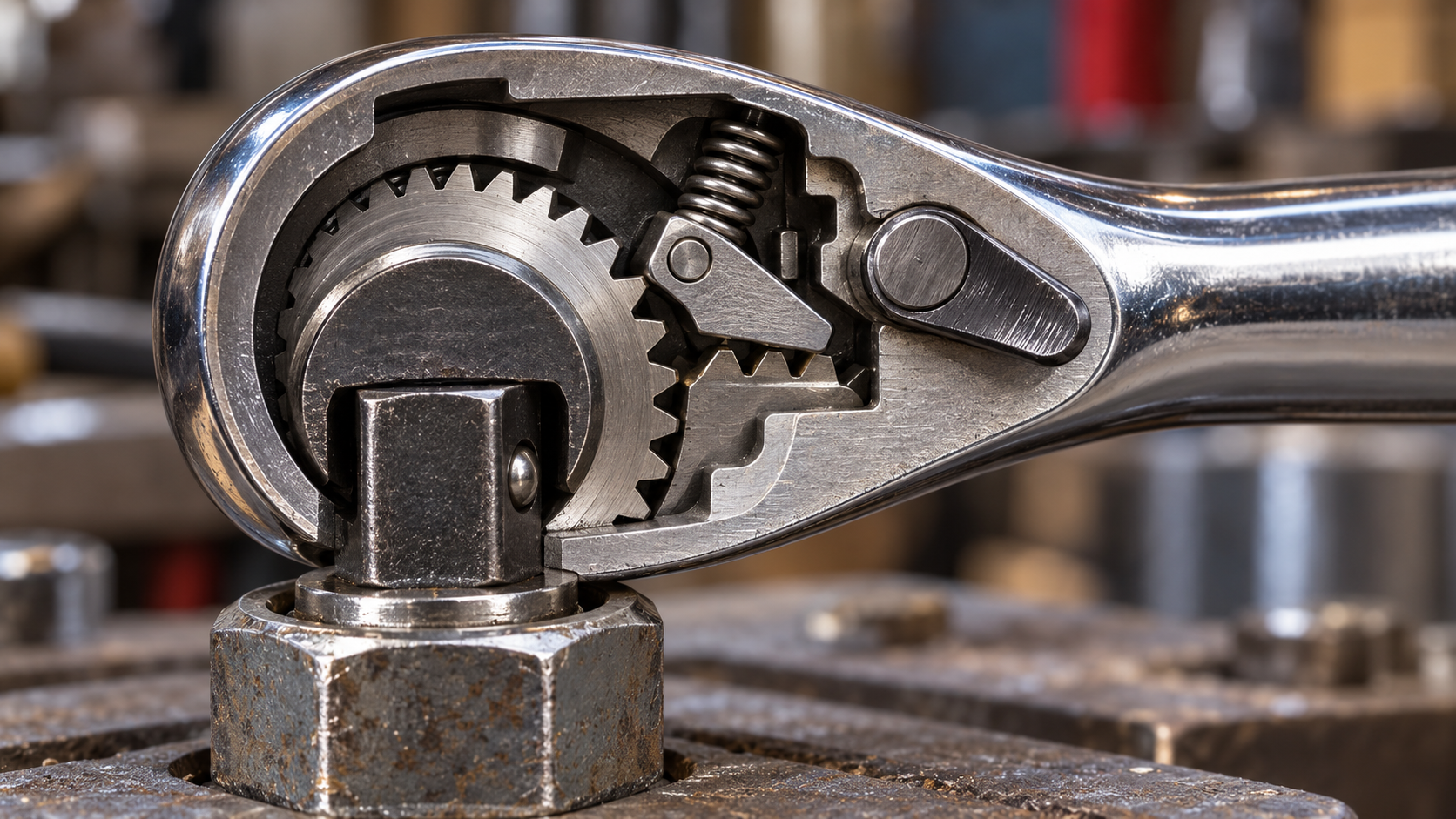
Ratchet Gear, Pawl, and Direction Selector
A toothed ratchet wheel engaged by a spring-loaded pawl whose orientation is selected by a reversing control is the core of this everyday mechanism. In normal use, on the drive stroke the loaded tooth face pushes solidly against the pawl and transmits torque; on the return stroke sloped tooth faces lift the pawl so it clicks over successive teeth without turning the socket backward. The result comes from an organized transfer of force, motion, pressure, or vibration rather than from any single part acting alone. Following the input through the control elements to the output makes the object easier to understand and use correctly.
The operating sequence begins when a person or surrounding system supplies an input. On the drive stroke the loaded tooth face pushes solidly against the pawl and transmits torque; on the return stroke sloped tooth faces lift the pawl so it clicks over successive teeth without turning the socket backward The parts are arranged so that each stage constrains the next: one component receives energy, another changes its direction or scale, and another produces the useful effect. The same sequence also explains common symptoms, because a worn contact, blocked passage, loose pivot, or damaged seal interrupts a specific step.
Real-world performance depends on tooth count, pawl geometry, selector position, spring force, lubrication, handle length, socket fit, applied torque, and wear. Those variables determine how much motion or force reaches the output and how consistently the mechanism repeats. They also explain why two examples of the same object can feel different, and why behavior may change with temperature, cleaning, installation, age, contamination, or a different load.
The correct-size socket is seated fully and the selector is moved only as the design allows. Dirt is removed and the mechanism is lubricated according to the tool maker. Troubleshooting should follow the actual path of energy or motion instead of relying on appearance alone. A symptom can narrow the possibilities, but it rarely proves one failed part without inspection. Manufacturer instructions remain important because similar-looking versions may use different clearances, materials, adjustments, or service procedures.
Fine teeth reduce the swing arc but also divide load among smaller features. A ratchet has a torque rating and should not be extended with a pipe or used as a hammer. Ratings and warnings matter because a mechanism that multiplies force, stores energy, creates pressure, or concentrates motion can also magnify misuse. Applying extra force to a jam often transfers the load to a weaker component instead of correcting misalignment, blockage, contamination, or wear.
In short, a ratcheting socket wrench drive one way and freewheel the other works through a coordinated chain of input, control, and output. On the drive stroke the loaded tooth face pushes solidly against the pawl and transmits torque; on the return stroke sloped tooth faces lift the pawl so it clicks over successive teeth without turning the socket backward Preserving the surfaces, joints, passages, and alignments that create that sequence keeps the device predictable. Unexpected leakage, heat, sound, resistance, looseness, vibration, or misalignment is useful evidence to investigate before continued use.
On the drive stroke the loaded tooth face pushes solidly against the pawl and transmits torque; on the return stroke sloped tooth faces lift the pawl so it clicks over successive teeth without turning the socket backward Key factors include tooth count, pawl geometry, selector position, spring force, lubrication, handle length, socket fit, applied torque, and wear.
During freewheel motion the pawl repeatedly rides up a tooth ramp and snaps into the next gap under spring force.
It shifts or flips the pawl so the locking face engages the opposite side of the ratchet teeth.
Explore more "Explainers"
Discover additional explainers across politics, science, business, technology, and other fields. Each explainer breaks down a complex idea into clear, everyday language—helping you better understand how major concepts, systems, and debates shape the world around us.