

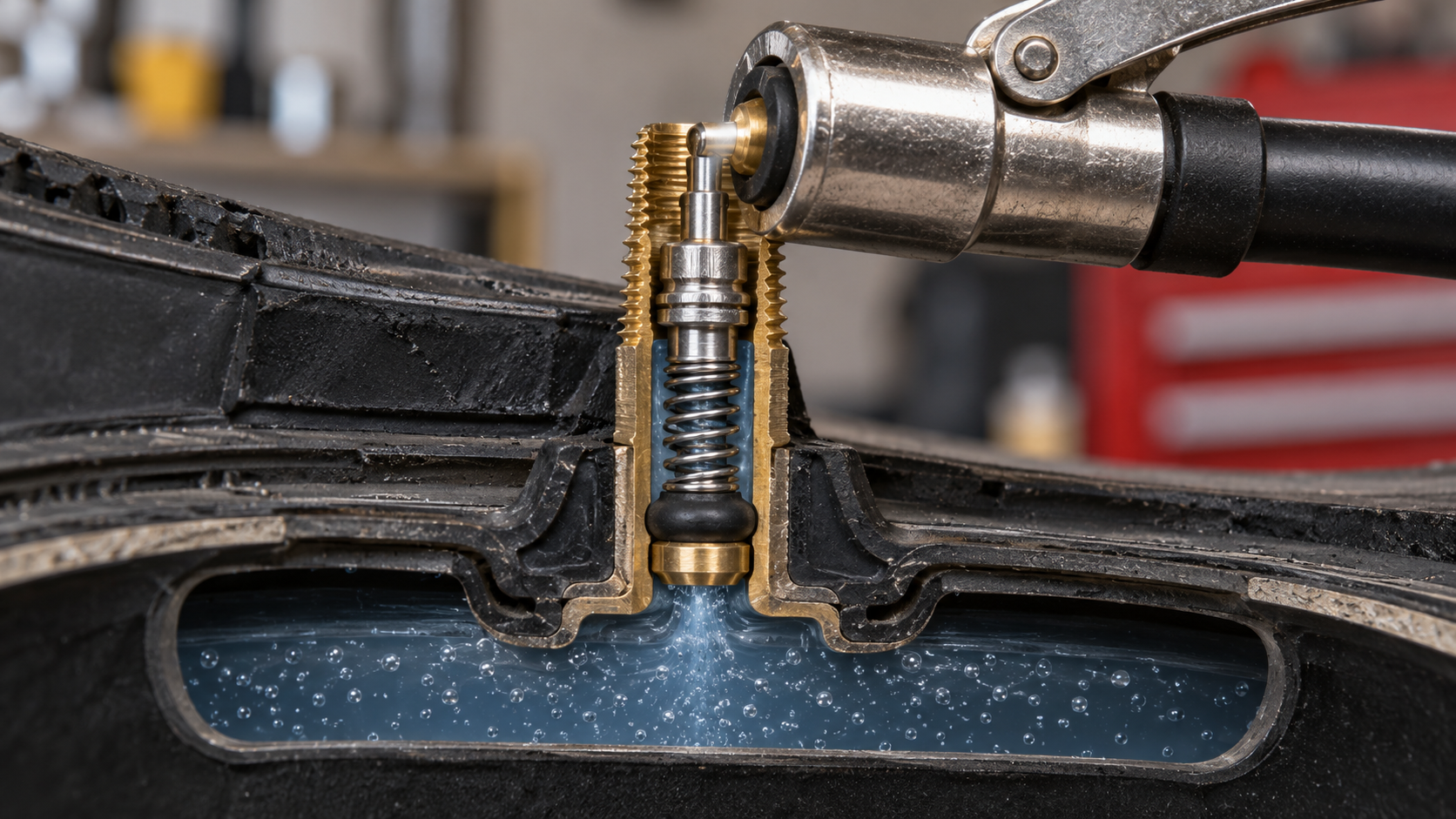
Schrader Valve Core, Spring, and Seal
A replaceable valve core whose spring-loaded poppet and elastomer seal close against a seat inside the stem is the core of this everyday mechanism. In normal use, with no pump attached, spring force and tire pressure press the seal closed; a compatible chuck depresses the center pin while supplying higher-pressure air, opening a path into the tire, and removal lets the core reseat. The result comes from an organized transfer of force, motion, pressure, or vibration rather than from any single part acting alone. Following the input through the control elements to the output makes the object easier to understand and use correctly.
The operating sequence begins when a person or surrounding system supplies an input. With no pump attached, spring force and tire pressure press the seal closed; a compatible chuck depresses the center pin while supplying higher-pressure air, opening a path into the tire, and removal lets the core reseat The parts are arranged so that each stage constrains the next: one component receives energy, another changes its direction or scale, and another produces the useful effect. The same sequence also explains common symptoms, because a worn contact, blocked passage, loose pivot, or damaged seal interrupts a specific step.
Real-world performance depends on core seal condition, spring force, pressure difference, pin travel, chuck fit, contamination, stem damage, temperature, and cap protection. Those variables determine how much motion or force reaches the output and how consistently the mechanism repeats. They also explain why two examples of the same object can feel different, and why behavior may change with temperature, cleaning, installation, age, contamination, or a different load.
The chuck is attached squarely and removed promptly, and leaks are checked without bending the stem. A loose core is serviced only with the correct tool and specifications. Troubleshooting should follow the actual path of energy or motion instead of relying on appearance alone. A symptom can narrow the possibilities, but it rarely proves one failed part without inspection. Manufacturer instructions remain important because similar-looking versions may use different clearances, materials, adjustments, or service procedures.
The dust cap protects against contamination but is not the primary pressure seal in a standard core. A damaged stem, corroded core, or unsuitable high-pressure application needs the correct replacement. Ratings and warnings matter because a mechanism that multiplies force, stores energy, creates pressure, or concentrates motion can also magnify misuse. Applying extra force to a jam often transfers the load to a weaker component instead of correcting misalignment, blockage, contamination, or wear.
In short, a schrader valve hold air in a tire works through a coordinated chain of input, control, and output. With no pump attached, spring force and tire pressure press the seal closed; a compatible chuck depresses the center pin while supplying higher-pressure air, opening a path into the tire, and removal lets the core reseat Preserving the surfaces, joints, passages, and alignments that create that sequence keeps the device predictable. Unexpected leakage, heat, sound, resistance, looseness, vibration, or misalignment is useful evidence to investigate before continued use.
With no pump attached, spring force and tire pressure press the seal closed; a compatible chuck depresses the center pin while supplying higher-pressure air, opening a path into the tire, and removal lets the core reseat Key factors include core seal condition, spring force, pressure difference, pin travel, chuck fit, contamination, stem damage, temperature, and cap protection.
The pin moves the poppet away from its seat, opening an annular path through the core.
Internal pressure acts on the sealing element in the closing direction, adding to the small spring force.
Explore more "Explainers"
Discover additional explainers across politics, science, business, technology, and other fields. Each explainer breaks down a complex idea into clear, everyday language—helping you better understand how major concepts, systems, and debates shape the world around us.