

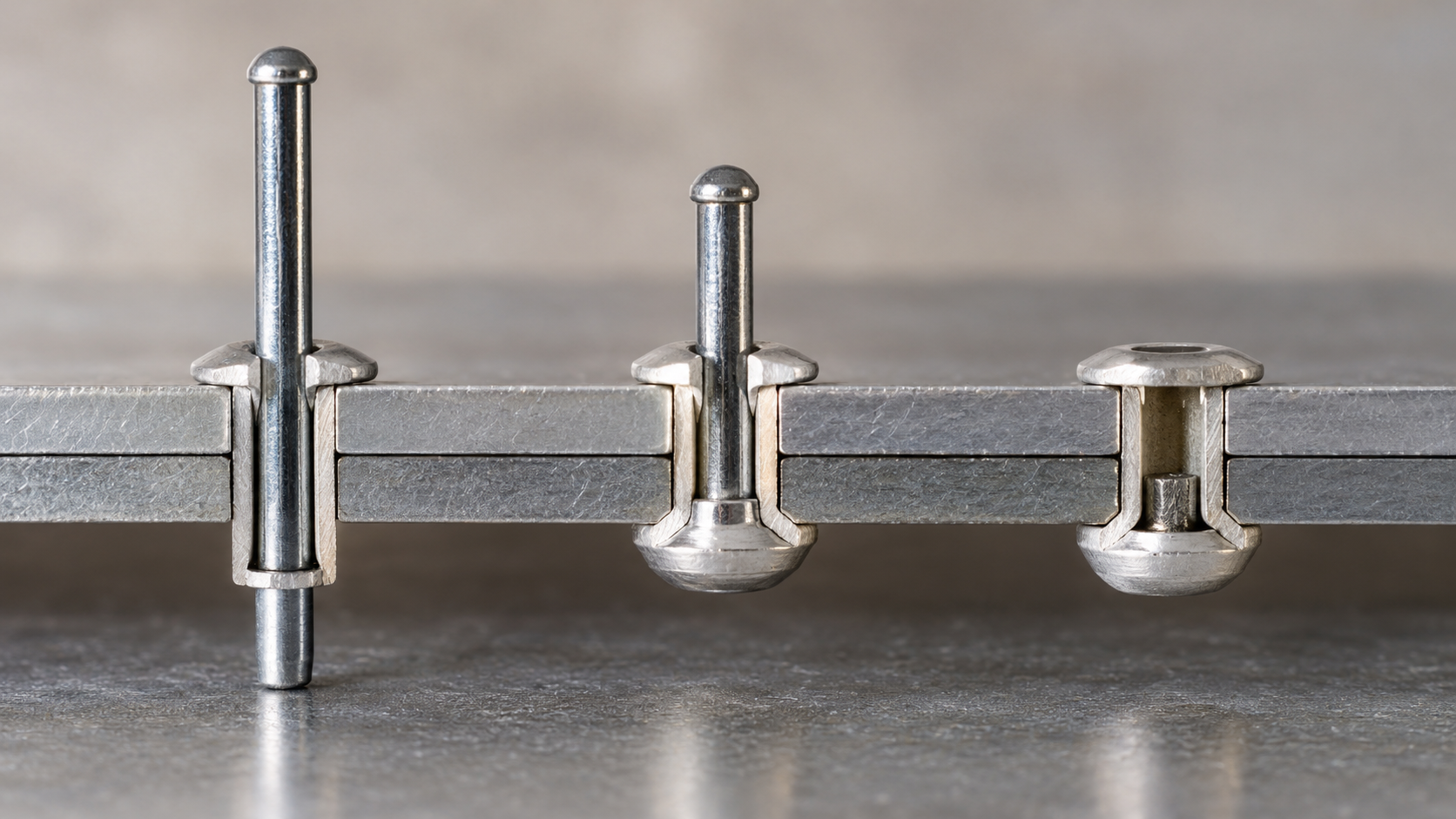
Blind Rivet Body, Mandrel, and Formed Head
A blind rivet pairs a hollow deformable rivet body with a mandrel whose enlarged head sits on the inaccessible side of the joint. A setting tool holds the rivet flange against the sheets while pulling the mandrel; its head upsets the body into a blind-side bulge, clamps the sheets, and finally breaks at a designed weak point. The useful result comes from a deliberate relationship among geometry, material properties, and constrained motion. Following that relationship from input to output makes the device easier to understand than treating it as a sealed mystery.
A setting tool holds the rivet flange against the sheets while pulling the mandrel; its head upsets the body into a blind-side bulge, clamps the sheets, and finally breaks at a designed weak point. During that sequence, reaction forces travel through the frame, housing, joint, or surrounding material as well as through the visibly moving part. Clearances and contact surfaces determine which components slide, flex, rotate, seal, or remain fixed, so a small change at one stage can alter the entire result.
Real-world performance depends on rivet diameter, grip range, body and mandrel materials, hole diameter, sheet stack thickness, mandrel break load, tool alignment, edge distance, and joint loading. These variables affect force, speed, repeatability, service life, and the way wear first appears. Two examples that look alike may therefore behave differently because of size, material, adjustment, prior loading, environment, or manufacturing tolerance.
The specified rivet is inserted through a clean correctly sized hole, seated squarely, and set with the matching nosepiece until the mandrel breaks normally. Inspection should follow the actual path of force or flow: look for damage, contamination, looseness, misalignment, blocked passages, and unusual friction before adding more effort. Cleaning, adjustment, lubrication, and replacement must follow the instructions for the specific product and materials.
A formed head does not guarantee a sound structural joint; wrong grip range, oversized holes, corrosion, poor seating, or an unsuitable rivet alloy can reduce strength. Ratings and warnings matter because mechanical advantage, stored spring energy, fluid pressure, sharp edges, and concentrated loads can magnify misuse. A jam or unexpected change in resistance is evidence to stop and investigate, not an invitation to add a longer handle or greater force.
In short, the mechanism works by controlling where energy and motion can travel. A setting tool holds the rivet flange against the sheets while pulling the mandrel; its head upsets the body into a blind-side bulge, clamps the sheets, and finally breaks at a designed weak point. Keeping the relevant surfaces, fasteners, clearances, and alignments within their intended condition preserves that sequence. Slipping, binding, leakage, cracking, excess heat, irregular sound, or a changed feel can identify the stage that deserves inspection.
A setting tool holds the rivet flange against the sheets while pulling the mandrel; its head upsets the body into a blind-side bulge, clamps the sheets, and finally breaks at a designed weak point. Key variables include rivet diameter, grip range, body and mandrel materials, hole diameter, sheet stack thickness, mandrel break load, tool alignment, edge distance, and joint loading.
The joint can be installed when the worker can reach only the front side because the mandrel forms the rear head internally.
A reduced section is designed to fracture after enough pulling force has formed and clamped the rivet body.
Explore more "Explainers"
Discover additional explainers across politics, science, business, technology, and other fields. Each explainer breaks down a complex idea into clear, everyday language—helping you better understand how major concepts, systems, and debates shape the world around us.