

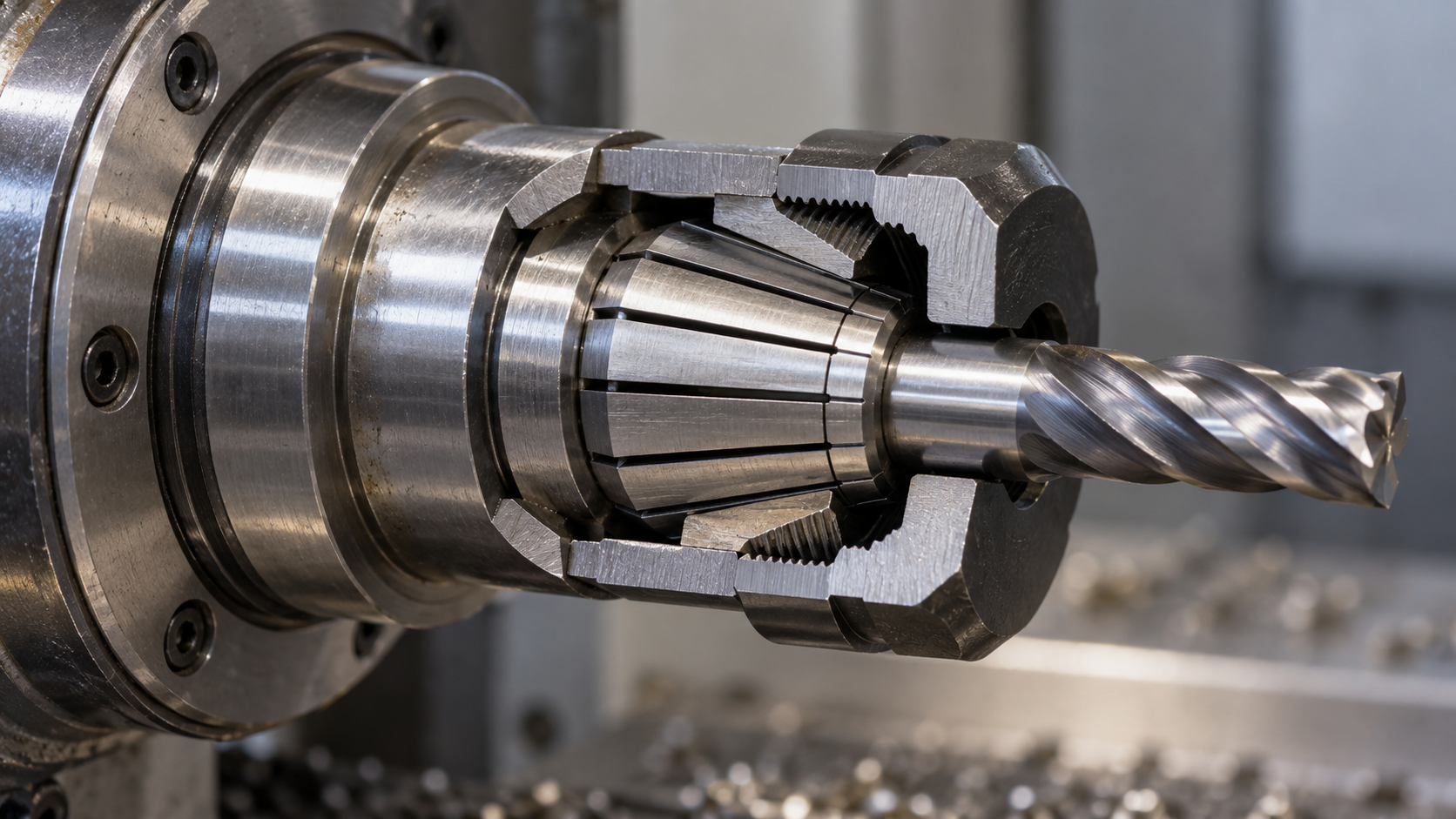
Tapered Collet, Split Segments, and Concentric Clamping
A collet chuck grips a round tool with a slotted sleeve whose outside taper matches a taper in the chuck body or nut. As the nut is tightened, matching conical surfaces draw the collet axially and squeeze its flexible segments inward, producing many evenly distributed contact zones around the tool shank. The result depends on the relationship among the working edge or gripping surfaces, the tool’s moving linkage, and the way the work is supported.
As the nut is tightened, matching conical surfaces draw the collet axially and squeeze its flexible segments inward, producing many evenly distributed contact zones around the tool shank. Parts that seem secondary still control the outcome. Guides keep motion on axis, springs or threads store and redirect force, and relief or open space lets chips, displaced material, or moving parts clear instead of jamming.
Real-world performance depends on collet family, nominal size and collapse range, taper cleanliness, nut design, tightening torque, tool shank diameter, insertion depth, runout, segment damage, coolant sealing, spindle accuracy, and balance. These variables change leverage, contact pressure, accuracy, surface damage, tool life, and the amount of control the user feels during the operation.
The correct collet and nut are assembled as designed, all mating surfaces are cleaned, the tool is inserted to an approved depth, and the nut is tightened with the specified wrench and torque. A change in resistance, sound, alignment, or finish is a reason to stop and inspect the setup rather than adding force automatically.
Over-collapsing the wrong collet, clamping on a flute or relief, or trapping chips on a taper can permanently distort the collet and increase runout. Eye protection, stable work support, and keeping hands outside the tool’s closing or cutting path remain basic safeguards. The product maker’s instructions should control compatible sizes, materials, adjustments, and permitted use.
In short, the tool works by converting a manageable hand motion into a concentrated and constrained action at the work. As the nut is tightened, matching conical surfaces draw the collet axially and squeeze its flexible segments inward, producing many evenly distributed contact zones around the tool shank. Consistent results come from correct sizing, full engagement, square alignment, gradual force, and stopping before a small mismatch becomes damage.
A collet chuck grips a round tool with a slotted sleeve whose outside taper matches a taper in the chuck body or nut. As the nut is tightened, matching conical surfaces draw the collet axially and squeeze its flexible segments inward, producing many evenly distributed contact zones around the tool shank.
Its many flexible segments close around nearly the full circumference instead of touching at only three narrow jaw lines.
The shallow cone converts axial nut force into uniform radial clamping force around the collet.
Explore more "Explainers"
Discover additional explainers across politics, science, business, technology, and other fields. Each explainer breaks down a complex idea into clear, everyday language—helping you better understand how major concepts, systems, and debates shape the world around us.