

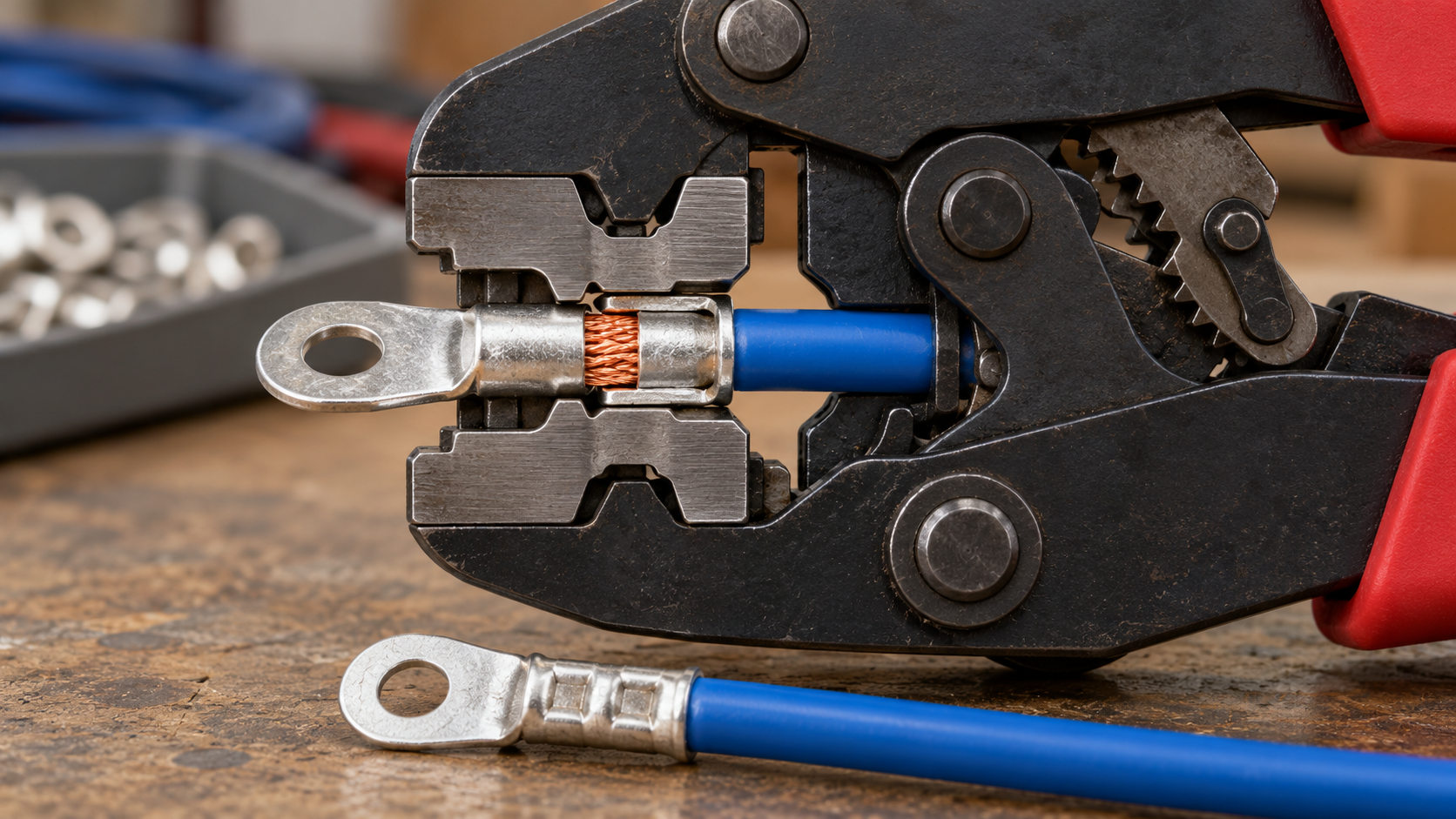
Matched Dies, Ratchet Cycle, and Cold-Formed Terminal
A ratcheting crimp tool uses matched die cavities and a controlled full stroke to plastically compress a terminal barrel around a prepared conductor. Closing the handles advances the dies in steps while the ratchet prevents early reopening; at full closure the barrel and wire strands are cold-formed into a dense shape, then the ratchet releases. The result depends on the relationship among the working edge or gripping surfaces, the tool’s moving linkage, and the way the work is supported.
Closing the handles advances the dies in steps while the ratchet prevents early reopening; at full closure the barrel and wire strands are cold-formed into a dense shape, then the ratchet releases. Parts that seem secondary still control the outcome. Guides keep motion on axis, springs or threads store and redirect force, and relief or open space lets chips, displaced material, or moving parts clear instead of jamming.
Real-world performance depends on terminal family, conductor size, strip length, die cavity, locator position, crimp orientation, ratchet calibration, handle force, strand condition, insulation support, cleanliness, and pull testing. These variables change leverage, contact pressure, accuracy, surface damage, tool life, and the amount of control the user feels during the operation.
The wire, terminal, and documented die are matched, the conductor is inserted to the specified stop, and the handles are closed completely without twisting before the finished crimp is inspected. A change in resistance, sound, alignment, or finish is a reason to stop and inspect the setup rather than adding force automatically.
Pliers, the wrong cavity, a partial cycle, solder contamination, or strands outside the barrel can make a connection that looks closed but has poor electrical and tensile performance. Eye protection, stable work support, and keeping hands outside the tool’s closing or cutting path remain basic safeguards. The product maker’s instructions should control compatible sizes, materials, adjustments, and permitted use.
In short, the tool works by converting a manageable hand motion into a concentrated and constrained action at the work. Closing the handles advances the dies in steps while the ratchet prevents early reopening; at full closure the barrel and wire strands are cold-formed into a dense shape, then the ratchet releases. Consistent results come from correct sizing, full engagement, square alignment, gradual force, and stopping before a small mismatch becomes damage.
A ratcheting crimp tool uses matched die cavities and a controlled full stroke to plastically compress a terminal barrel around a prepared conductor. Closing the handles advances the dies in steps while the ratchet prevents early reopening; at full closure the barrel and wire strands are cold-formed into a dense shape, then the ratchet releases.
Its pawl holds each step so the dies normally reach the calibrated bottoming point before release, reducing partial crimps.
High die pressure deforms the barrel tightly around clean strands, creating many stable metal-to-metal contact points and mechanical grip.
Explore more "Explainers"
Discover additional explainers across politics, science, business, technology, and other fields. Each explainer breaks down a complex idea into clear, everyday language—helping you better understand how major concepts, systems, and debates shape the world around us.