

Emergency Alert Systems Explainer
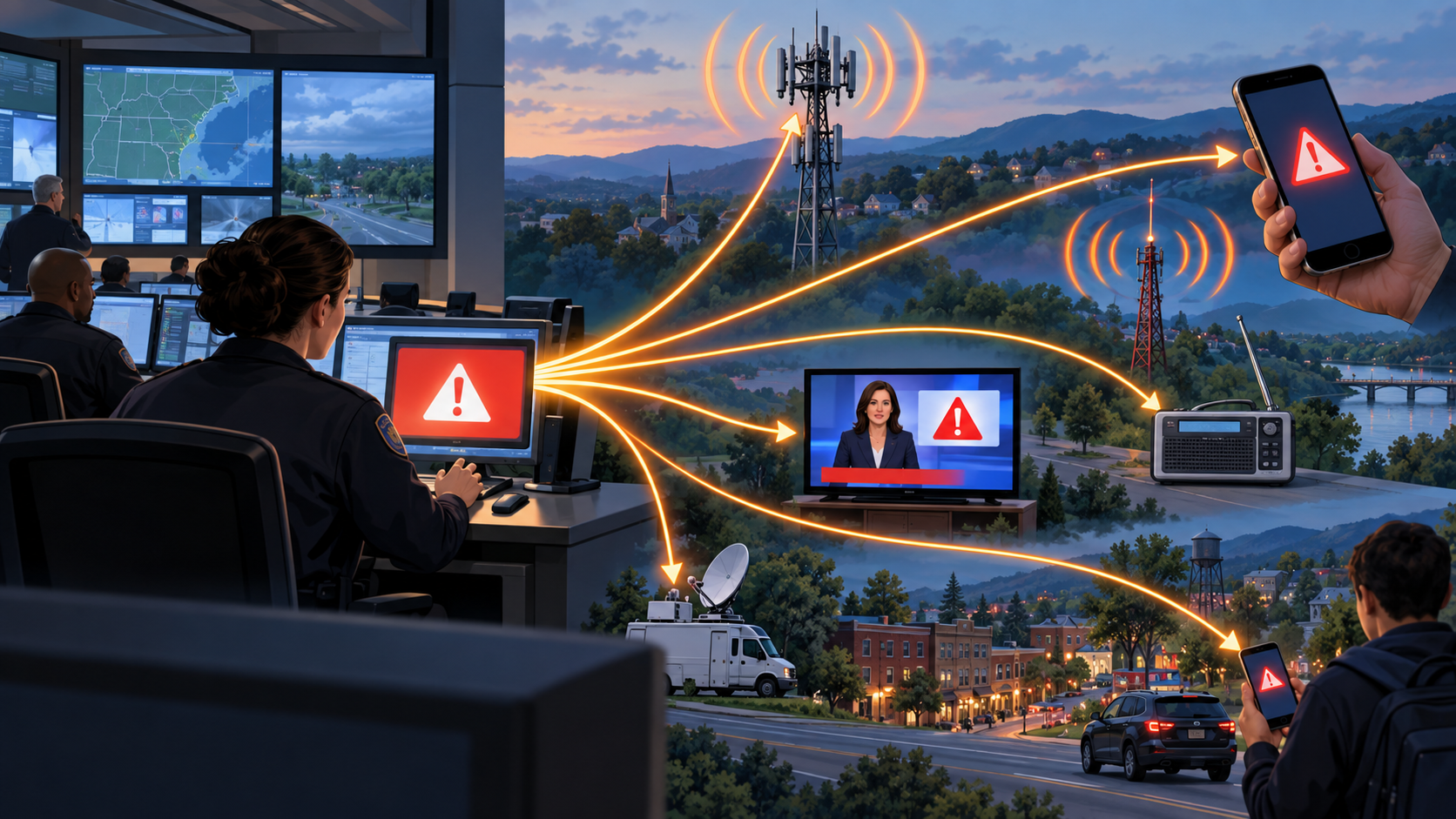
Emergency alerts reach the public through a network that lets authorized government agencies create one authenticated warning and send it across several communication channels. In the United States, FEMA’s Integrated Public Alert and Warning System, or IPAWS, connects approved federal, state, local, tribal, and territorial alerting authorities with mobile carriers, radio and television broadcasters, weather radio, and other distributors. The system does not decide when to warn people; trained public-safety officials decide what to send and define the affected area.
An alert originator uses approved software to compose a message with the hazard, location, timing, severity, and recommended action. The software formats it using the Common Alerting Protocol, a standard that allows the same core information to travel through different systems. IPAWS authenticates the sender and makes the message available to participating distributors. Depending on the alert, a Wireless Emergency Alert can be broadcast from cell towers to compatible phones in a target area, while the Emergency Alert System interrupts participating radio and television programming.
Wireless Emergency Alerts are not ordinary text messages. They use cell broadcast, which sends a message from towers to capable devices in a geographic area without relying on a list of individual phone numbers. That helps reach visitors as well as residents and avoids the congestion of sending millions of separate texts. Geography is not perfectly precise, however. Tower coverage, device capability, carrier participation, settings, signal conditions, and the boundaries selected by officials can affect who receives a warning. Broadcast and weather-radio pathways provide redundancy when mobile service is limited.
Good alerting is a public-information discipline as much as a technical one. A message must quickly identify the threat and tell people what action to take, while follow-up alerts should correct, update, or end the warning. Overuse and vague messages can create alert fatigue, but delaying a life-safety warning can be far more dangerous. People should treat alerts as prompts to act and then consult official local sources for updates. No single channel reaches everyone, so emergency managers combine IPAWS with sirens, local apps, websites, social media, and direct community outreach.
Alert systems work best when the public prepares before an emergency. People can keep compatible phone alerts enabled, learn the meaning of local sirens, obtain a battery-powered weather radio where appropriate, and know which official accounts provide updates. Agencies should test accessibility, translation, geographic targeting, and backup channels, then review delivery after each incident. Those steps help warnings reach people with different devices, languages, abilities, and levels of connectivity.
Only approved alerting authorities can use IPAWS to warn the public. These can include federal, state, local, tribal, and territorial agencies with trained personnel and authorized software. Agencies establish procedures, permissions, and testing so an individual cannot casually send a public alert from an ordinary account.
The originating agency is responsible for deciding that an emergency warrants an alert, choosing the area, and writing instructions appropriate to the hazard. FEMA operates the national gateway, but the local or specialized authority closest to the incident normally supplies the warning's substance and protective action.
The Common Alerting Protocol packages the core warning in a standard form. IPAWS authenticates it and distributes it to systems such as Wireless Emergency Alerts and the Emergency Alert System. Standard fields help different technologies interpret the same hazard, urgency, location, and instruction.
Cell carriers broadcast eligible messages from towers, while radio and television participants relay EAS alerts. NOAA Weather Radio and other services add additional pathways. A sender can tailor details for each channel's length and technical limits while preserving a consistent core warning.
Phone model, carrier support, device settings, tower coverage, geography, network damage, and the selected target area can change whether and when a person receives a warning. People near a boundary may receive an alert for a nearby danger, while damaged infrastructure can leave gaps inside the target zone.
Redundant channels reduce—but do not eliminate—gaps. Clear follow-up messages and trusted local information help people understand changing conditions after the first alert. Emergency managers also use sirens, websites, social media, door-to-door outreach, and community partners to reach people who may miss automated systems.
Explore more "Explainers"
Discover additional explainers across politics, science, business, technology, and other fields. Each explainer breaks down a complex idea into clear, everyday language—helping you better understand how major concepts, systems, and debates shape the world around us.