

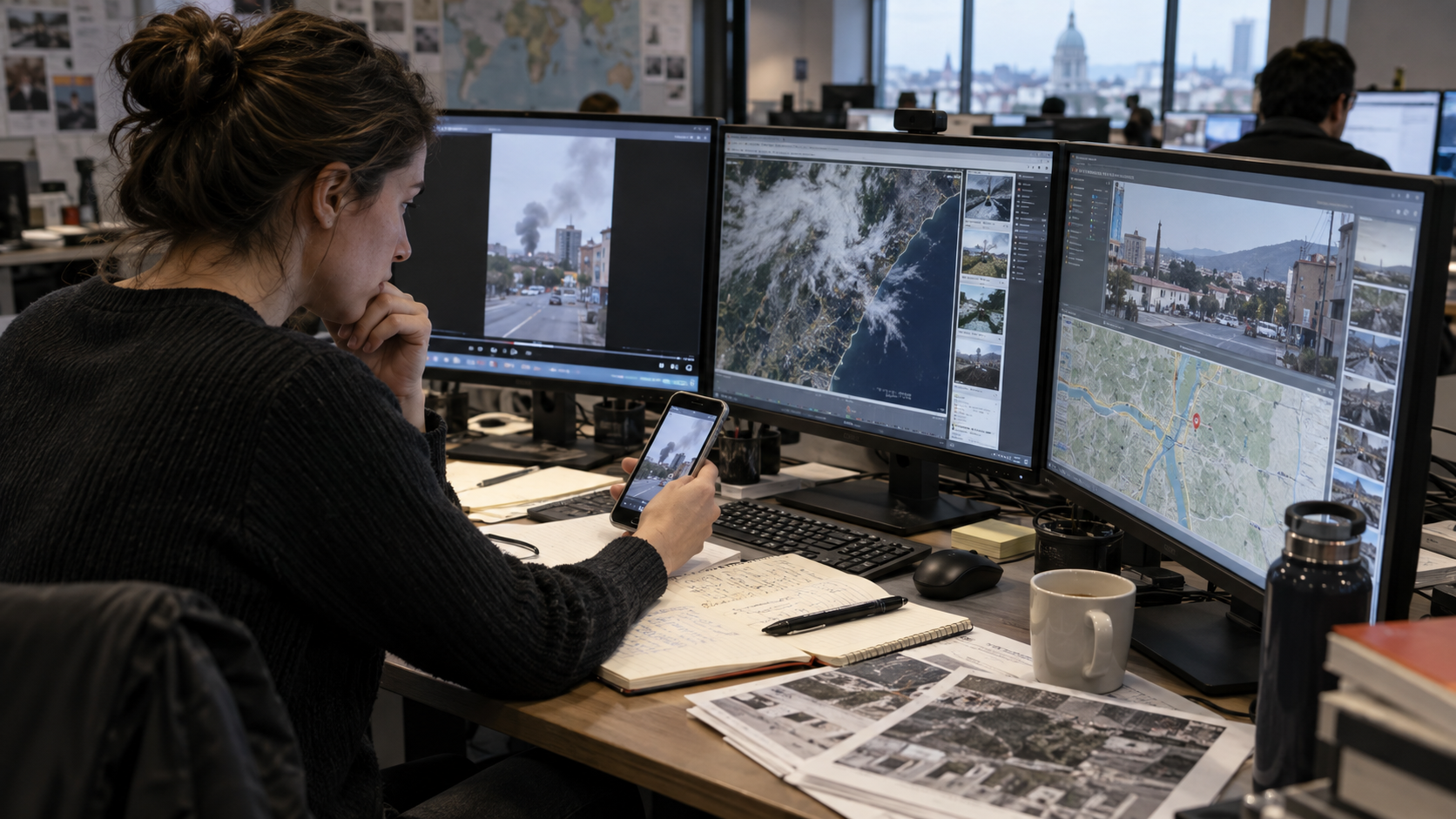
Eyewitness Video Verification Explainer
Eyewitness video can show events before reporters reach the scene, but seeing a dramatic clip is not the same as knowing what it proves. Journalists first ask who recorded it, where and when it was made, whether it has been altered, and whether the visible event matches the claim attached to it. Verification is a chain of evidence rather than a single tool. A reverse-image search might reveal an older upload, but a new clip with no search history still requires source interviews, visual analysis, metadata checks, and corroboration from independent reporting.
The original source matters because reposts strip away context. Reporters trace the earliest available upload, contact the person who made the recording, and ask what happened before and after the captured moment. They confirm authorship, obtain permission, and request the original file when possible. The Associated Press describes checking permissions and authorship as part of its process for user-generated content. An original file may preserve metadata, higher resolution, and a longer sequence than the compressed copy circulating on social platforms, although metadata alone can be missing or manipulated and is never treated as decisive proof.
Geolocation tests whether the surroundings match the claimed place. Journalists compare road layouts, skylines, storefronts, utility poles, terrain, shadows, signs, and landmarks with maps, satellite imagery, street-level photographs, and earlier reporting. Chronolocation tests the claimed time through weather records, sun position, event schedules, building progress, vegetation, clothing, traffic, and other changing details. Audio can provide language, accents, alarms, aircraft, or ambient sounds, but analysts avoid overconfident conclusions from noisy recordings. Each clue should fit the same explanation rather than being forced to support it.
Technical review looks for editing, synthetic elements, and misleading presentation. Reporters inspect frames for discontinuities, duplicated regions, impossible reflections, inconsistent lighting, or audio that does not align with movement. They compare key frames with older images to see whether a genuine video has been relabeled as a new event. Modern generative tools make provenance and context even more important, but conventional deception remains common: cropping, selective sequencing, false captions, and clips taken from another country can mislead without sophisticated manipulation.
Finally, journalists corroborate the scene with other evidence. They seek additional witnesses, official records, emergency logs, local reporters, nearby photographs, live streams, and independently filmed angles. They state what remains uncertain and avoid identifying vulnerable people unnecessarily. If verification is incomplete, the newsroom may withhold the footage, describe it cautiously, or report the claim without showing the clip. The objective is not to prove that every pixel is authentic in isolation. It is to establish, with multiple converging sources, that the recording came from the claimed source, depicts the claimed place and time, and supports the conclusion presented to the audience.
Find the earliest source and ask who recorded the video. A direct conversation and the original file can reveal context, authorship, permission, and details lost through repeated reposting.
No. Metadata can support a conclusion, but platforms may remove it and files can be altered. Journalists combine it with visual clues, source interviews, geolocation, timing evidence, and independent corroboration.
Independent recordings can confirm location, sequence, and visible details while exposing misleading crops or captions. They also reduce reliance on a single witness or camera position.
Explore more "Explainers"
Discover additional explainers across politics, science, business, technology, and other fields. Each explainer breaks down a complex idea into clear, everyday language—helping you better understand how major concepts, systems, and debates shape the world around us.