

Visual Editor Explainer
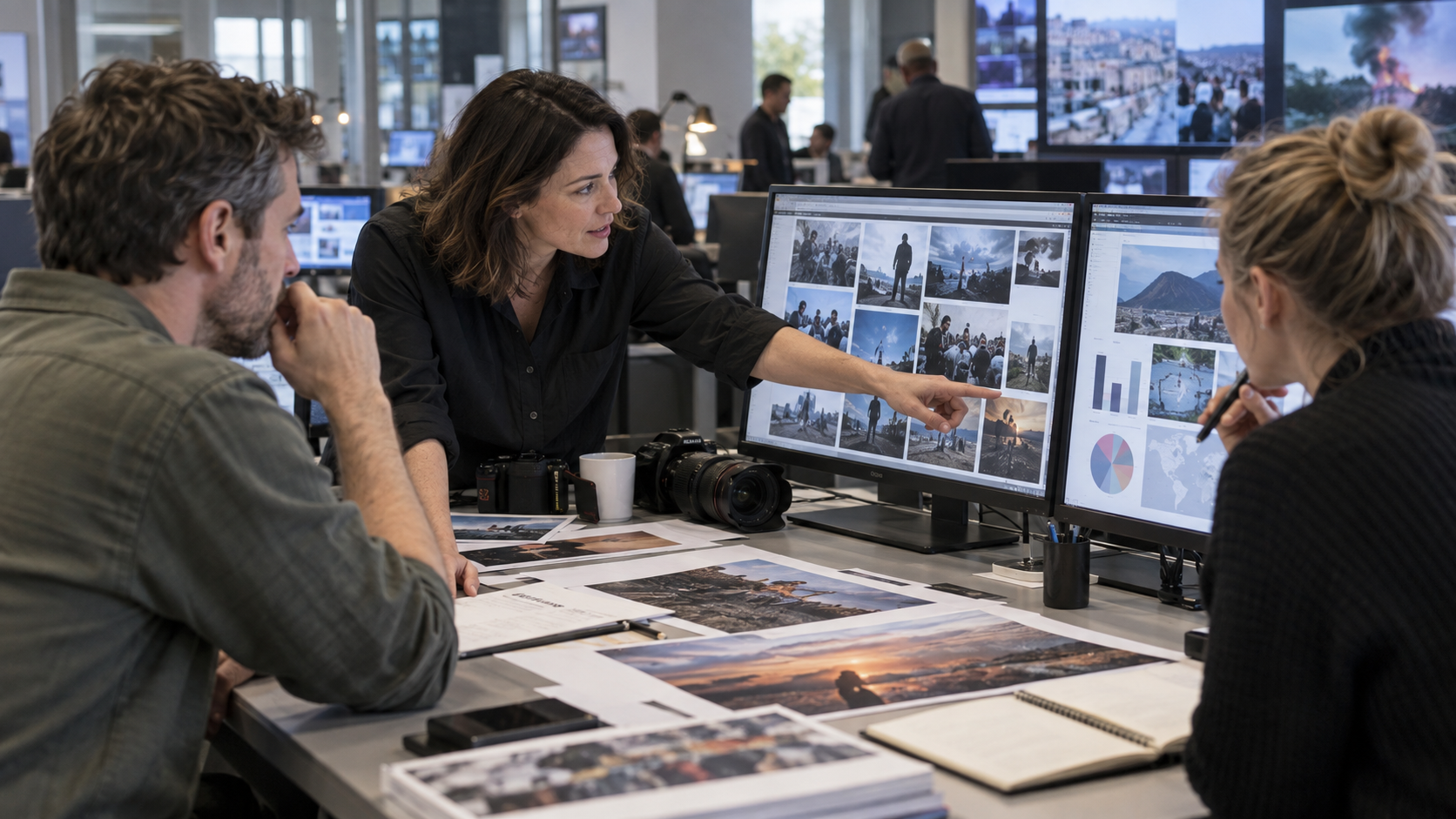
A visual editor guides how a news organization reports with photographs, video, graphics, illustrations, maps, and other visual forms. The role may be called photo editor, visuals editor, graphics editor, or director of visual journalism, and responsibilities vary widely. Some visual editors assign photographers in the field; others select agency images, commission graphics, edit video, or coordinate the presentation of a major project. The common purpose is editorial: visuals should contribute verified information and understanding, not merely attract attention or decorate a page.
Early involvement improves visual reporting. A visual editor joins planning conversations to identify which scenes, people, places, documents, or data can show the story accurately. The editor may assign a photojournalist, request archival material, arrange access, locate satellite or surveillance imagery, or ask a graphics team to explain a process. Safety, consent, privacy, timing, technical needs, and diversity of perspective are considered before the assignment. A strong visual plan is connected to the reporting question rather than built around a dramatic image chosen in advance.
Selection requires verification and context. Editors confirm the source, creator, date, location, caption information, rights, and any permissible technical adjustments. They check that an image actually depicts the event claimed and has not been misleadingly cropped, altered, recycled, or stripped of context. Captions identify what is visible and disclose relevant limitations without guessing. The editor also compares images with the article so the visual does not imply a fact the reporting cannot support, such as presenting an unrelated crowd, building, or file photograph as if it showed the current event.
Visual editors make choices about sequence, prominence, and audience impact. They balance news value with dignity, safety, and the risk of unnecessary harm. A powerful image may require warning language, reduced prominence, careful cropping, or a decision not to publish. Editors coordinate with designers and accessibility specialists on layouts, mobile presentation, color, labels, alternative text, and image descriptions. In data graphics, scales, baselines, symbols, and annotations must represent quantities faithfully rather than turning small differences into visual drama.
The final work is collaborative. Reporters contribute context, photographers explain what they witnessed, designers shape presentation, and standards or legal editors may review difficult cases. The visual editor keeps these pieces coherent and preserves documentation for later corrections or questions. Audiences often absorb images before reading the article, so a visual error can mislead quickly and persist in memory. By combining verification, visual literacy, production skill, and ethical judgment, the visual editor helps ensure that seeing the news is also a reliable way of understanding it.
Not always. Depending on the newsroom, the role may include photographs, video, graphics, maps, illustrations, data visualization, assignments, and presentation across several platforms.
The editor checks the creator, source, date, location, caption, rights, context, and whether cropping or technical adjustments change the meaning of the material.
Early involvement allows the team to arrange access, safety, consent, photography, video, graphics, data, and accessibility around the reporting goal instead of adding visuals at the end.
Explore more "Explainers"
Discover additional explainers across politics, science, business, technology, and other fields. Each explainer breaks down a complex idea into clear, everyday language—helping you better understand how major concepts, systems, and debates shape the world around us.