

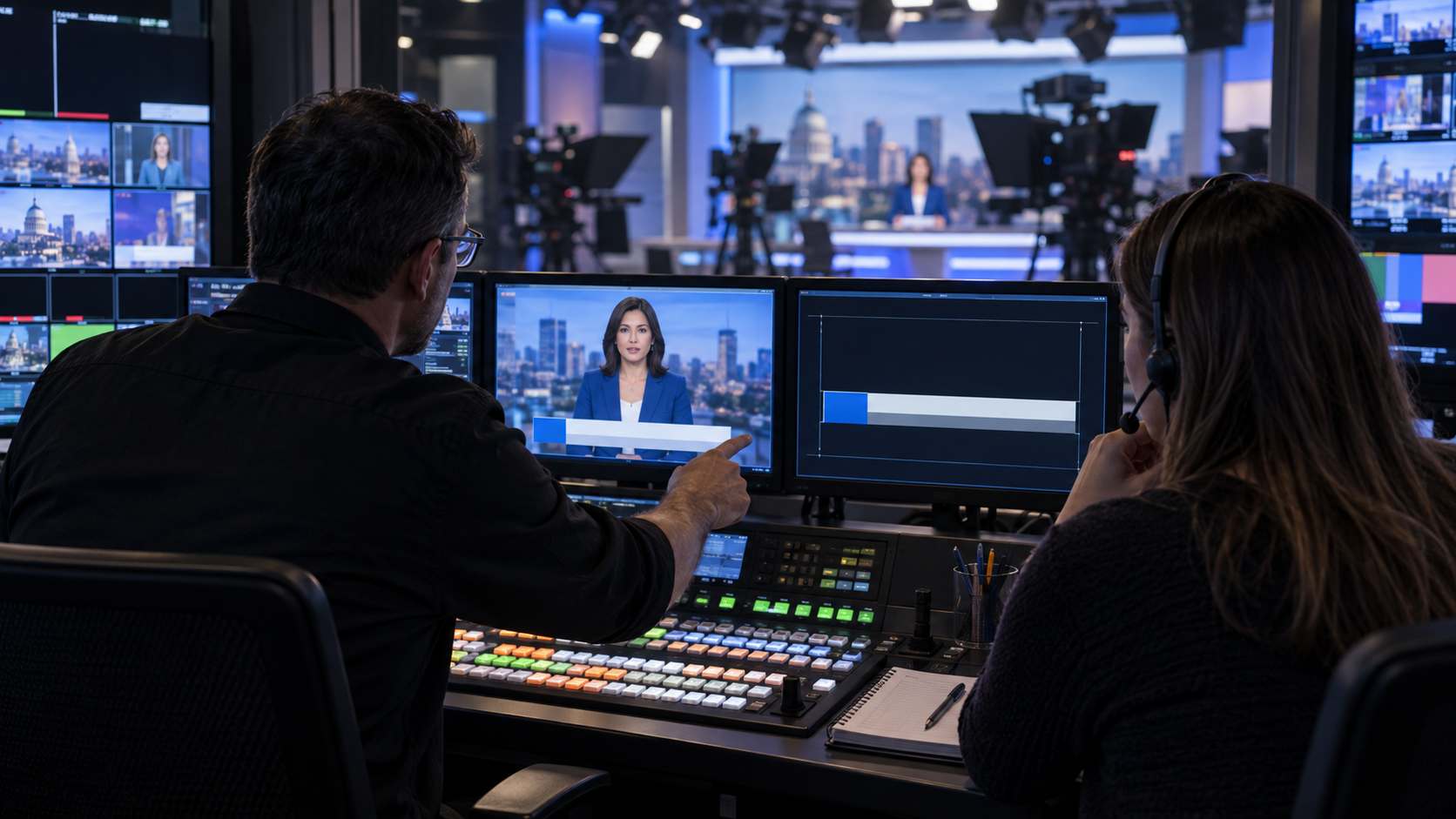
Chyron Explainer
A chyron is text or a graphic placed over a television image, usually near the bottom of the screen. In everyday U.S. broadcast language, the term often refers to a lower-third banner that identifies a speaker, gives a location, names a story, or summarizes a development. “Lower third,” “banner,” “super,” and “chyron” are sometimes used interchangeably, although individual newsrooms may distinguish among them. The word became common because Chyron was a prominent maker of broadcast character-generation equipment.
Chyrons are prepared through a broadcast graphics system. A producer, writer, or graphics operator enters the words, chooses a template, and connects the graphic to the correct camera shot or video clip. During a live program, the control room calls for the graphic to appear and disappear at specific moments. Modern systems can store many name keys, topic banners, election labels, weather alerts, and other elements, but people still need to match each graphic to the right person and context.
The limited space demands concise writing. A speaker identification may contain a name on one line and a job title or affiliation on another. A story banner works more like a short headline. Producers verify spelling, titles, locations, and wording because a mistake can misidentify someone or broadcast a false claim instantly. Chyrons are different from closed captions or subtitles, which reproduce spoken dialogue or provide accessibility; a chyron adds editorial information selected by the newsroom.
That editorial role gives the graphic influence. A few words can frame how viewers interpret the video even when the spoken report is more nuanced. Sensational, vague, or premature language can oversimplify a developing story, while a stale identification can become wrong after a person’s role changes. Good practice keeps wording factual, readable, and synchronized with the segment. Designers also consider contrast, type size, safe placement, and how the graphic interacts with captions and other on-screen information.
Viewers should read a chyron as a compact newsroom summary, not as a transcript or independent source of proof. Its value is speed: someone joining a broadcast can immediately learn who is speaking and what the segment concerns. Its weakness is compression. Accurate chyrons support understanding without crowding the picture or outrunning the reporting, and corrections should be made quickly when an identification or headline is wrong.
Often, especially in U.S. newsrooms. Lower third describes the graphic’s screen position, while chyron originated as a brand name for broadcast graphics equipment.
No. Closed captions reproduce dialogue and sounds for accessibility; a chyron supplies names, locations, headlines, or other editorial context.
Depending on the newsroom, producers, writers, editors, or graphics operators prepare them, with the control room timing their appearance.
Explore more "Explainers"
Discover additional explainers across politics, science, business, technology, and other fields. Each explainer breaks down a complex idea into clear, everyday language—helping you better understand how major concepts, systems, and debates shape the world around us.