

Satellite Feed Explainer
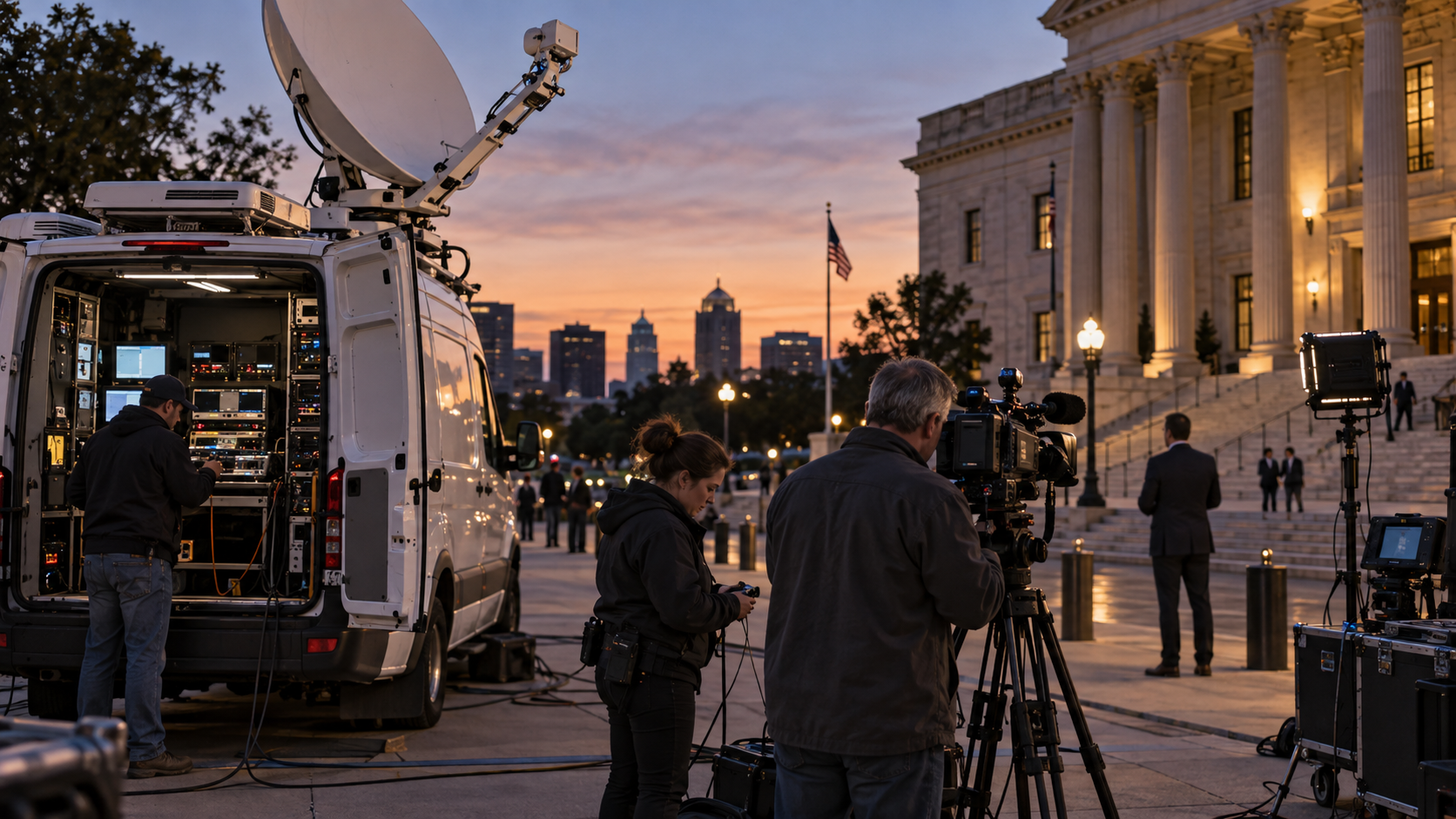
A satellite feed is a video and audio transmission sent from one location to another through a communications satellite. News organizations use it to move live reports, interviews, pool coverage, and prerecorded material over long distances when satellite capacity is available. A field signal travels from an uplink dish to a satellite and then back to a receiving station within the satellite’s coverage area. The received feed can be routed into a studio or distribution network.
At a remote scene, a satellite truck or portable uplink system connects cameras and microphones to encoding and transmission equipment. Technicians aim the dish, confirm the assigned frequency, and coordinate with a control room or satellite operator. In the studio, engineers verify picture, sound, timing, and return communication with the reporter. A small transmission delay can affect conversation, so anchors leave room for the remote journalist to hear a question and begin answering.
Feeds may be private to one outlet, shared among a group, or provided as a pool when access and space are limited. They can carry a clean signal without station graphics or a fully produced program. Scheduling matters because satellite bandwidth is reserved for a particular window, and another user may need the same capacity afterward. Crews test before airtime, monitor weather and equipment, and keep contact by phone or internet in case the primary communication path fails.
Satellite transmission introduces practical and editorial risks. Heavy rain can weaken some signals, dishes need a clear and safe line of sight, and field crews must avoid power lines, traffic, and unstable ground. Engineers protect access so an unauthorized signal cannot replace or interrupt the feed. Journalists also verify the origin, date, and ownership of incoming material. Receiving a professional-looking satellite picture does not by itself prove that the images are current or accurately described.
Fiber connections, bonded cellular systems, and internet streaming now handle many live news transmissions, but satellites remain useful where terrestrial networks are unavailable, damaged, congested, or too far away. They can distribute one source to many receivers across a broad region and support coverage from remote locations. Viewers usually see only the finished report, not the path it traveled. Behind it is a coordinated chain of field production, frequency management, engineering checks, and editorial verification.
No. Many live reports now travel by fiber, bonded cellular service, or internet connection.
The signal must travel to space and back, adding latency to the conversation and production cues.
No. Newsrooms still need to verify the source, date, location, rights, and description of the material.
Explore more "Explainers"
Discover additional explainers across politics, science, business, technology, and other fields. Each explainer breaks down a complex idea into clear, everyday language—helping you better understand how major concepts, systems, and debates shape the world around us.