

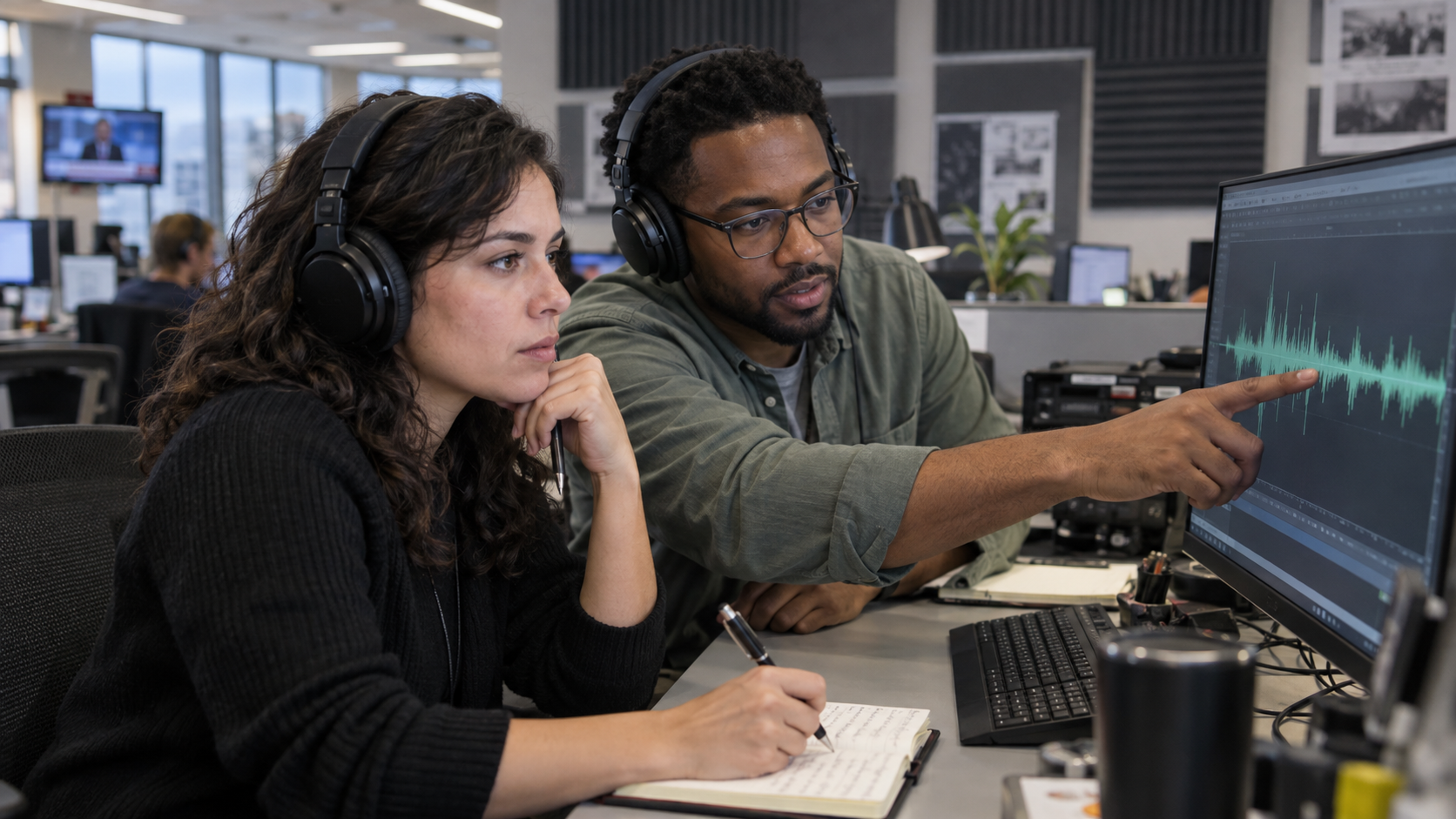
Audio Verification Explainer
An audio recording can sound convincing and still be incomplete, edited, mislabeled, or fabricated. Newsrooms therefore treat a clip as a lead rather than proof. The first task is to establish provenance: who made the recording, how that person obtained it, when it was captured, and whether the newsroom can receive the original file instead of a copy reposted through messaging or social media. Reporters document every handoff because each conversion or upload can remove useful information. They also ask what the source wants from publication and whether that motivation creates reasons for caution.
The original file may contain metadata about its creation time, device, format, and editing history, although metadata can be stripped or altered and is never decisive by itself. Audio editors inspect duration, compression, abrupt changes in background noise, repeated waveforms, and other discontinuities that may indicate cuts. They listen with good headphones and compare the clip with any longer version available. A clean transition does not prove authenticity, while an apparent glitch may come from a weak connection or ordinary processing, so technical clues must be interpreted in context.
Identifying a speaker requires more than saying that a voice sounds familiar. Journalists compare the recording with reliable samples, consider accent, cadence, vocabulary, room acoustics, and the possibility of impersonation or synthetic speech. Whenever possible, they contact the person said to be speaking and people who were present. A denial is relevant but does not settle the question, just as a voice-matching tool cannot independently prove identity. Automated deepfake detectors can provide one signal, but their results vary with language, compression, noise, and the model used to create a synthetic voice.
The words and sounds in the recording also have to fit external facts. Reporters check references to dates, places, weather, scheduled events, known participants, and other details that can be corroborated through documents or interviews. Background sounds may suggest a setting, but they can be added or misunderstood. A newsroom may consult an audio-forensics specialist for a consequential clip, especially when an allegation could affect safety, an election, a criminal case, or a person’s reputation. Specialists should explain their methods and the limits of any conclusion.
Editors then decide what the evidence supports. If the recording is authentic but selectively edited, the missing context may change its meaning. If only part of the clip can be verified, coverage should state that boundary plainly. Newsrooms may publish a transcript or short excerpt rather than an entire recording when privacy, graphic content, source protection, or copyright matters are involved. They should avoid overstating certainty with labels such as real or fake when the more accurate conclusion is that the material remains unverified.
A transparent report tells audiences where the audio came from, which checks were completed, what independent facts support it, and what remains unknown. The same discipline applies after publication: journalists keep looking for the original, preserve their verification notes, and correct the story if new evidence changes the assessment. Careful audio verification is slower than reposting a dramatic clip, but it protects the public from false attribution and protects genuine evidence from being dismissed merely because synthetic audio now exists.
Newsrooms also plan ahead by training reporters to request original files, maintain secure transfer methods, and recognize the limits of detection tools. A written checklist reduces the chance that urgency will skip a basic step. For especially important audio, a second editor can independently review the chain of evidence and listen without being told the preferred conclusion. That separation helps expose assumptions. Verification is strongest when technical analysis, traditional reporting, and transparent editorial judgment all point in the same direction rather than when a single tool produces a confident score.
No. Detection tools can flag patterns, but their results must be combined with provenance, technical review, speaker checks, and corroborating evidence.
The original usually preserves more quality and metadata and has passed through fewer conversions that can hide edits or introduce artifacts.
Editors may withhold it or report only what is known, clearly labeling the clip unverified and explaining the missing evidence.
Explore more "Explainers"
Discover additional explainers across politics, science, business, technology, and other fields. Each explainer breaks down a complex idea into clear, everyday language—helping you better understand how major concepts, systems, and debates shape the world around us.