

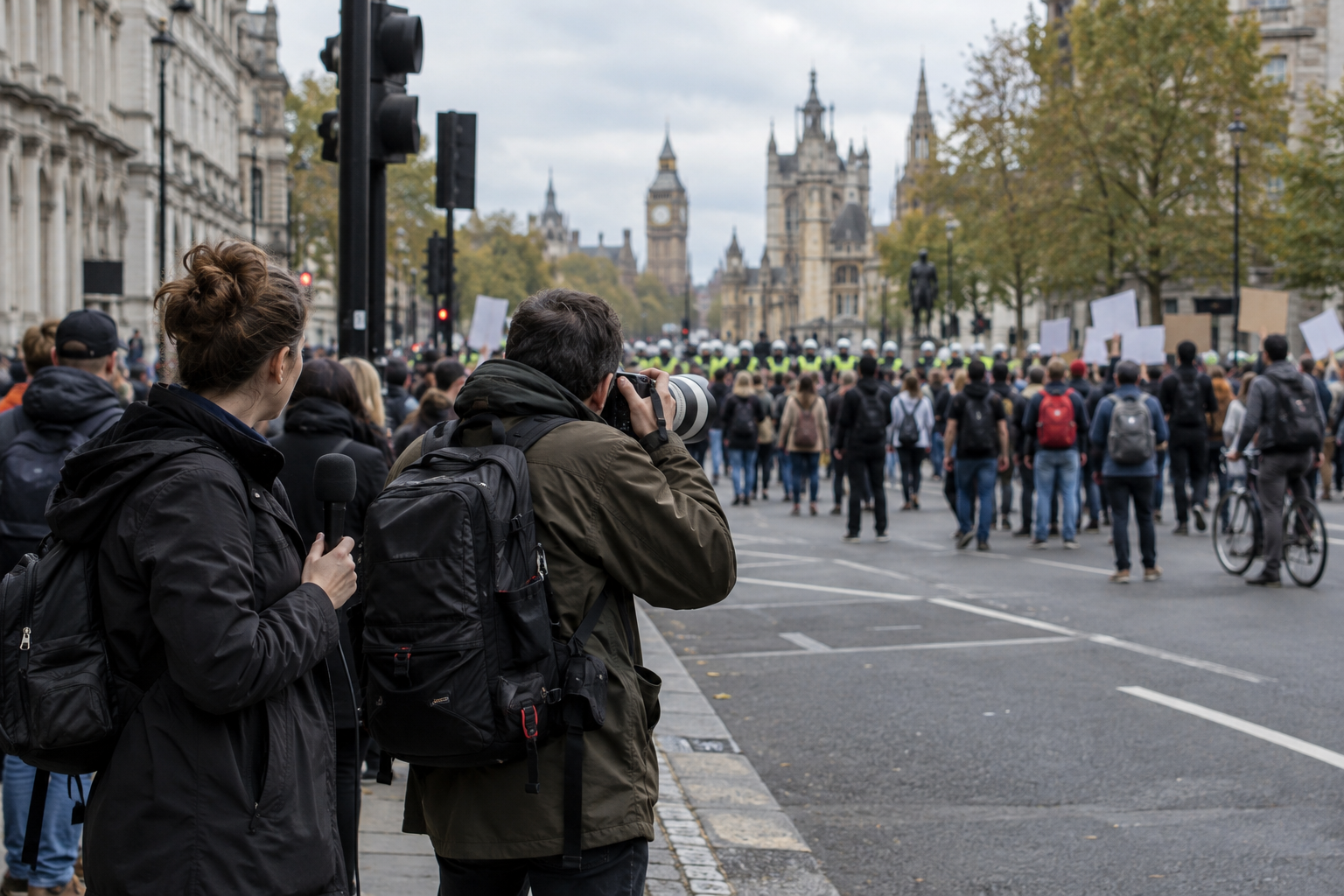
Civil Unrest Coverage Explainer
Civil unrest can include peaceful assemblies, marches, confrontations, property damage, arrests, and official uses of force occurring in the same place or at different times. Newsrooms avoid reducing an entire event to its most dramatic image. Reporters establish a timeline, identify locations, and describe observable actions precisely. Terms such as protest, riot, clash, or violence carry different meanings and should reflect verified conduct rather than political rhetoric.
Field safety begins before deployment. Teams discuss routes, communications, protective equipment, transportation, legal support, and check-in schedules. Reporters maintain distance from dangerous confrontations and do not assume a press credential guarantees protection. Editors monitor changing conditions and can withdraw a crew when risk becomes unreasonable. Freelancers and local journalists should receive the same safety planning and support as staff.
Visual verification is essential because old or unrelated footage often circulates during unrest. Newsrooms confirm creators, locations, timing, and sequence through original files, landmarks, weather, metadata, and independent views. A short clip may begin after an important preceding event or end before a response. Reporters seek longer recordings and eyewitnesses with different positions before assigning cause from one angle.
Sources should reflect the event's complexity. Journalists interview organizers, participants, bystanders, residents, business owners, medical workers, legal observers, police, and public officials while evaluating each person's vantage point and interests. Official statements are attributed and checked against video, records, and direct observation. Arrest numbers, injury totals, and damage estimates are labeled preliminary until reliable agencies or documentation confirm them.
Privacy and identification require judgment. A clear face can expose a participant to harassment, retaliation, or legal consequences, while concealing identity can sometimes limit accountability for serious public conduct. Editors consider news value, consent, local law, and the person's role. They avoid broadcasting tactical locations that could endanger people and take care not to reveal vulnerable sources through background details or metadata.
After the streets quiet, reporting continues through court records, policy decisions, investigations, community impact, and corrections to early accounts. Newsrooms review whether headlines or images overstated isolated acts and whether coverage examined official power as closely as public disorder. Accurate civil-unrest journalism makes room for conflicting evidence without creating false equivalence. It documents who did what, when, where, and with what consequences, while resisting pressure to turn uncertainty into a simple narrative.
The label can overstate limited conduct and should be based on verified actions, scale, timing, and context rather than rhetoric.
Usually not. A short clip may omit earlier events or other angles, so reporters seek longer footage, timelines, and independent witnesses.
Identification can create disproportionate risk, and editors balance public interest, accountability, consent, and potential harm.
Explore more "Explainers"
Discover additional explainers across politics, science, business, technology, and other fields. Each explainer breaks down a complex idea into clear, everyday language—helping you better understand how major concepts, systems, and debates shape the world around us.