

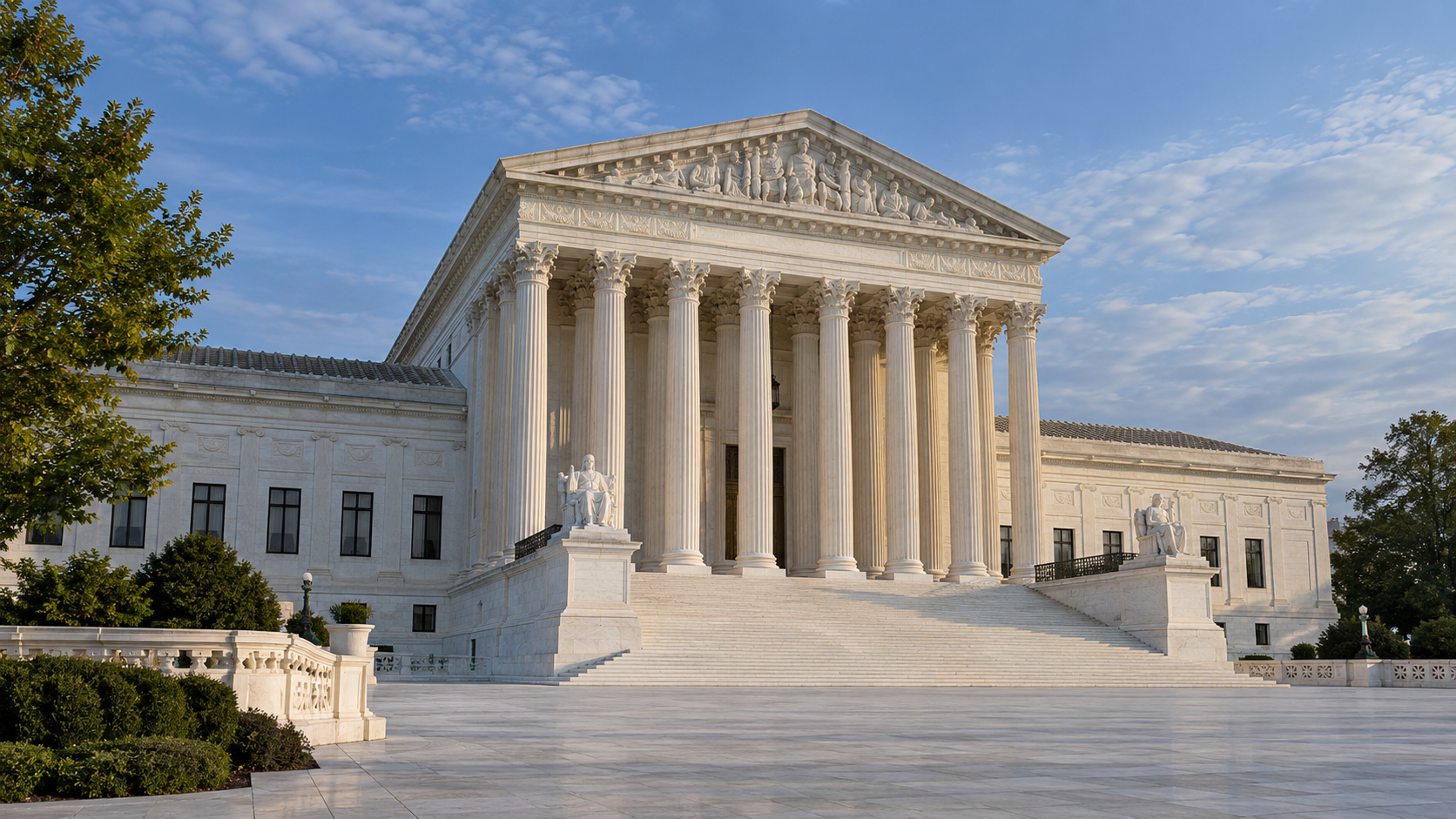
Judicial Review Explainer
Judicial review is the authority of courts to examine whether laws or government actions comply with the Constitution. When a court resolves a case, it may find that applying a statute or enforcing an official action would violate a constitutional requirement. The court can then refuse to give that measure effect in the dispute before it. Judicial review therefore adds a constitutional test to government decision-making. A law’s passage through Congress or a state legislature does not by itself settle whether that law is constitutionally valid.
The Supreme Court’s 1803 decision in Marbury v. Madison established the familiar foundation for judicial review of federal legislation. William Marbury sought a court order requiring delivery of his judicial commission. Chief Justice John Marshall’s opinion concluded that a provision giving the Supreme Court authority to issue the requested order conflicted with the Constitution’s rules for its original jurisdiction. The Court declined to exercise that authority. The case illustrates a distinctive point: constitutional review can limit a court’s own power as well as constrain other branches.
Judicial review generally happens through litigation, rather than a court’s unsolicited inspection of every new policy. Federal courts require a case or controversy, and rules about standing and timing affect whether a dispute can be heard. Lower courts, as well as the Supreme Court, decide constitutional questions. A hypothetical challenge to a speech restriction, for example, would require an appropriate plaintiff, legal claims and a court with jurisdiction. A headline announcing a lawsuit means a challenge has begun; it does not mean the challenged policy has already been held unconstitutional.
A ruling’s practical effect depends on what the court decided and the remedy it ordered. Courts may interpret a law to avoid a constitutional conflict, invalidate a particular application or address a broader defect. Appeals and later decisions can alter the legal position. Judicial review is not a general opportunity for judges to replace policies they dislike with preferred alternatives. Understanding the constitutional issue, the stage of the case and the scope of relief helps readers assess claims that a court has blocked or upheld government action.
A written constitution sets rules that ordinary legislation must respect. Judicial review makes those higher rules part of deciding legal disputes. The central question is whether the challenged measure fits the Constitution, rather than whether judges consider it wise.
Marbury v. Madison concerned the Supreme Court’s original jurisdiction, meaning its authority to hear certain cases in the first instance. The Court found that Congress could not enlarge that jurisdiction through the statutory provision at issue.
Courts first need authority to hear the dispute. A constitutional argument can be substantial while a particular lawsuit still fails because the plaintiff lacks standing or the claim is not ready for adjudication. Procedure affects access to a decision on the merits.
A temporary order is different from a final judgment. Readers following a case should check whether the court is preserving conditions during litigation, resolving a claim or reviewing another court’s decision. Each stage answers a different question.
Declaring one application unconstitutional does not necessarily erase every use of a statute. The reasoning and remedy determine how far a ruling reaches. A careful explanation should identify the provision, government action and parties actually covered.
Judicial review generates debate about constitutional interpretation and the role of unelected judges. Those debates should be kept distinct from the immediate holding in a case. A court’s legal explanation provides the starting point for understanding what changed.
Explore more "Explainers"
Discover additional explainers across politics, science, business, technology, and other fields. Each explainer breaks down a complex idea into clear, everyday language—helping you better understand how major concepts, systems, and debates shape the world around us.